

SciELO - Scientific Electronic Library Online

 
vol.12 número3Primer reporte de chinche de encaje Gargaphia lunulata (Hemiptera: Tingidae) en Sicana odorifera (Cucurbitaceae)Productos no tradicionales de la economía paraguaya: dinamismo de la exportación de productos de base tecnológica. Años 2014-2024 índice de autoresíndice de materiabúsqueda de artículos
Home Pagelista alfabética de revistas  

Servicios Personalizados

Revista

Articulo

Indicadores

  • No hay articulos citadosCitado por SciELO

Links relacionados

  • No hay articulos similaresSimilares en SciELO

Compartir


Revista Científica de la UCSA

versión On-line ISSN 2409-8752

Rev. ciente. UCSA vol.12 no.3 Asunción dic. 2025

https://doi.org/10.18004/ucsa/2409-8752/2025.012.03.007 

Artículo Original

Predation of a caterpillar (Lepidoptera: Saturniidae) by wasp polybia jurinei de saussure, 1854 (hymenoptera: vespidae)

Depredación de una oruga (Lepidoptera: saturniidae) por la avispa polybia jurinei de saussure, 1854 (Hymenoptera: Vespidae)

Laura Tereza Inacio-Borges1 
http://orcid.org/0009-0009-9594-1041

Francesca Victorino Zabatiero1 
http://orcid.org/0009-0006-6034-5889

Glauco Cássio de Sousa-Oliveira2 
http://orcid.org/0000-0001-9811-8485

Marcos Magalhães-de Souza1 
http://orcid.org/0000-0003-0415-1714

1Instituto Federal de Educação, Ciência e Tecnologia, do Sul de Minas Gerais, Praça Tiradentes, nº 416, 37576-000, Inconfidentes, Minas Gerais, Brasil

2Universidade Federal de Lavras, Programa de Pós-Graduação em Botânica Aplicada. Lavras, MG, Brasil


ABSTRACT

The purpose of this work is the predation of a caterpillar (Lepidoptera: Saturniidae) by wasp Polybia jurinei de Saussure, 1854 (Hymenoptera: Vespidae). Social wasps provide important ecosystem services, such as trophic regulation and biological control of agricultural pests, including Lepidoptera larvae. However, there is limited information regarding the diet and feeding behavior of some species, such as Polybia jurinei de Saussure. Thus, the aim of this study to document the predation of a caterpillar (Lepidoptera: Saturniidae) by this species of social wasp on a ruderal plant, Crepis japonica (L.) DC. |(Asteraceae) in the southern region of the state of Minas Gerais, Brazil. The observation was made occasionally in November 2024, and the predatory behavior was described. This study contributes to the understanding of the predatory behavior of this vespid, and future studies may determine the frequency and impact of P. jurinei predation on caterpillars.

Keywords: Ethology; polistinae; natural enemy; crepis

RESUMEN

El propósito de este trabajo es la depredación de una oruga (Lepidoptera: Saturniidae) por la avispa Polybia jurinei de Saussure, 1854 (Hymenoptera: Vespidae). Las avispas sociales desempeñan importantes servicios ecosistémicos, como la regulación trófica y el control biológico de plagas agrícolas, incluidas las larvas de Lepidoptera. Sin embargo, hay poca información sobre la dieta y el comportamiento alimentario de algunas especies, como Polybia jurinei de Saussure. De esta manera, el objetivo de este estudio es documentar la depredación de una oruga (Lepidoptera: Saturniidae) por esta especie de avispa social sobre una planta ruderal, Crepis japonica (L.) DC. (Asteraceae), en el sur del estado de Minas Gerais. La observación se realizó de manera ocasional en noviembre de 2024 y se describió el comportamiento depredador. Este trabajo añade información sobre el comportamiento depredador de este véspido, y estudios futuros podrán indicar la frecuencia e impacto de la depredación de P. jurinei sobre orugas.

Palabras clave: Etología; polistinae; enemigo natural; crepis

Social wasps (Hymenoptera: Vespidae), due to their predatory and generalist behavior, can provide different ecosystem services, such as trophic regulation and biological control of different agricultural pests (Prezoto et al., 2019; Brock et al., 2021). Lepidoptera larvae are prey frequently present in the diet of different species of social wasps, including those of the genus Polybia Lepeletier 1836 (Vespidae: Polistinae) (Gobbi et al., 1984; Gobbi & Machado 1985a,b; Machado et al., 1988; Prezoto et al., 2005; Bichara-Filho et al., 2009; Picanço et al., 2010; López et al., 2013; Dejean et al., 2017; Brügger et al., 2019; Oliveira et al., 2023; Oliveira & Souza, 2023).

This genus is distributed throughout the Neotropical region, with 59 species, 51 of which are found in Brazilian territory (Somavilla et al., 2021). Although there is information regarding the diet of the genus, data for some species remain scarce, even for those with a wide geographic distribution in Brazil (Somavilla et al., 2021), recorded in different biomes (Souza et al., 2020a,b), such as Polybia jurinei de Saussure 1854. This highlights the importance of studies that contribute to the understanding of the ethology and diet of these insects.

Therefore, the present study aimed to record the predation of a caterpillar (Lepidoptera: Saturniidae) by P. jurinei on a ruderal plant, Crepis japonica (L.) DC. (Asteraceae), in the southern region of the state of Minas Gerais, Southeast Brazil.

The observation was made occasionally on November 2, 2024, around 10:00 AM, at the teaching farm of the Federal Institute of Southern Minas Gerais (IFSULDEMINAS), Inconfidentes Campus, in the municipality of Inconfidentes, located in the southern region of Minas Gerais. The observations took place in a human-altered area with buildings, plantations, and pig farming, adjacent to a fragment of semideciduous forest within the Atlantic Forest domain.

The predatory act was observed in two sessions of approximately 15 minutes each, using the ad libitum method (Del Claro, 2010), totaling 30 minutes of observation. Following this, the individuals were collected using an entomological net. The specimens were preserved in 70% alcohol and later prepared and dry-mounted in the zoology laboratory. The identification of the social wasp was carried out using the dichotomous keys of Richards (1978) and by comparison with the collection of the Biological Collection of Social Wasps (CBVS). The Lepidoptera specimen was identified through a photograph sent to MSc. Lucas Vieira from ESALQ, Piracicaba. Due to the physical condition of the prey, it was only possible to identify it at the family level.

At first, an individual of P. jurinei was spotted flying over the C. japonica plant, carrying fragments of a prey in its mandibles, probably heading toward its nest. After about 2 minutes, an individual of P. jurinei returned to the plant and landed on the abaxial surface of the C. japonica leaf, where the caterpillar was located, and began removing more portions of the prey's body, which was still alive (Figure 1). Then, P. jurinei took flight with a fragment of the caterpillar, at which point it was captured using an entomological net. No other individuals were observed preying on the caterpillar until the end of the observations.
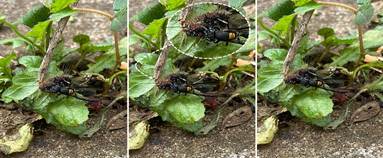
Figure 1.  Predation of Polybia jurinei on a Saturniidae caterpillar on a Crepis japonica plant in Southern Minas Gerais, Southeast Brazil. Sequence of prey manipulation. Source: the authors, 2025. 

The observed behavior is typical of social wasps that hunt relatively large prey, which is cut into small fragments and transported to their colonies for the feeding of the offspring, as is often the case with Lepidoptera larvae (Brown et al., 2012; Dejean et al., 2017). However, it differs from some situations, such as when smaller adult insects are preyed upon, where the social wasp consumes the prey on-site (Oliveira and Souza, 2023), or larger adults, in which non-palatable appendages, e.g. locomotory parts and the head, are removed, and only the abdomen is mashed and transported (Crispim et al., 2023).

Caterpillars of the Saturniidae family can cause damage to various forest species, such as eucalyptus (Zanuncio, 1993) and rubber trees (Santos & Gonçalves, 2005). Their natural predators include birds and stink bugs (Favalesso et al., 2020), as well as social wasps (Prezoto et al., 2006; Bichara-Filho et al., 2009). Therefore, P. jurinei is a potential predator of these pests, although this still needs further investigation. On the other hand, since C. japonica is an exotic plant (Lorenzi, 2000), in this specific case, P. jurinei appears to be performing a role opposite to those typically played by social wasps, by hunting the natural predator of a species that does not belong to the Brazilian flora. The success of the establishment of exotic species is, among other factors, due to the absence of natural predators (Lake & Leishman, 2004; Parker & Gilbert, 2007; Rankin, 2021).

There is little information about the diet of P. jurinei, but it is known that this species preys on blowfly larvae (Gomes et al., 2009) in addition to feeding on plant-based materials, such as fruit pulp (e.g., mango and guava) (Barbosa et al., 2014; Renne et al., 2024) and pollen (Crestana, 1995). Therefore, due to its diverse diet, P. jurinei seems to behave as a generalist and opportunist in its search for food resources, much like other congeners (Michelutti et al., 2017).

Although this study provides one of the few records of P. jurinei predating Lepidoptera larvae, such prey is frequently found in the diet of wasps from this genus, such as Polybia emaciata Lucas 1879 (López et al., 2013), Polybia fastidiosuscula de Saussure 1854 (Brügger et al., 2019; Oliveira & Souza, 2023), Polybia ignobilis (Haliday) 1836 (Gobbi & Machado, 1985b; Picanço et al., 2010; Oliveira & Souza, 2023), Polybia occidentalis (Olivier) 1792 (Gobbi et al., 1984), Polybia paulista H. von Ihering 1896 (Gobbi & Machado, 1985a), Polybia platycephalaRichards 1978 (Prezoto et al., 2005), Polybia rejecta (Fabricius) 1798 (Dejean et al., 2017), Polybia scutellaris (White) 1841 (Oliveira et al., 2023), and Polybia sericea (Olivier) 1792 (Machado et al., 1988; Bichara-Filho et al., 2009).

In conclusion, this study adds information about the predatory behavior of a social wasp species with a little-known diet. Future studies may indicate the frequency of Lepidoptera larvae in the diet of P. jurinei, as well as the feasibility of using this social wasp in biological control programs in crops where these pests are a problem.

ACKNOWLEDGEMENTS

To MSc. Lucas Vieira (ESALQ) for the identification of the Saturniidae caterpillar.

REFERENCES

Barbosa, B. C., Paschoalini, M. F. & Prezoto, F. (2014). Temporal activity patterns and foraging behavior by social wasps (Hymenoptera, Polistinae) on fruits of Mangifera indica L. (Anacardiaceae). Sociobiology, 61(2): 239-242. http://dx.doi.org/10.13102/sociobiology.v61i2.239-242 [ Links ]

Bichara Filho, C.C., Santos, G.M., Resende, J.J., Cruz, J.D., Gobbi, N., & Machado, V.L. (2009). Foraging Behavior of the Swarm-Founding Wasp, Polybia (Trichothorax) sericea (Hymenoptera, Vespidae): Prey Capture and Load Capacity. Sociobiology, 53, 61-69. [ Links ]

Bichara Filho, C. C., Santos, G. M. M., Santos Filho, A. B., Santana-Reis, V. P., Cruz, J. D., & Gobbi, N. (2010). Foraging Behavior of the Swarm-founding Wasp Polybia (Trichothorax) sericea (Hymenoptera, Vespidae) Daily Resource Collection Activity and Flight Capacity. Sociobiology , 55(3), 899-907. [ Links ]

Brock, R. E., Cini, A. & Sumner, S. (2021) Ecosystem services provided by aculeate wasps. Biological Reviews, 96(4), 1645-1675. 10.1111/brv.12719. [ Links ]

Brown, R., Payne, A., Graham, K. K & Starks, P. T. Prey capture and caste-specific payload capacities in the European paper wasp Polistes dominulus. (2012). Insectes Sociaux, 59, 519-525. https://doi.org/10.1007/s00040-012-0246-6 [ Links ]

Brügger, B. P., Alcántara-de la Cruz, R., de Carvalho, A. G., Soares, M. A., Prezoto, F. & Zanuncio, J. C. (2019). Polybia fasticiosuscula (Hymenoptera: Vespidae) foraging activity patterns. Florida Entomologist, 102 (1), 264-265. http://dx.doi.org/10.1653/024.102.0150 [ Links ]

Crestana, C. de S. M. (1995). Ecologia da polinização de Genipa americana L. (Rubiaceae) na estação ecológica de Moji-Guaçu, Estado de São Paulo. Revista Do Instituto Florestal, 7(2), 169-195. https://doi.org/10.24278/2178-5031.199572705 [ Links ]

Crispim, F., Teófilo-Guedes, G. S., Clemente, M. A. & Souza, M. M. (2023). Predação de louva-deus (Mantodea) pela vespa social Polistes cinerascens Saussure, 1854 (Hymenoptera). Acta Ambiental Catarinense, 20(1). https://doi.org/10.24021/raac.v20i1.7493 [ Links ]

Dejean, A., Rodríguez-Pérez, H., Carpenter, J. M., Azémar, F., & Corbara, B. (2017). The predatory behavior of the Neotropical social wasp Polybia rejecta. Behavioural Processes, 140, 161-168. [ Links ]

Del-Claro, K. (2010). Introdução à Ecologia Comportamental: Um Manual Para Estudo do Comportamento Animal. (1ª ed.). Technical Books [ Links ]

Gobbi, N., Machado, V. L. L., & Tavares Filho, J. A. (1984). Sazonalidade das presas utilizadas na alimentação de Polybia occidentalis (Olivier, 1791) (Hym., Vespidae). In Anais Da Sociedade Entomológica Do Brasil (pp. 63-69). https://doi.org/10.37486/0301-8059.v13i1.330 [ Links ]

Gobbi, N. & Machado, V.L.L. (1985a). Material capturado e utilizado na alimentação de Polybia (Myrapetra) paulista Ihering, 1896 (Hymenoptera, Vespidae). In Anais da Sociedade Entomológica do Brasil (pp. 189-195). [ Links ]

Gobbi, N. & Machado, V.L.L. (1985b). Material capturado e utilizado na alimentação de Polybia (Trychothorax) ignobilis (Haliday, 1836) (Hymenoptera, Vespidae). In Anais da Sociedade Entomológica do Brasil (pp. 117-124). [ Links ]

Gomes, L., Gomes, G., & Desuó, I. C. (2009). A preliminary study of insect fauna on pig carcasses located in sugarcane in winter in southeastern Brazil. Medical and Veterinary Entomology, 23(2), 155-159. https://doi.org/10.1111/j.1365-2915.2009.00796.x [ Links ]

Lake, J. C., & Leishman, M. R. (2004). Invasion success of exotic plants in natural ecosystems: the role of disturbance, plant attributes and freedom from herbivores. Biological Conservation, 117(2), 215-226. https://doi.org/10.1016/S0006-3207(03)00294-5 [ Links ]

López, Y., Hernández, J. & Caraballo, P. (2013). Actividad de forrajeo de la avispa social Polybia emaciata (Hymenoptera: Vespidae: Polistinae). Revista Colombiana de Entomología, 39(2), 250-255. [ Links ]

Lorenzi, H. (Ed.).(2000). Plantas daninhas do Brasil: Terrestres, aquáticas, parasitas e tóxicas. Instituto Plantarum de Estudos da Flora. [ Links ]

Machado, V. L. L., Gobbi, N. & Alves Junior., V.V. (1988). Material capturado e utilizado na alimentação de Polybia (Trichothorax) sericea (Olivier, 1791) (Hymenoptera, Vespidae). Revista Brasileira de Zoologia, 5(2): 261-266. [ Links ]

Favalesso, M. M., Chiyo, L., Casafús, M. G., Guimarães, A. T. B, & Peichoto, M. E. (2020). Relato de eventos predatórios em Lonomia spp.(Saturniidae: Hemileucinae). Oecologia Australis, 24(1), 235-241. https://doi.org/10.4257/oeco.2020.2401.23 [ Links ]

Michelutti, K. B., Soares, E. R. P., Prezoto, F. & Antonialli-Junior, W. F. (2017) Opportunistic Strategies for Capture and Storage of Prey of Two Species of Social Wasps of the Genus Polybia Lepeletier (Vespidae, Polistinae, Epiponini). Sociobiology , 64(1), 105-110. 10.13102/sociobiology.v64i1.1142 [ Links ]

Oliveira, G. C. S., Rubim, L. G. T. & Souza, M. M. (2023) First record of Polybia scutellaris (White, 1841), (Hymenoptera: Vespidae) predating on Samea multiplicalis (Guenée, 1854) (Lepidoptera: Pyralidae), an herbivore of Salvinia spp. (Salviniaceae). Brazilian Journal of Biology, 83, Article e271130. http://dx.doi.org/10.1590/1519-6984.271130 [ Links ]

Oliveira, G. C. S. & de Souza, M. M. (2023). New records of predation of Samea multiplicalis (Guenée, 1854)(Lepidoptera: Pyralidae) by social wasps (Hymenoptera: Vespidae) on Salvinia auriculata (Aublet, 1775)(Salviniales: Salviniaceae) in Brazil. Revista Chilena de Entomología, 49(3), 527-531. [ Links ]

Parker, I. M., & Gilbert, G. S. (2007). When there is no escape: the effects of natural enemies on native, invasive, and noninvasive plants. Ecology, 88(5), 1210-1224. https://doi.org/10.1890/06-1377 [ Links ]

Picanço, M. C., de Oliveira, I. R., Rosado, J. F., da Silva, F. M., Gontijo, P. C. & da Silva, R. S. (2010). Natural Biological Control of Ascia monuste by the Social Wasp Polybia ignobilis (Hymenoptera: Vespidae). Sociobiology , 56(1), 67-76. [ Links ]

Prezoto, F., Lima, M. A. P. & Machado, V. L. L. (2005). Survey of preys captured and used by Polybia platycephala (Richards) (Hymenoptera: Vespidae, Epiponini). Neotropical Entomology, 34(5), 849-851. https://doi.org/10.1590/S1519-566X2005000500019 [ Links ]

Prezoto, F., Santos-Prezoto, H. H., Machado, V.L. & Zanuncio, J. C. (2006) Prey captured and used in Polistes versicolor (Olivier) (Hymenoptera: Vespidae) Nourishment. Neotropical Entomology, 35(5), 707-709. https://doi.org/10.1590/S1519-566X2006000500021 [ Links ]

Prezoto, F., Maciel, T. T., Detoni, M., Mayorquin, A. Z., & Barbosa, B. C. (2019). Pest control potential of social wasps in small farms and urban gardens. Insects,10(7), 192. https://doi.org/10.3390/insects10070192 [ Links ]

Rankin, E. E. W. (2021). Emerging patterns in social wasp invasions. Current Opinion in Insect Science, 46, 72-77. https://doi.org/10.1016/j.cois.2021.02.014 [ Links ]

Renne, D. G. S., Costa, M. J., Jacques, G. C. & Souza, M. M. (2024). Avaliação dos danos aos frutos de Psidium guajava (Linnaeus, 1753), Myrtaceae var. Kumagai, por vespas sociais (Vespidae: Polistinae). ForScience, 12(2), e01277. https://doi.org/10.29069/forscience.2024v12n2.e1277 [ Links ]

Richards, O. W. (1978) The social wasps of the Americas excluding the Vespinae. London: British Museum (Natural History). [ Links ]

Santos, R. S., & Gonçalves, R. C. (2015). Infestação de Lonomia sp.(Lepidoptera: Saturniidae) em seringal de cultivo no Estado do Acre. Agrotrópica, 27(1), 83-86. [ Links ]

Somavilla, A., Barbosa, B.C., Souza, M.M., & Prezoto, F. (2021). List of species of social wasps from Brazil. In F. Prezoto, F.S. Nascimento, B.C. Barbosa, B.C. & A. Somavilla (Eds.), Neotropical Social Wasps, (pp. 293-316). Springer Cham. https://doi.org/10.1007/978-3-030-53510-0_16#DOI [ Links ]

Souza, M. M., Teófilo-Guedes, G. S., Milani, L. R., Souza, A. S. B. & Gomes, P. P. (2020a). Social wasps (Vespidae: Polistinae) from the Brazilian Atlantic Forest. Sociobiology, 67(1), 1-12. http://dx.doi.org/10.13102/sociobiology.v67i1.4597 [ Links ]

Souza, M. M., Teófilo-Guedes, G. S., Bueno, E. T., Milani, L. R. & Souza, A. S. B. (2020b). Social wasps (Hymenoptera, Polistinae) from the Brazilian savanna. Sociobiology, 67(2), 129-138. http://dx.doi.org/10.13102/sociobiology.v67i2.4958 [ Links ]

Zanuncio, J. C. (Coord.). (1993). Manual de pragas em floresta: Lepidoptera desfolhadores de eucalipto - biologia, ecologia e controle. Folha de Viçosa Ltda. [ Links ]

Proceso de revisión: Evaluación por pares a doble ciego.

Editora responsable: Graciela María Patricia Velázquez de Saldivar https://orcid.org/0000-0002-8763-086X . Universidad del Cono Sur de las Américas, UCSA.

Contribution of the authors: Laura Tereza Inácio Borges and Francesca Victorino Zabatiero contributed to data collection, obtaining the results, and manuscript writing. Marcos Magalhães de Souza was responsible for the identification of the biological material, manuscript writing, critical manuscript review, and final approval. Glauco Cássio de Sousa Oliveira participated in manuscript writing, critical manuscript review, and final approval.

Conflict of interest: The authors declare that there is no conflict of interest.

Funding: This study was self-funded.

Received: August 17, 2025; Accepted: September 20, 2025

Autor correspondiente: Glauco Cássio de Sousa Oliveira. Programa de Pós-Graduação em Botânica Aplicada, Universidade Federal de Lavras, Lavras, MG, Brasil. Email: glaucomlds@hotmail.com

Creative Commons License This is an open-access article distributed under the terms of the Creative Commons Attribution License