




Serviços Personalizados
Journal

Artigo
 texto em
 Inglês (pdf)
 Artigo em XML
 Referências do artigo

 Tradução automática
 Enviar este artigo por email
Indicadores
-
 Citado por SciELO
Links relacionados
-
 Similares em
SciELO
Compartilhar

 Permalink

Cirugía paraguaya
versão On-line ISSN 2307-0420
Cir. parag. vol.49 no.1 Asunción abr. 2025
https://doi.org/10.18004/sopaci.2025.abril.8
Original Article
Characteristics of esophageal cancer in patients admitted to the First Chair of Surgical Clinic service of the Hospital de Clinicas San Lorenzo from 2010-2022

1Hospital Distrital de Ñemby. Paraguay
2Hospital de Clínicas, I Cátedra de Clínica Quirúrgica. San Lorenzo, Paraguay
Introduction: Esophageal cancer is one of the most aggressive neoplasms of the digestive tract, with high morbidity and mortality, and is the eighth most common cancer worldwide. Objective: To determine the management of esophageal cancer in patients admitted to the First Department of Clinical Surgery at the San Lorenzo Clinics Hospital from 2010 to 2022. Materials and methods: An observational, retrospective, descriptive, and cross-sectional study. Results: Thirty-one patients were diagnosed with esophageal cancer at the First Department of Clinical Surgery at the San Lorenzo Clinics Hospital from 2010 to 2022. 83.9% of the patients were men. Mean age was 63.7 years. The most frequent clinical manifestation was dysphagia and weight loss with constitutional syndrome. 41.9% presented vegetative lesions. 67% of the lesions were located in the middle third. The most common histological type, 83.9%, was squamous cell carcinoma. Conclusion: The current challenge is to implement screening policies for this disease, taking into account the associated risk factors.
Keywords: esophageal cancer; screening; squamous cell carcinoma; adjuvant treatment.
Introducción: El cáncer de esófago es una de las neoplasias más agresivas del tracto digestivo, presenta alta morbilidad y mortalidad, ocupa el octavo lugar dentro de los cánceres a nivel mundial. Objetivo: Determinar el manejo del cáncer de esófago en pacientes internados en la Primera Cátedra de Clínica Quirúrgica del Hospital de Clínicas San Lorenzo del 2010 al 2022. Material y método: Estudio observacional, retrospectivo, descriptivo y transversal. Resultados: 31 pacientes con diagnóstico de cáncer de esófago en Primera Cátedra de Clínica Quirúrgica del Hospital de Clínicas durante el período de 2010 a 2022. El 83,9% de los pacientes eran hombres. Media de edad, 63,7 años. La manifestación clínica más frecuente fue la disfagia y pérdida de peso con síndrome constitucional. Presentaron lesiones vegetantes 41,9%. Las lesiones estaban ubicadas en tercio medio 67%. El tipo histológico más frecuente en 83,9% fue carcinoma escamoso. Conclusión: El desafío actual es implementar políticas de screening de esta enfermedad teniendo en cuenta los factores de riesgo asociados.
Palabras claves: Cáncer de esófago; screening; carcinoma escamoso; adyuvancia
Introduction
Esophageal cancer is one of the most aggressive malignancies of the digestive tract, with high morbidity and mortality, ranking eighth among cancers worldwide and sixth as a cause of death from this disease. 1-4
There is a geographic predisposition, such as in Asia, where the occurrence is 50 to 100 times higher than in other parts of the world. 5,6 It is the fourth most common cancer in China. Its age frequency ranges from 60 to 70 years, with a predominance in males, although there are areas with an approximately equal sex ratio due to the high incidence. 7-9
In the last three decades, there has been a shift in the epidemiological pattern, with adenocarcinoma increasingly located in the lower esophagus and cardia among Caucasian populations in Western countries. 10-13
In South America, the overall incidence rate is low, estimated at 7 cases per 100,000 men and 2 cases per 100,000 women; Colombia, Chile, Argentina, and Uruguay are considered the countries at highest risk. 14-15
There are factors involved in the development of esophageal cancer. Toxic habits such as smoking and alcohol consumption are important independent risk factors. 16-18
The diagnosis of esophageal cancer in its asymptomatic or early, low-stage phase is important for improving prognosis; unfortunately, this is only possible in a few patients. 19
Materials and methods
Observational, descriptive, cross-sectional, and retrospective study. Non-probabilistic sampling of consecutive cases.
The complete records of male and female patients over 18 years of age, diagnosed with esophageal cancer and hospitalized in the 1st Course of Surgical Clinic at the Clinics Hospital, between 2010 and 2022, were included.
The studied variables were:
Sex
Age
Toxic habits
Reason for consultation
Tumor location
Type of surgery
Surgical approach
Macroscopic characteristics
Biopsy
Degree of differentiation
Stage
Postoperative complications
The data was logged into a data collection sheet, then transferred to an electronic spreadsheet in Microsoft Excel 365®, and processed using the free statistical analysis software PSPP. The presentation was prepared with the Microsoft Word 365® word processor.
RESULTS
A total of 31 patients diagnosed with esophageal cancer were studied in the First Chair of Surgical Clinic at the Hospital de Clínicas between 2010 and 2022, of whom 83.9% were male and 16.1% female. The mean age was 63.7 years, with most cases (61%, 19 patients) in the 60 years and older group, and 39% (12 patients) under 60 years of age, ranging from 37 to 84 years.
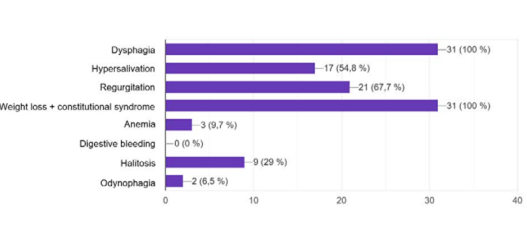
All patients presented with dysphagia and weight loss associated with constitutional syndrome, and less frequently with regurgitation, observed in 67.7% of cases (Graph 1).
Source: Bases de datos del Servicio de la I Cátedra de Clínica Quirúrgica.
Graph 1: Most frequent clinical manifestations in patients diagnosed with esophageal cancer (n:31) at the 1st Course of Surgical Clinic, Clinics Hospital, 2010-2022.
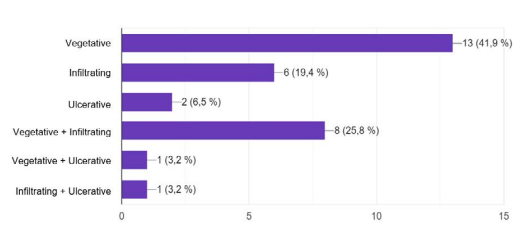
Among the endoscopic findings, most esophageal lesions were of the exophytic (vegetative) type, observed in 41.9% of cases, followed by combined exophytic-infiltrative lesions in 25.8% of cases (Graph 2).
Source: Bases de datos del Servicio de la I Cátedra de Clínica Quirúrgica.
Graph 2: Endoscopic findings in patients diagnosed with esophageal cancer (n:31) at the 1st Course of Surgical Clinic, Clinics Hospital, 2010-2022.
Regarding the most frequent location, lesions in the middle third accounted for 66.7% of cases, followed by those in the distal third with 25.8%, and the upper third with 7.5% of cases. In terms of friability during endoscopic manipulation, 64.5% were non-friable, while 35.5% were friable.
The most frequent histological type in the biopsies was squamous cell carcinoma, accounting for 83.9% of cases, while adenocarcinomas represented 16.1%. A total of 61.3% of tumors were passable, and 38.7% were impassable. The predominant degree of differentiation was GII, found in 64.5% of cases, followed by GIII in 35.5% of malignant esophageal tumors.
Regarding the treatment provided, only 16.1% of patients underwent curative surgery (esophagectomy using the McKeown technique in 60% of cases and the transhiatal approach in 40%). Palliative surgeries accounted for 41.9%, consisting of Stamm-type gastrostomies (69.2%) and Witzel-type jejunostomies (30.7%). Unfortunately, 42% of patients did not undergo any surgical intervention.
Table 1 summarizes the types of esophagectomies performed, the stage, and the length of hospital stay.
Table 1: Healing surgery in patients diagnosed with esophageal cancer (n:5) at the 1st Course of Surgical Clinic, Clinics Hospital, 2010-2022.
| Surgery type (n:5) | Stage | Percentage (%) | ICU | In-patient days in ICU | Day average |
|---|---|---|---|---|---|
| McKeown | II | 60 % | Yes | 1 | |
| Trashiatal | II | Yes | 8 | 7.6 days | |
| McKeown | III | Yes | 3 | ||
| McKeown | III | 40 % | Yes | 16 | |
| Trashiatal | III | Yes | 10 |
Source: Bases de datos del Servicio de la I Cátedra de Clínica Quirúrgica.
In this series, three patients developed postoperative complications: mediastinitis, anastomotic necrosis, and postoperative peritonitis. Two patients died in the immediate postoperative period, representing a 40% mortality rate among those who underwent curative surgery.
Meanwhile, among the palliative surgeries (Stamm gastrostomy and Witzel jejunostomy), 76.9% (10 cases) were in stage IV, 15.4% (2 cases) were in stage III, and 7.7% (1 case) was in stage II of the disease. Patients who underwent palliative surgery had a mortality rate of 15.3%. (Table 2).
Table 2: Complications and morality within surgeries performed in patients diagnosed with esophageal cancer (n:18) at the 1st Course of Surgical Clinic, Clinics Hospital, 2010-2022.
| Patients submitted to surgery | Stage | Surgery type | Complications | Mortality |
|---|---|---|---|---|
| Healing (n:5) | II (n:3) | McKeown (n:3) Trashiatal (n:2) | Anastomotic necrosis (n:1) | 40% |
| III(n:2) | Peritonitis PO (n:1) | |||
| Mediastinitis (n:1) | ||||
| Palliative | II (n:1) | Gastrostomy (n:9) | Pneumonia (n:3) | 15.3% |
| (n:13) | (n:13) | Jejunostomy | Peritonitis (n:1) | |
| IV (n:10) | (n: 4) | Pneumonia (n:1) |
Source: Bases de datos del Servicio de la I Cátedra de Clínica Quirúrgica.
Regarding toxic habits, 74.2% of patients reported a history of tobacco use; among them, 47.8% also consumed alcoholic beverages, while 25.8% denied any toxic habits.
Discusión
A total of 31 patient records with a diagnosis of esophageal cancer, hospitalized in the First Chair of Surgical Clinic at the Hospital de Clínicas, were reviewed.
The mean age was 63.7 years, with most patients (61%) aged 60 years or older. The youngest patient was 37 years old and the oldest 84 years old, findings consistent with other publications reporting an average age between 60 and 70 years1-6. 83.9% (26) of the patients were male, a finding that is consistent with published studies reporting a higher prevalence of esophageal cancer in men compared to women7-9.
Clinical manifestations such as dysphagia and constitutional syndrome associated with weight loss were present in 100% of patients in this study. However, Bujanda and Sarasqueta (2009)10 reported these same symptoms in 57% of patients; Youmes M. and Henson E.D. (2002)11 in 73.6%; and El‑Serag H.B., Mason A.C., and Petersen N12. in 90%. This difference is presumed to be due to the fact that patients attending consultations at the Hospital de Clínicas generally present at an advanced stage of the disease.
The most frequent histological type in the biopsies was squamous cell carcinoma, representing 83.9% (26 cases) of neoplasms, consistent with reference studies. Adenocarcinomas accounted for 16.1% (5 patients), a lower proportion compared with recent publications such as Mukkamalla et al. (2022)13, which reports that in the United States the incidence of squamous cell carcinomas has decreased to less than 30%, while adenocarcinomas have increased to over 60%. When stratified by anatomical location, the incidence of adenocarcinoma of the distal esophagus and gastroesophageal junction (GEJ) continues to rise rapidly, largely due to Barrett’s esophagus cases that are not monitored regularly and present with established neoplasia. Tumors of the proximal third remain a minority compared with those of the distal third, where in this series a lower percentage was found-6.7% (2 patients). Regarding histological grade, GII was the most frequent, representing 64.5% (20 cases), in line with other publications but with a higher percentage, followed by GIII in 35.5% (11 cases). Notably, no GI histological grades were found, which is believed to be due to the disease being diagnosed at advanced stages14,15.
Patients who underwent curative surgeries accounted for 16.1% (5 patients). These patients were in stage II and III of the disease, and none of them received adjuvant treatment. In comparison with other publications, in the same stage, RT-QM was performed as reported by the American Cancer Society in the treatment of esophageal cancer16 in 2022 with curative intent.
All patients were staged using contrast-enhanced computed tomography, as the service does not have endoscopic ultrasound for staging, which is currently preferred since it improves staging accuracy and thereby speeds up the indication of appropriate treatment, as reported by Lepage, Rachet, and Jooste V et al. in the American Journal of Gastroenterology18.
Among the endoscopic findings, most of the lesions (13 cases) were exophytic in 41.9%, followed by 25.8% (8 cases) of combined exophytic-infiltrative lesions, with a higher percentage compared to other publications such as that of Lepage, Rachet, Jooste V et al. in the American Journal of Gastroenterology18.
A high mortality rate was observed among patients who underwent esophageal resection, representing 60% in our service; this figure is higher compared to specialized centers, which report mortality rates of 10%. This could be related to risk factors present in our patients, such as advanced age, nutritional status, and toxic habits, which could influence the high morbidity and mortality in our patients18,19.
Conclusión
The majority of patients were elderly males with a long history of smoking, and in all patients the main presenting symptom was dysphagia.
At the time of diagnosis, most patients were in stage III or IV and underwent palliative treatment (gastrostomy and jejunostomy).
The most frequent histological type was squamous cell carcinoma, located in the distal third. Regarding curative surgery, only 5 patients were able to undergo a surgical intervention with esophageal resection, with a postoperative mortality rate of 60%.
REFERENCES
1. Baan R, Straif K, Grosse Y. Carcinogenicity of alcoholic beverages. Lancet Oncol. 2007 Apr;8(4):292-3 [ Links ]
2. Wang KK, Sampliner RE. Updated guidelines 2008 for the diagnosis, surveillance and therapy of Barrett's esophagus. Am J Gastroenterol. 2008;103(3):788-797. [ Links ]
3. Fleischer DE, Bergein F. Overholt, Virender K. Sharma. Endoscopic ablation of Barrett's esophagus: a multicenter study with 2.5-year follow-up. Gastrointestinal Endoscopy Volume 68, Issue 5, November 2008, Pages 867-876 [ Links ]
4. Markar SR, Karthikesalingam A, Thrumurthy S, Low DE. Volume-outcome relationship in surgery for esophageal malignancy: systematic review and metaanalysis 2000 2011. J Gastrointest Surg 2012; 16: 1055 1063. [ Links ]
5. Sjoquist KM, Burmeister BH, Smithers BM et al. Survival after neoadjuvant chemotherapy or chemoradiotherapy for resectable oesophageal carcinoma: an updated meta-analysis. Lancet Oncol 2011; 12: 681 692. [ Links ]
6. Kranzfelder M, Schuster T, Geinitz H et al. Meta-analysis of neoadjuvant treatment modalities and definitive non-surgical therapy for oesophageal squamous cell cancer. Br J Surg 2011; 98: 768 783. [ Links ]
7. Van Hagen P, Hulshof MC, van Lanschot JJ et al. Preoperative chemoradiotherapy for esophageal or junctional cancer. N Engl J Med 2012; 366: 2074 2084. [ Links ]
8. Shapiro J, van Lanschot JJ, Hulshof MC et al. Neoadjuvant chemoradiotherapy plus surgery versus surgery alone for oesophageal or junctional cancer (CROSS): long term results of a randomised controlled trial. Lancet Oncol 2015; 16: 1090 1098. [ Links ]
9. Markar S, Gronnier C, Duhamel A et al. Salvage surgery after chemoradiotherapy in the management of esophageal cancer: is it a viable therapeutic option? J Clin Oncol 2015; 33: 3866 3873. [ Links ]
10. Ronellenfitsch U, Schwarzbach M, Hofheinz R et al. Preoperative chemo(radio) therapy versus primary surgery for gastroesophageal adenocarcinoma: systematic review with meta-analysis combining individual patient and aggregate data. Eur J Cancer 2013; 49: 3149 3158. [ Links ]
11. Omloo JM, Lagarde SM, Hulscher JB, et al. Extended transthoracic resection compared with limited transhiatal resection for adenocarcinoma of the mid/distal esophagus: five-year survival of a randomized clinical trial. Ann Surg. 2007;246(6):992-1001. [ Links ]
12. Orringer MB, Marshall B, Chang AC, Lee J, Pickens A, Lau CL. Two thousand transhiatal esophagectomies: changing trends, lessons learned. Ann Surg. 2007;246(3):363-374. doi:10.1097/SLA.0b013e31814697f2 [ Links ]
13. Pérez Pereyra J, Velarde O. Cáncer de esófago: características epidemiológicas, clínicas y patológicas en el Hospital Rebagliati - Lima. [ Links ]
14. Bujanda L, Gil I, Sarasqueta C, Hijona E, Cosme Á, Elorza JL. Características clinicopatológicas y supervivencia de los pacientes con cáncer de esófago. Resultados de 200 casos consecutivos. Medicina Clínica 2009; 133(18), 689-693. [ Links ]
15. Mukkamalla SKR, Recio-Boiles A, Babiker HM. Esophageal Cancer. 2022 Jul 10. In: StatPearls [Internet]. Treasure Island (FL): StatPearls Publishing; 2022 Jan-. PMID: 29083661. [ Links ]
16. Paulson EC, Ra J, Armstrong K, Wirtalla C, Spitz F, Rapaport R. Under use of esophagectomy as treatment for resectable esophageal cancer. ArchSurg. 2008;143:1198-203 [ Links ]
17. Ku GY, Ilson DH. Chapter 71 - Cancer of the Esophagus. In: Niederhuber JE, Armitage JO, Dorshow JH, Kastan MB, Tepper JE, eds. Abeloff's Clinical Oncology. 6th ed. Philadelphia, Pa. Elsevier: 2020 [ Links ]
18. Lepage C, Rachet B, Jooste V, Faivre J, Coleman MP. Continuing rapid increase in esophageal adenocarcinoma in England and Wales. Am J Gastroenterol. 2008;103:2694-9. [ Links ]
19. González-González J, Sanz-Álvarez L, Marqués-Álvarez L, Navarrete-Guijosa F, Martínez-Rodríguez E. Revisión de Conjunto. Artículo 170.293. Complicaciones de la cirugía de exéresis del cáncer de esófago. Cirugía Española. Cir Esp. 2006;80(6):349-60 [ Links ]
Author contributions: all authors participated in the information search, data collection, drafting of the manuscript, critical review of the manuscript, and final approval of the same.
Received: February 12, 2025; Revised: February 22, 2025; Accepted: March 18, 2025
 Este es un artículo publicado en acceso abierto bajo una licencia Creative Commons
