




Servicios Personalizados
Revista

Articulo
 texto en
 Inglés (pdf)
 Articulo en XML
 Referencias del artículo

 Traducción automática
 Enviar articulo por email
Indicadores
-
 Citado por SciELO
Links relacionados
-
 Similares en
SciELO
Compartir

 Permalink

Cirugía paraguaya
versión On-line ISSN 2307-0420
Cir. parag. vol.48 no.3 Asunción dic. 2024
https://doi.org/10.18004/sopaci.2024.diciembre.17
Original article
Our results in temporary closure techniques for the open abdomen
1
 http://orcid.org/0000-0001-6675-3302
1
http://orcid.org/0000-0003-2991-0115
1
http://orcid.org/0009-0003-5922-3786
1
http://orcid.org/0009-0008-1508-9518
1
http://orcid.org/0000-0002-4072-5351
1
http://orcid.org/0000-0002-0126-5487
1
http://orcid.org/0000-0001-9201-7691
1
http://orcid.org/0009-0005-0020-9116
1Universidad Nacional de Asunción. Facultad de Ciencias Médicas. II Cátedra de Clínica Quirúrgica. San Lorenzo, Paraguay
Introducción:
El manejo de la pared abdominal en el abdomen abierto (AA), constituye un reto para el cirujano general, se han introducido varias técnicas y estrategias con resultados alentadores.
Objetivo:
Describir las técnicas de cierre temporal para el manejo del AA en la Segunda Cátedra de Clínica Quirúrgica del Hospital de Clínicas UNA de marzo 2023 a febrero 2024
Pacientes y método:
Estudio retrospectivo, observacional, descriptivo, de corte transverso, con muestreo no probabilístico, fueron incluidos pacientes portadores de AA, las técnicas empleadas para su manejo y cierre temporal, de marzo 2023 a febrero 2024, en la II Cátedra de Clínica Quirúrgica del Hospital de Clínicas de la UNA.
Resultados:
Un total de 28 pacientes cumplieron con los criterios de inclusión, de los cuales el 77% eran hombres y el 23% mujeres. La edad promedio fue de 49 años.
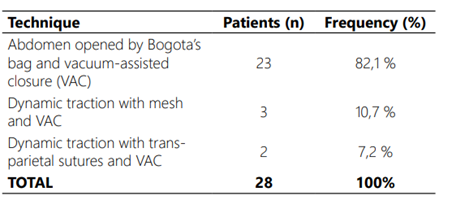
Las técnicas empleadas fueron: abdomen abierto con bolsa de Bogotá y sistema de aspiración al vacío (VAC) en 23 casos, Tracción dinámica con malla y VAC 3 casos y Tracción dinámica con suturas de retención transparietales y VAC en 2 casos.
El cierre definitivo de la pared abdominal se logró en solo 4 casos, mientras que en otros 4 se realizó el afrontamiento de la piel. En 16 casos, el cierre se llevó a cabo mediante cicatrización por segunda intención. La tasa de mortalidad fue del 14,2%.
Conclusión:
La técnica de cierre temporal para el manejo del AA utilizada con mayor frecuencia fue la bolsa de Bogotá y sistema de aspiración al vacío. Se logró el cierre de pared en 4 pacientes. Se registraron 4 óbitos.
Palabras claves: Abdomen abierto; Cierre temporal; Bolsa de Bogotá
Introduction:
The management of the abdominal wall in open abdomen (OA) cases represents a challenge for general surgeons. Several techniques and strategies have been introduced, yielding promising results.
Patients and Methods:
A retrospective, observational, descriptive, cross-sectional study with non-probabilistic sampling was conducted. Patients with OA were included, evaluating the techniques used for their management and temporary closure, from March 2023 to February 2024, at the Second Chair of Surgical Clinic.
Results:
A total of 28 patients met the inclusion criteria, of whom 77% were men and 23% were women. The average age was 49 years.
The techniques used were: open abdomen with Bogotá bag and vacuum-assisted closure (VAC) in 23 cases, dynamic traction with mesh and VAC in 3 cases, and dynamic traction with transparietal retention sutures and VAC in 2 cases.
Definitive closure of the abdominal wall was achieved in only 4 cases, while in another 4 cases, skin approximation was performed. In 16 cases, closure occurred through secondary intention healing. The mortality rate was 14.2%.
INTRODUCTION
The open abdomen (OA) is defined as the separation of all layers of the abdominal wall, with controlled exposition of the entrails, after a laparotomy. This technique is employed in critical patients who require specialized handling, particularly in cases of abdominal sepsis, compartment syndrome risk and other conditions that compromise the patient’s stability. The main indications for OA include severe visceral edema, damage control, fecal peritonitis and the presence of large parietal defects, such as those usually present in patients with extensive burns.1,2 Open abdomen (OA) is divided into three periods: initial, middle, and final. During the initial period, the abdomen’s opening is performed along with a temporary abdominal closure (TAC). Its main objectives are:
Allow re-exploration of the abdominal cavity and performing cleanings if necessary.
Decrease intra-abdominal pressure.
Evaluate the vitality of inner organs.
Prevent evisceration and protect abdominal organs, maintaining their temperature.
Facilitate additional procedures, such as debridement or organ resections, while the patient stabilizes and reaches a general adequate state for definitive closure3.
Temporal abdominal closure (TAC) entails a series of methods designed to protect abdominal entrails while the patient remains with an open abdomen (OA). Literature offers diverse TAC options, making it essential to choose the most adequate technique to maximize the abdominal wall’s definitive closure and minimize associated complications. Among the main complications that are to be avoided with adequate use of TAC are enteroatmospheric fistulas, intraabdominal abscesses, frozen abdomen and planned hernias3. The second treatment period corresponds to the phase in which the patient remains with the open abdomen (OA) without the possibility of definitive closure. During this time, the patient may be placed in the Intensive Care Unit (ICU) or in-patient room, depending on the clinical state. In this stage, it’s possible that the patient requires multiple additional surgical interventions, including re-explorations, abdominal cleanings and adjustments in the temporary closure’s handling, with the objective of preserving the viability of the organs and to prevent complications until sufficient stabilization for definitive closure is achieved2,3,4. The third treatment period starts when the patient’s clinical and surgical conditions allow for the definitive closure of the abdominal wall. Elapsed time between the first intervention and recovery varies significantly according to the open abdomen’s (OA) indication and general patient state. In prolonged evolution cases, such as in abdominal sepsis patients, several complications may arise, such as:
Retraction of the musculoaponeurotic system
Loss of parietal domain
Visceral edema
Frozen abdomen formation Thus, the closure strategy must adapt to the patient’s evolution to minimize these complications and enhance functional and structural results of the abdominal wall. Temporary abdominal closure (TAC) can be performed through static or dynamic techniques, with or without the use of negative pressure. However, handling guidelines based on evidence recommend the use of negative pressure due to the multiple benefits it offers to the patient’s evolution. Definitive closure depends on the patient’s general state as much as it does on the abdominal wall’s condition. In many cases, the scarring process occurs due to a second intervention, which can allow for planned hernias, requiring a future parietal fix. The objective of the present study is to describe the temporary closure techniques used in open abdomen (OA) handling.
MATERIALS AND METHODS
Retrospective, observational, descriptive, cross-cut study, with non-probabilistic sampling, patients of both genders with OA, employed techniques in their handling and temporary closure were included, from March 2023 to February 2024, in the Clinical Surgery’s 2nd Subject. Data collection was done through clinical files’ revision, and with the creation of a questionary to gather information with the study variables (age, gender, temporary closure technique, definitive closure technique, death) to be investigated in this work. All ethical and confidential principles were upheld.
RESULTS
28 patients were included, of which 77% were man and 23% were women. The average age was 49 years old. The techniques employed were: Table I. Distribution of Temporary Abdominal Closure (TAC) Techniques
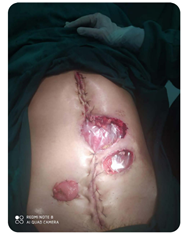
Definitive closure of the abdominal wall was achieved in 4 patients (14.3%), while in 4 cases (14.3%) only the skin closure was performed. In 16 patients (57.2%), closure was done through scarring by second intention. The mortality rate was 14.2%.
DISCUSSION
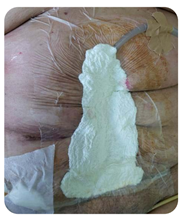
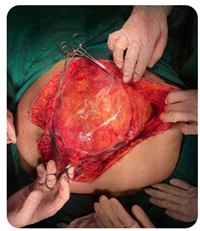
OA is defined as a clinical situation where the abdominal wall is left unclosed after surgical intervention, and it’s handled with temporary abdominal closure (TAC). In certain situations, it’s due to an intervention or surgical complication, such as a partial resection of the abdominal wall due to necrosing infection, trauma or tumor, but can be a technique employed to treat critical abdominal cases, situations in which the abdomen is left open due to several causes like damage control, or an important visceral edema just as published by Leppäniemi7. Bjorck8 published a modification of the open abdomen’s classification which characterizes the different stages according to the infection and fixing grade, from a clean, open, nonadhering abdomen to a frozen abdomen with one or more enteroatmospheric fistulas. In some patients, open abdomen is used as a treatment technique and it’s combined with some form of TAC, it can be divided into static or dynamic, with or without negative pressure, static temporary abdominal closures without negative pressure are found in the unused skin closure, the use of meshes that are already contraindicated due to fistula emergence, and Bogota’s bag which is still a handling option for OA, used on a majority of patients in this investigation2,3. All patients in this study received vacuum pressure therapy, nowadays there are several studies that recommend the use of negative pressure, given its beneficial effects: such as reduction of intra-abdominal liquids, visceral edema’s decrease, favoring the tissue granulation process, favoring irrigation and neovascularization, contamination control and elimination of intra-abdominal cytokines, as per the research done by Petersson, Tolonen and Cheatham9,10,11,12. Dynamic closure (DC) is a technique that consists in the progressive closure of the abdominal wall through a TAC that allows traction for abdominal wall’s muscles towards the medium line, sequentially, during each surgical intervention until a primary fascial closure (PFC) is achieved, using, in some cases, a negative pressure system. A TAC that allows the association of dynamic closure and negative pressure counters the OA complications, given that it avoids muscle retraction and dominance loss from the beginning and allows the visceral blockade to develop in a controlled manner; this way, it allows for definitive closure of the abdominal cavity when conditions are met in most cases. In a small percentage of subjects submitted to this study were handled with dynamic traction, due to the learning curve to reproduce the techniques13,14,15. International guides recommend the use of TAC with dynamic techniques over static ones, performing definitive abdominal closure as soon as possible with the goal of reducing mortality, complications and in-patient stay related to OA, negative pressure techniques must always be used if available, performing means to prevent enteroatmospheric fistula, such as not applying negative pressure directly over the entrails, nor placing gauzes in contact or compressing with them, it’s possible to apply Bogota’s bag in low resource contexts, taking into account that a lower late fascial closure rate and higher intestinal fistula rate will occur, if there are no other available methods, or if a dynamic closure technique isn’t an option, a TAC with negative pressure therapy in a static closure OA must be performed, similar to the results obtained in this study15,16. Lastly, it’s important to perform an OA indication with much character, knowing all modern TAC methods, learning to properly use them, understanding what is fundamental for the multidisciplinary treatment of severe patients, favorable evolution will depend on antibiotic therapy run by isolated germ, correction of metabolic and systemic disorders such as anemia or hipoalbuminemia17).
REFERENCES
1. Carnicer Escuso E. El cierre temporal de la cavidad abdominal: una revisión. Rev hispanoam hernia.2015;3(2):49-58. [ Links ]
2. Lúdica F, Cingolani P, Barragán F, Nogueira F. Cierre dinámico en el manejo del abdomen abierto. Relato oficial del 5to Congreso Argentino de Cirugía de la Pared Abdominal. 2024. [ Links ]
3. Coccolini F, Roberts D, Ansaloni L, et al. The open abdomen in trauma and non-trauma patients: WSES guidelines. World J Emerg Surg. 2018; 13:7. [ Links ]
4. López-Cano M, García-Alamino JM, Antoniou SA, et al. EHS clinical guidelines on the management of the abdominal wall in the context of the open or burst abdomen. Hernia. 2018; 22:921-39. [ Links ]
5. Borráez O. Abdomen abierto: la herida desafiante. Rev Colomb Cir 2008;23(4):204-209 [ Links ]
6. Roberts DJ, Zygun DA, Grendar J, et al. Negative-pressure wound therapy for critically ill adults with open abdominal wounds: a systematic review. J Trauma Acute Care Surg. 2012;73(3):629-39. [ Links ]
7. Leppäniemi A. Abdomen abierto en el tratamiento del abdomen catastrófico: evidencia y controversias. Cir Esp.2021;99(8):559-561. [ Links ]
8. Bjorc M, Kirkpatrick AW, Cheatham M, Kaplan M, Leppaniemi A, De Waele JJ. Amended classification of the open abdomen. Scand J Surg. 2016; 105:5-10. [ Links ]
9. Roberts DJ, Zygun DA, Grendar J, et al. Negative-pressure wound therapy for critically ill adults with open abdominal wounds: a systematic review. J Trauma Acute Care Surg . 2012;73(3):629-39. [ Links ]
10. P. Petersson, A. Montgomery, U. Petersson. Vacuum-assisted wound closure and permanent onlay mesh-mediated fascial traction: A novel technique for the prevention of incisional hernia after open abdomen therapy including results from a retrospective case series. Scand J Surg .2019; 108 :216-226 [ Links ]
11. M. Tolonen, P. Mentula, V. Sallinen, S. Rasilainen, M. Bäcklund, A. Leppäniemi. Open abdomen with vacuum-assisted wound closure and mesh-mediated fascial traction in patients with complicated diffuse secondary peritonitis: A single-center 8-year experience. J Trauma Acute Care Surg . 2017;82 :1100-1105 [ Links ]
12. Cheatham ML, Demetriades D, Fabian TC, et al. A prospective study examining clinical out- comes associated with a negative pressure wound therapy system and Barker’s vacuum packing technique. World J Surg. 2013; 37:2018-30. [ Links ]
13. Verdam FJ, Dolmans DE, Loos MJ, et al. Delayed primary closure of the septic open abdomen with a dynamic closure system. World J Surg . 2011;35(10):2348- 55. [ Links ]
14. Barker DE, Green JM, Maxwell RA, et al. Experience with vacuum-pack temporary abdominal wound closure in 258 trauma and general and vascular surgical patients. J Am Coll Surg. 2007; 204: 784-92. [ Links ]
15. Haddock C, Konkin DE, Blair NP. Management of the open abdomen with the abdominal reapproximation anchor dynamic fascial closure system. Am J Surg. 2013; 205(5): 528-33. discussion 533. [ Links ]
16. Boele van Hensbroek P, Wind J, Dijkgraaf MG, et al. Temporary closure of the open abdomen: a systematic review on delayed primary fascial closure in patients with an open abdomen. World J Surg. 2009;33(2):199-207. [ Links ]
17. R. Udyavar, E.E. Cornwell, J.M. Havens, Z.G. Hashmi, J.W. Scott, D. Sturgeon, et al. Surgeon-driven variability in emergency general surgery outcomes: Does it matter who is on call?. Surgery. 2018;164 :1109-1116. [ Links ]
AUTHOR’S CONTRIBUTION
12All authors participated equally in the creation of the study, data recollection and analysis, writing and approval of the manuscript’s final version. All assume responsibility for the work’s content.
FUNDING
CONFLICT OF INTERESTS
Received: September 02, 2024; Revised: October 09, 2024; Accepted: November 21, 2024
 Este es un artículo publicado en acceso abierto bajo una licencia Creative Commons
