




Services on Demand
Journal

Article
 text in
 English (pdf)
 Article in xml format
 Article references

 Automatic translation
 Send this article by e-mail
Indicators
-
 Cited by SciELO
Related links
-
 Similars in
SciELO
Share

 Permalink

Investigación Agraria
On-line version ISSN 2305-0683
Investig. Agrar. vol.28 no.1 San Lorenzo June 2026 Epub Apr 06, 2026
https://doi.org/10.18004/investig.agrar.2026.e2801858
Scientific article
Effect of an Artisanal Biopreparation of Efficient Microorganisms on the Growth and Yield of Tomato (Solanum lycopersicum L.)
1
*
 http://orcid.org/0009-0006-9128-5284
1
http://orcid.org/0009-0003-0448-3628
1 Universidad de Cienfuegos "Carlos Rafael Rodríguez". Cienfuegos, Cuba.
2 Universidad de Cienfuegos “Carlos Rafael Rodríguez”, Centro de Estudios para la transformación Agraria Sostenible. Cienfuegos, Cuba.
With the objective of evaluating the effect of efficient microorganism applications on morphological and yield variables in tomato cultivation, an experiment was conducted at the "Las Flores" farm, Cruces municipality, Cienfuegos province (Cuba), on a Brown soil without Carbonate. The commercial tomato variety "Lignon" was used, and a randomized block experimental design was applied with three treatments and four replications, covering a total area of 278 m². The efficient microorganism biopreparation was applied on three occasions every seven days, at doses of 7 L ha⁻¹ and 10 L ha⁻¹. Ten plants per plot were evaluated and the economic feasibility of each treatment was calculated. The results demonstrated that the application of efficient microorganisms promoted soil microbial activity and improved its biochemical capacity, resulting in greater vegetative development, a significant increase in flowering and fruiting, as well as a notable improvement in agricultural yield compared to the control. The economic analysis confirmed that the 10 L ha⁻¹ dose was the most profitable. The use of this biopreparation not only increases crop productivity but also contributes to the regeneration and enrichment of degraded soils, representing a sustainable and economically viable alternative for agricultural systems with fertility limitations.
Keywords: microbial activity; efficient microorganisms; yield; degraded soils
Con el objetivo de evaluar el efecto de la aplicación de microorganismos eficientes sobre variables morfológicas y de rendimiento en el cultivo de tomate, se desarrolló un experimento en la finca "Las Flores", municipio Cruces, provincia Cienfuegos (Cuba), sobre un suelo Pardo sin Carbonato. Se empleó la variedad comercial de tomate "Lignon" y se utilizó un diseño experimental de bloques al azar con tres tratamientos y cuatro repeticiones, con un área total de 278 m². El biopreparado de microorganismos eficientes se aplicó en tres ocasiones cada siete días, en dosis de 7 L ha⁻¹ y 10 L ha⁻¹. Se evaluaron diez plantas por parcela y se calculó la factibilidad económica de cada tratamiento. Los resultados demostraron que la aplicación de microorganismos eficientes promovió la actividad microbiana del suelo y mejoró su capacidad bioquímica, lo que se tradujo en mayor desarrollo vegetativo, incremento significativo en la floración y fructificación, así como aumento notable del rendimiento agrícola en comparación con el control. El análisis económico confirmó que la dosis de 10 L ha⁻¹ resultó ser la más rentable. El uso de este biopreparado no solo incrementa la productividad del cultivo, sino que también contribuye a la regeneración y enriquecimiento de suelos degradados, constituyendo una alternativa sostenible y económicamente viable para sistemas agrícolas con limitaciones de fertilidad.
Palabras claves: actividad microbiana; microorganismos eficientes; rendimiento; suelos degradados
INTRODUCTION
Tomato (Solanum lycopersicum L.) is one of the most important vegetables globally, both for its nutritional value and its economic impact (Food and Agriculture Organization of the United Nations, 2023). Its production in Cuba faces significant challenges related to input availability, soil fertility, and climate variability, which have affected its yield and productive stability in recent years. According to data from the National Office of Statistics and Information (ONEI, 2022), national tomato production reached 209.9 thousand tons in 2021, showing a recovery compared to previous years, but still below historical levels.
Production is sustained mainly by the state and cooperative sectors, with a growing push toward urban and suburban agriculture to bring production closer to consumers and reduce import dependency (Rodríguez León, Teherán Sierra, Arias Arias, and Cenipalma, 2025b). However, limiting factors such as low availability of chemical fertilizers, soil degradation, particularly in soil types such as Brown soils without Carbonates of low natural fertility (Blanco-Imbert, Alvarado-Ruffo and Fernández-Velázquez, 2026), and the effects of prolonged droughts have generated yield fluctuations, which, according to the Food and Agriculture Organization of the United Nations (2023), average around 16 t ha⁻¹ to 18 t ha⁻¹, a figure below the crop's genetic potential.
In the Cruces municipality, Cuba, tomato production is limited by various factors such as soil fertility problems, low organic matter levels, and compaction (Gómez, Rodríguez, Enrique, Miranda, and González, 2009). Efficient microorganisms (EM) represent a technology developed by Professor Teruo Higa, based on a microbial mixture of different genera of microorganisms (bacteria, fungi, yeasts, among others) (Díaz Fuentes and Benítez González, 2023).
Soil microorganisms constitute an environmentally safe option, as they play a fundamental role in the health of terrestrial ecosystems and food production. Although soil may appear inert to the naked eye, it is teeming with microscopic life that performs essential functions such as the decomposition of organic matter from fallen leaves, plant residues, and other waste, releasing nutrients that plants can absorb to support their growth. Furthermore, many soil bacteria are capable of fixing atmospheric nitrogen and transforming it into forms assimilable by plants, thereby reducing their dependence on synthetic fertilizers (Castro-Landin, Zapata-Velasco and Palacios-Lopez, 2023).
This technology has been researched, developed, and applied across a wide range of agricultural and environmental uses, being utilized in more than 80 countries, including Cuba, which in recent years has carried out intensive research related to the subject (Mesa Reinaldo, 2020).
According to López et al. (2024), soil microorganisms, including bacteria and fungi, are essential for aggregate formation, which improves soil structure and porosity. This improvement in soil structure not only increases its water retention capacity but also facilitates gas and nutrient exchange. Microorganisms play a crucial role in the decomposition of organic matter, releasing essential nutrients such as nitrogen, phosphorus, and potassium, as well as micronutrients necessary for optimal plant growth.
This research seeks to evaluate the effect of applying a biopreparation based on artisanal efficient microorganisms, produced using strains obtained from local primary forests, on morphological variables and the yield of the tomato crop.
MATERIALS AND METHODS
Experimental location and period
The study was conducted in the Cruces municipality, from January 1 to April 30, 2025 (spring campaign). Certified tomato seeds of the Lignon variety (95% germination rate) were used, acquired from the Agricultural Consulting Store (CTA) of the Cruces Urban Farm. Sowing was carried out by manual transplanting, with seedlings placed at a depth of 5 cm to 6 cm, using a planting framework of 0.90 m between rows and 0.40 m between plants (National Center for Agricultural and Forestry Technology (CENTA), 2023).
Experimental design and treatments
A randomized block design was used with three treatments and four replications (Figure 1). The experimental area was 270 m² with a total trial area of 278 m², and individual plots of 22.5 m² (5 m × 4.50 m). The plots were distributed across four blocks with a 1 m separation between them. Ten plants per plot were sampled.
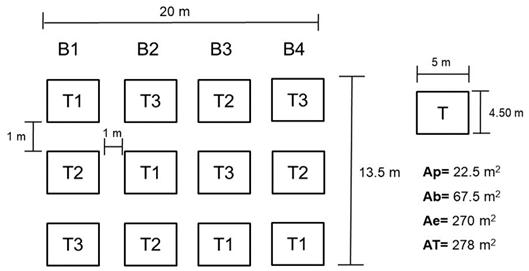
Figure 1 Treatment distribution in the randomized block experimental design. T1: control (no application); T2: 7 L ha⁻¹ of efficient microorganisms; T3: 10 L ha⁻¹ of efficient microorganisms. B1-B4: blocks 1 to 4. Ap: area per plot; Ab: area per block; Ae: experimental area; AT: total area.
The evaluated treatments were: T1 (control, no EM application), T2 (EM-based biopreparation at 7 L ha⁻¹), and T3 (EM-based biopreparation at 10 L ha⁻¹).
The evaluated biopreparation was produced at the "La Caoba" farm, Cruces municipality, Cienfuegos, Cuba, by the research team led by Alejandro Raúl González-Cruz, following the capture and fermentation methodology proposed by Mesa et al. (2018). The raw material consisted of natural substrates (leaf litter, organic matter, and topsoil) collected under sterile conditions from an undisturbed area of the farm itself. The preparation involved the anaerobic fermentation of these substrates in a 10% molasses solution as a base medium, maintained at ambient temperature (28-30 °C) for 30 days. Subsequent microbiological characterization identified a consortium dominated by the saprophytic fungi Penicillium spp. and Aspergillus spp., along with Mucor spp., Rhizopus spp., Curvularia spp., and the yeast Candida spp., as well as the plant growth-promoting bacteria Pseudomonas aeruginosa and Enterobacter spp.
Both foliar and soil-directed applications were carried out every seven days, with the first application beginning ten days after transplanting. Treatments were applied using a 16 L backpack sprayer with a hollow cone nozzle, between 18:00 and 19:00 h to avoid thermal stress.
Monthly data on mean temperature (°C), relative humidity (%), and precipitation (mm) were recorded, as provided by the Provincial Meteorology Unit of Cienfuegos and the rain gauge of the National Institute of Hydraulic Resources located at the farm.
Evaluated variables
Plant height (cm): An initial sampling was conducted seven days after transplanting, followed by weekly evaluations up to 35 days (final sampling). Height was measured with a tape measure from the soil surface to the apical bud, in a total of ten plants per replication.
Number of flowers and fruits per plant: These were counted at the end of the flowering stage and at harvest, respectively.
Fruit length (cm): The length of twenty randomly selected fruits from the study plots was measured with a tape measure at the time of harvest, and the values were averaged. This evaluation was carried out at each harvest.
Fruit diameter per plant (cm): The diameter of twenty randomly selected fruits from the study plots was measured with a tape measure at the time of harvest, and the values were averaged. This evaluation was performed at each harvest and compared with the crop's quality parameters.
Fruit weight (g): The weight of twenty randomly selected fruits from the study plots was determined at the time of harvest, weighed on an analytical balance. This evaluation was carried out at each harvest.
Yield (t ha⁻¹): Obtained based on the total fruit weight per experimental plot divided by the plot area. The production obtained from the study plots was determined and expressed in kilograms.
Statistical and economic analysis
Data were analyzed using the SPSS statistical package for Windows, version 25. Means were compared using Tukey's HSD test, with a probability level of 5% established for treatment comparisons.
The final agricultural yield was determined in tons per hectare (t ha⁻¹) using the following formula:

Depreciation was calculated for the equipment used, such as the plow, harrow, ridger, turbine, and tractor, based on their initial value and estimated useful life. This allowed the annual depreciation to be obtained. Subsequently, the number of hours these assets worked annually was calculated, and the depreciation per hour worked for the total area was determined using the following formula:

RESULTS AND DISCUSSION
Climatic variables
During the experimental period (January-March 2025), climatic conditions were favorable for crop development (Table 1). Mean temperatures between 26.5 °C and 28.7 °C were recorded, along with increasing relative humidity (from 69% to 80%) and rising precipitation that reached 170 mm - conditions typical of the spring campaign in the region. These data reflect a favorable environment for crop development, with greater water availability during the final stage of the trial.
Table 1 Climatic conditions during the experimental period in Cruces, Cienfuegos, Cuba (January-March, 2025).
| Month | Mean Temperature (°C) | Relative Humidity (%) | Precipitation (mm) |
| January | 26.5 | 69 | 90 |
| February | 27.0 | 78 | 150 |
| March | 28.7 | 80 | 170 |
Source: Institute of Meteorology of the Republic of Cuba (INSMET, 2025).
Herrera (2018) notes that excess moisture deprives roots of oxygen, reduces photosynthetic capacity, and causes significant yield decreases, particularly in sensitive crops. Therefore, although increasing humidity can be beneficial, a prolonged excess may hinder optimal crop development.
Soil characteristics
The predominant soil type in the municipality corresponds to Brown soils without Carbonates, identifiable by their light brown coloration and clay-loam texture, which favors moisture retention. This soil type presents challenges such as low natural fertility, scarce organic matter content (below 2%), and the absence of calcium carbonates, making it particularly suitable for crops sensitive to alkalinity. It presents a slightly acidic pH (5.5 to 6.5), a range that limits the availability of nutrients such as phosphorus, potassium, and nitrogen. Its poorly structured A horizon and cambic B horizon reflect a young profile, suggesting high responsiveness to regeneration practices such as the use of biofertilizers and the incorporation of green manures.
These results are consistent with the findings of Hortalán (2024), who states that Brown soils without Carbonates are classified as low-productivity soils due to their low organic matter and fertility; however, proper management with sustainable practices can turn them into viable agricultural resources. The incorporation of organic amendments, such as compost, improves soil structure, increases microbial biodiversity, and reduces erosion, contributing to soil fertility in the medium and long term.
Plant height
Analyzing the values in Table 2, the effect of the biopreparation on plant height at 14 days (P > 0.05) indicates a latency or establishment period of microbial activity. The statistical significance (P < 0.05) obtained in subsequent evaluations confirms that the differences observed between treatments are not random. The 13.1 cm increase in final plant height for plants treated with the 10 L ha⁻¹ dose compared to the control is not only statistically significant but also represents a relevant agronomic advantage. This growth leap suggests an enhancement of physiological processes, likely mediated by microbial synthesis of phytohormones or an improvement in nutritional efficiency.
Table 2 Effect of the efficient microorganism biopreparation on the height of tomato plants.
| Treatments | Plant Height (cm) | ||
| 14 days | 21 days | 28 days | |
| T1. Control | 17.50 a | 34.60 c | 40.50 c |
| T2. EM Biopreparation 7 L ha-1 | 17.40 a | 42.30 b | 47.60 b |
| T3. EM Biopreparation 10 L ha-1 | 17.40 a | 48.00 a | 53.60 a |
| Es ± | 0.094 NS | 0.234* | 0.225* |
Note: Unequal letters indicate significant differences (P < 0.05). NS: not significant; *: significant.
In this regard, the use of biopreparations contributes to agricultural sustainability by reducing dependence on chemical fertilizers and improving soil health. In recent studies with applied Trichoderma asperellum strains, increases in plant height and yield of between 20% and 30% have been reported, attributable to improvements in soil enzymatic activity and the promotion of root development (Ruiz-Sánchez, Echeverría-Hernández, Muñoz-Hernández, Martínez-Robaina and Cruz-Triana, 2022).
Number of flowers per plant
When evaluating the effect of the biopreparation on the number of flowers per plant (Table 3), highly significant differences (P < 0.05) were observed between treatments. The 10 L ha⁻¹ dose (T3) generated the greatest floral promotion, being statistically superior to the 7 L ha⁻¹ treatment (T2), which in turn significantly outperformed the control (T1). The 53.8% increase (9.2 additional flowers) in T3 compared to the control is not only statistically significant, but also of great agronomic relevance, as a higher number of flowers potentially correlates with final yield.
Table 3 Effect of the efficient microorganism biopreparation on the number of flowers per plant.
| Treatments | Number of Flowers |
|---|---|
| T1. Control | 17.10 c |
| T2. EM Biopreparation 7 L ha⁻¹ | 22.40 b |
| T3. EM Biopreparation 10 L ha⁻¹ | 26.30 a |
| Es ± | 0.736 * |
Note: Unequal letters indicate significant differences according to Tukey's HSD test (P < 0.05). *: P < 0.05
The significant increase in the number of flowers is attributed to the production of phytohormones such as indole-3-acetic acid (IAA) by plant growth-promoting bacteria, such as Brevibacillus borstelensis. Recent studies have demonstrated that these bacteria stimulate flowering in long bean cultivation, promoting not only floral emergence but also the development of reproductive structures (Bayard-Vedey and Orberá-Ratón, 2020).
Number of fruits per plant
The analysis of the number of fruits per plant (Table 4) shows a significant effect (P < 0.05) of the biopreparation throughout the entire measurement cycle. This indicates that the initial advantage (7 DAF) was maintained and amplified through harvest (35 DAF). The 10 L ha⁻¹ treatment (T3) produced a final increase of 8.4 fruits per plant compared to the control, representing a productive improvement of 48.3%. This result is crucial, as it translates the advantage in vegetative growth (height) and reproduction (flowers) directly into the final yield component (number of fruits).
Table 4 Effect of the efficient microorganism biopreparation on the number of fruits per plant.
| Treatments | Number of Fruits per Plant | ||
|---|---|---|---|
| 7 DAF | 21 DAF | 35 DAF | |
| T1. Control | 6.40 c | 11.60 c | 17.40 c |
| T2. EM Biopreparation 7 L ha⁻¹ | 9.00 b | 16.00 b | 21.10 b |
| T3. EM Biopreparation 10 L ha⁻¹ | 10.10 a | 22.00 a | 25.80 a |
| Es ± | 0.331* | 0.831* | 0.691* |
Note: Unequal letters indicate significant differences *(P < 0.05). DAF: Days After Fruiting.
The combination of biopreparations with organic matter enhances microbial activity in the soil, resulting in an increase in both the quantity and quality of fruits. Tanya Morocho and Leiva-Mora (2019) found that the combined application of efficient microorganisms and organic amendments increased the length, mass, and number of fruits in horticultural crops, by improving the productivity and sustainability of the agricultural system. This synergistic effect is key to optimizing yield under low-fertility conditions.
Likewise, a meta-analysis by Kaushal, Ali, Saini, Pati, and Maitra Pati (2023) on biostimulants concluded that the increase in fruit number is one of the most consistent effects, highlighting that success depends on the compatibility of the microbial consortium with the crop's physiology and on the application of adequate doses to ensure effective rhizospheric colonization, which explains the superiority of the higher dose in this study.
Fruit diameter
Analyzing the results obtained (Table 5), a significant and increasing effect of the biopreparation on fruit diameter is demonstrated. The superiority of T3 remained constant across all samplings. The final absolute increase of 2.96 cm (74% greater) in T3 compared to the control evidences a substantial agronomic advantage. The statistical significance from the first sampling suggests an early action of the biostimulant, likely through improvement in initial cell division, while the growing difference over time indicates a sustained acceleration of cell expansion during fruit filling.
Table 5 Effect of the efficient microorganism biopreparation on fruit diameter.
| Treatments | Fruit Diameter (cm) | |||
|---|---|---|---|---|
| 42 DAT | 49 DAT | 56 DAT | 63 DAT | |
| T1. Control | 1.06 c | 2.01 c | 3.48 c | 4.01 c |
| T2. EM Biopreparation 7 L ha⁻¹ | 1.18 ab | 2.53 b | 4.47 b | 5.47 b |
| T3. EM Biopreparation 10 L ha⁻¹ | 1.23 a | 3.03 a | 5.47 a | 6.97 a |
| Es ± | 0.025* | 0.033* | 0.047* | 0.045* |
Note: Unequal letters indicate significant differences according to Tukey's HSD test (P < 0.05). DAT: days after transplanting. *: P < 0.05.
Mosquera Ponce, Muñoz Pinela, Guano Castro, Mena Villavicencio and Gómez Caamaño (2025) showed that the application of bioinputs, including efficient microorganisms and compost, significantly increased fruit diameter compared to the control, with an increase of 15% to 20%. This confirms the viability of bioinputs as sustainable alternatives for improving the quality and yield of vegetables.
Studies by Soriano-Melgar, Izquierdo-Oviedo, Saucedo-Espinosa and Cárdenas-Flores (2020) reported significant increases in fruit diameter following the application of biostimulants based on Azotobacter chroococcum combined with organic products, achieving improvements of more than 15% compared to the control. These treatments promoted nutrient absorption and postharvest quality, demonstrating the potential of microorganisms to increase fruit size.
Fruit weight
The analysis of variance (Table 6) confirms a significant effect (P < 0.05) of the biopreparation on final fruit weight, with a clear statistical separation among the three treatments. The treatment with the highest dose (10 L ha⁻¹) nearly doubled the average fruit weight, achieving a gain of 20.93 g (98% more) compared to the control. This result integrates and materializes the improvements observed in the previous variables: a greater number and size of fruits (diameter) translate directly into a substantial increase in unit weight, which physiologically suggests an optimization in biomass and assimilate accumulation in the fruit.
Table 6 Effect of the efficient microorganism biopreparation on fruit weight.
| Treatments | Weight (g) |
|---|---|
| T1. Control | 21.30 c |
| T2. EM Biopreparation 7 L ha⁻¹ | 34.12 b |
| T3. EM Biopreparation 10 L ha⁻¹ | 42.23 a |
| Es ± | 0.367* |
Nota. Letras desiguales indican diferencias significativas según la prueba HSD de Tukey (P < 0,05). *: P < 0,05.
Ojeda (2023) indicates that the application of biopreparations in tomato cultivation acts as a plant growth stimulant by improving physiological processes that result in a significant increase in fruit size and weight. These biopreparations also promote nutrient absorption, which contributes to optimizing crop yield and quality. His study highlights that higher doses of biopreparations tend to further enhance these benefits, demonstrating a viable and sustainable strategy for efficient tomato agricultural production.
In addition to improving fruit weight, the use of biopreparations contributes to agricultural sustainability by reducing dependence on chemical fertilizers and improving soil health. Yasser-Lorente et al. (2021) demonstrated that foliar application of a brassinosteroid analogue (Biobras-16) significantly increased plant fresh mass and fruit weight, linked to greater root emission and improved nutrient absorption.
Crop yield
Table 7 describes a notable impact of the biopreparation on crop yield. The control treatment (T1) presented the lowest values (0.53 t ha⁻¹), while the maximum dose of 10 L ha⁻¹ (T3) yielded the best results (1.06 t ha⁻¹), representing a 100% increase compared to the control. Statistically significant differences (P < 0.05) were observed among all evaluated treatments. The direct relationship between the biopreparation dose and the increase in yield suggests that its application optimizes the crop's physiological processes.
Table 7 Effect of the efficient microorganism biopreparation on yield.
| Treatments | Yield (t ha⁻¹) |
|---|---|
| T1. Control | 0.53 c |
| T2. EM Biopreparation 7 L ha⁻¹ | 0.85 b |
| T3. EM Biopreparation 10 L ha⁻¹ | 1.06 a |
| Es ± | 0.0158* |
Note: Unequal letters indicate significant differences according to Tukey's HSD test (P < 0.05). *: P < 0.05.
These results are consistent with recent studies that have evaluated the use of biostimulants and natural extracts in agricultural production. Mosquera Ponce et al. (2025) reported that the application of seaweed extract combined with micronutrients significantly improved both yield and economic profitability in tomato cultivation. Likewise, these authors showed that the increase in yield translates into higher income and a relative reduction in costs, which validates the economic viability observed in the present study.
Economic analysis
The economic analysis (Table 8) confirms the superiority of treatment T3 (10 L ha⁻¹). The results demonstrate a positive relationship between dose, yield, and profitability. The net profit of 1,356.7 CUP in T3 exceeds the control (T1) by 113%, demonstrating a significant economic impact. The statistically significant improvement in yield (P < 0.05) translates directly into higher income, creating a differential that far exceeds the increase in total cost. The key indicator of cost per unit weight (0.52 CUP kg⁻¹ in T3) is the lowest, confirming greater productive efficiency. The 90% profitability in T3 reflects that for every peso invested, the investment is recovered and a substantial profit is generated, validating the application of the optimal dose from an economic andfinancial perspective.
Table 8 Economic results of the application of efficient microorganisms in tomato cultivation
| Indicators | Unit | T1 (Control) | T2 (7 L ha⁻¹) | T3 (10 L ha⁻¹) |
|---|---|---|---|---|
| Yield obtained | t ha⁻¹ | 0.53 | 0.85 | 1.06 |
| Total production | T | 0.01431 | 0.02295 | 0.02862 |
| Income | CUP | 1,431.0 | 2,295.0 | 2,862.0 |
| Total cost | CUP | 795.0 | 1,240.5 | 1,505.3 |
| Net profit | CUP | 636.0 | 1,054.5 | 1,356.7 |
| Cost per unit weight | CUP kg⁻¹ | 0.55 | 0.54 | 0.52 |
| Unit cost | CUP t⁻¹ | 55,570 | 54,040 | 52,600 |
| Profitability | % | 80.0 | 85.0 | 90.0 |
Source: Own elaboration.
The economic superiority of treatment T3 may be explained by the positive effect of EM on soil microbial activity, which promotes nitrogen fixation and phosphate solubilization. However, it is important to note that the study did not include commercialization costs, which could affect profit margins under real market conditions. Furthermore, the research was limited to evaluating three EM doses, so future studies should explore a wider range to identify possible saturation points in the crop's response (Mohan Babu, Jagadeesh, Vara Lakshmi, Sparjan Babu and Sharma, 2025).
Biopreparations offer significant agronomic benefits, including improved soil fertility and reduced dependence on chemical inputs. Moreover, their production using local and biodegradable resources reduces environmental impact and risks to human health. These characteristics position them as key tools for sustainable agriculture, particularly in production systems seeking to balance productivity and environmental conservation (Rodríguez Rollero, Vallejo Zamora, Peña Turruellas, Capó Pérez, and Del Pozo Núñez, 2025a).
CONCLUSIONS
The application of the efficient microorganism biopreparation comprehensively improved the yield components of the tomato crop, including the number, size, and weight of fruits. The 10 L ha⁻¹ dose doubled the yield compared to the control (1.06 t ha⁻¹ vs. 0.53 t ha⁻¹) and increased economic profitability to 90%, validating its potential as a technical, economic, and sustainable alternative for agricultural production in low-fertility soils.
REFERENCES
Bayard-Vedey, I., y Orberá-Ratón, T. (2020). Fertilización de Habichuela Larga con biopreparados bacterianos, materia orgánica y fertilizante NPK. Revista Cubana de Química, 32(2), 299-310. http://scielo.sld.cu/scielo.php?script=sci_arttext&pid=S2224-54212020000200299 [ Links ]
Blanco, R., Alvarado, M., y Fernández, A. (2026). Procesos de degradación en el suelo Pardo del Valle de Guantánamo. Avances, 28(1),007. https://avances.pinar.cu/index.php/publicaciones/article/view/961/2251 [ Links ]
Castro-Landin, A. L., Zapata-Velasco, M. L., y Palacios-Lopez, L. A. (2023). El rol de los microorganismos en la fertilidad del suelo agrícola basado en una revisión de estudios recientes. Innovascience Journal, 1(1), 26-37. https://doi.org/10.63618/omd/isj/v1/n1/8 [ Links ]
Centro Nacional de Tecnología Agropecuaria y Forestal (CENTA). (2023). Guía técnica del cultivo de tomate. Ciudad Acre La Libertad, El Salvador. https://www.centa.gob.sv/download/guia-tecnica-del-cultivo-de-tomate/ [ Links ]
Díaz Fuentes, K., y Benítez González, H. (2023). Microorganismos eficientes, mecanismo, formas de acción y aplicaciones en la ganadería. Veterinaria Argentina, 40(417). https://www.veterinariargentina.com/revista/2023/01/microorganismos-eficientes-mecanismo-formas-de-accion-y-aplicaciones-en-la-ganaderia/ [ Links ]
Gómez, L., Rodríguez, M. G., Enrique, R., Miranda, I., y González, E. (2009). Factores limitantes de los rendimientos y calidad de las cosechas en la producción protegida de hortalizas en Cuba. Revista de Protección Vegetal, 24(2), 117-122. http://scielo.sld.cu/scielo.php?script=sci_arttext&pid=S1010-27522009000200007 [ Links ]
Herrera, J. (2018). Efecto del exceso de humedad del suelo sobre el rendimiento en algunos cultivos de importancia agrícola en Cuba. Ingeniería Agrícola, 6(2), 3-7. https://revistas.unah.edu.cu/index.php/IAgric/article/view/811 [ Links ]
Hortalán. (2024). Tipos de suelos agrícolas. https://hortalan.com/ultimas-noticias/tipos-de-suelo-agricolas/ [ Links ]
Instituto de Meteorología de la República de Cuba (INSMET, 2025). El clima de Cuba. Características generales. http://www.insmet.cu/asp/genesis.asp?TB0=PLANTILLAS&TB1=CLIMAC&TB2=%2Fclima%2FClimaCuba.htm [ Links ]
Kaushal, P., Ali, N., Saini, S., Pati, P. K., & Maitra Pati, A. (2023). Physiological and molecular insight of microbial biostimulants for sustainable agriculture. Frontiers in Plant Science, 14, Article 1041413. https://doi.org/10.3389/fpls.2023.1041413 [ Links ]
López, A., Marín, J., & Rivero, E. (2024). Predicción del rendimiento agrícola en el cultivo de la habichuela. Sapientia Technological, 5(1), 57-65. https://doi.org/10.58515/021RSPT [ Links ]
Mesa Reinaldo, J. (2020). Microorganismos eficientes y su empleo en la protección fitosanitaria de los cultivos. Revista Científica Agroecosistemas, 8(2), 102-109. https://aes.ucf.edu.cu/index.php/aes/article/view/407 [ Links ]
Mesa, J., Almoguea, M., García, C., González, J., Carvajal, R., Cárdenas, Y., y García, J. (2018). Tecnología de producción de un biopreparado a base de microorganismos eficientes, a partir de recursos locales. Cienfuegos: CITMA. [ Links ]
Mohan Babu, Y. N., Jagadeesh, U., Vara Lakshmi, P., Sparjan Babu, D. S., y Sharma, R. K. (2025). Evaluation of Amino Acid Based Biostimulant with Surfactant on Groundnut Growth and Yield. International Journal of Plant & Soil Science, 37(2), 276-281. https://doi.org/10.9734/ijpss/2025/v37i25330 [ Links ]
Mosquera Ponce, J. C., Muñoz Pinela, A. G., Guano Castro, D. R., Mena Villavicencio, E. E., y Gómez Caamaño, K. G. (2025). Efectos de diferentes dosis de bio-insumos en el cultivo de rábano (Raphanus sativus). Reincisol, 4(7), 1787-1812. https://doi.org/10.59282/reincisol.V4(7)1787-1812 [ Links ]
Oficina Nacional de Estadística e Información (ONEI). (2022). Anuario Estadístico de Cuba 2021. https://www.onei.gob.cu/anuario-2021 [ Links ]
Ojeda, C. J. (2023). Evaluación del efecto del uso de los biopreparados purín de ortiga y supermagro en el rendimiento de tomate (Solanum lycopersicum ‘Platense’) (Doctoral dissertation, Universidad Nacional de La Plata). https://sedici.unlp.edu.ar/bitstream/handle/10915/157045/Documento_completo.pdf-PDFA.pdf?sequence=1&isAllowed=y [ Links ]
Organización de las Naciones Unidas para la Alimentación y la Agricultura (FAO). (2023). Bueno para ti. Beneficios para la salud y la nutrición. FAO. https://www.fao.org/3/cb2395es/online/src/html/bueno-para-ti.html [ Links ]
Rodríguez León, A., Teherán Sierra, L., Arias Arias, N., y Cenipalma. (2025a). Elaboración y uso de biopreparados en la palmicultura como práctica de la agricultura regenerativa. (Boletin técnico N° 48). https://doi.org/10.56866/9786287711068 [ Links ]
Rodríguez Rollero, G., Vallejo Zamora, Y., Peña Turruellas, E., Capó Pérez, J., y Del Pozo Núñez, E. (2025b). La agricultura urbana, suburbana y familiar. Su contribución a la alimentación de la población cubana. Cooperativismo y Desarrollo, 13(2), e878. https://coodes.upr.edu.cu/index.php/coodes/article/view/878 [ Links ]
Ruiz-Sánchez, M., Echeverría-Hernández, A., Muñoz-Hernández, Y., Martínez-Robaina, A. y Cruz-Triana, A. (2022). Aplicación de dos cepas de Trichoderma asperellum S. como estimulante de crecimiento en el cultivo del arroz. Cultivos Tropicales, 43(1), e10. https://ediciones.inca.edu.cu/index.php/ediciones/article/view/1646 [ Links ]
Soriano-Melgar, Ll. A., Izquierdo-Oviedo, H., Saucedo-Espinosa, Y., y Cárdenas-Flores, A. (2020). Efecto de la aplicación de bioestimulantes sobre la calidad y capacidad antioxidante de frutos de calabacita (Cucurbita pepo L. var. ‘Grey Zucchini’). Terra Latinoamericana, 38(1), 17-28. https://doi.org/10.28940/terra.v38i1.516 [ Links ]
Tanya Morocho, M., y Leiva-Mora, M. (2019). Microorganismos eficientes, propiedades funcionales y aplicaciones agrícolas. Centro agrícola, 46(2), 93-103. http://scielo.sld.cu/scielo.php?script=sci_arttext&pid=S0253-57852019000200093&lng=es&tlng=es [ Links ]
Yasser-Lorente, G., Rodríguez-Hernández, D., Camacho-Rajo, L., Carvajal-Ortiz, C. C., De Ávila-Guerra, R., González-Olmedo, J., y Rodríguez-Sanchez, R. (2021). Efecto de la aplicación de Biobras-16 sobre el crecimiento y calidad de frutos de piña ‘MD-2’. Cultivos Tropicales , 42(2). https://www.redalyc.org/journal/1932/193268052006/html/ [ Links ]
Data availability: The complete dataset supporting the results of this study is available upon request to the corresponding author. The dataset is not publicly available as it is recent research conducted within the territory.
Responsible editor:Arnaldo Esquivel-Fariña https://orcid.org/0000-0002-7727-5243. National University of Asunción, Faculty of Agricultural Sciences. San Lorenzo, Paraguay.
Review comments: This article has been evaluated through a double-blind peer review process. The review reports, in line with the editorial transparency policy, are available at: https://www.agr.una.py/revista/index.php/ria/article/view/858/669
Received: August 31, 2025; Accepted: December 03, 2025; Published: April 06, 2026
 Este es un artículo publicado en acceso abierto bajo una licencia Creative Commons
