




Services on Demand
Journal

Article
 text in
 English (pdf)
 Article in xml format
 Article references

 Automatic translation
 Send this article by e-mail
Indicators
-
 Cited by SciELO
Related links
-
 Similars in
SciELO
Share

 Permalink

Investigación Agraria
On-line version ISSN 2305-0683
Investig. Agrar. vol.27 no.2 San Lorenzo 2025 Epub Dec 16, 2025
https://doi.org/10.18004/investig.agrar.2025.2702854
Scientific article
Fungicide Sensitivity of Paraguayan Strains of Pyricularia oryzae Isolated from Wheat
1
2
 http://orcid.org/0009-0005-2542-5931
1
2
*
http://orcid.org/0000-0003-1804-4143
2
http://orcid.org/0009-0003-7287-5447
1 Universidad Católica Nuestra Señora de la Asunción, Unidad Pedagógica Caacupé. Caacupé, Paraguay.
2 Cámara Paraguaya de Exportadores y Comercializadores de Cereales y Oleaginosas, Proyecto Pyricularia en Trigo. Asunción, Paraguay.
Wheat blast caused by Pyricularia oryzae is a challenging disease to control, considering the multiple reports of fungicide resistance in triazole and strobilurin fungicides. The objective of this work was to evaluate the sensitivity of Paraguayan strains of P. oryzae to five fungicide products under in vitro conditions through determination of the median inhibitory concentration (IC50). The experiment was conducted at the Hernando Bertoni Research Center, IPTA, Caacupé. A randomized complete block design with a 5×5×8 factorial arrangement and 10 replications was used. The factors studied were five strains of P. oryzae; five fungicides (Cyproconazole 12% + Azoxystrobin 20%; Benzovindiflupyr 5% + Picoxystrobin 10%; Tebuconazole 25%; Fluxapyroxad 33.3%; Fluxapyroxad 7.7% + Pyraclostrobin 15.5% + Revysol 11.6%), and eight concentrations of each fungicide (0 (control); 0.1; 1; 5; 10; 20; 40, and 80 μg ml⁻¹). The IC50 was calculated by determining the relative growth of strains at each fungicide concentration using three-parameter log-logistic regression LL.3. Strain sensitivity and fungicide fungitoxicity were classified based on IC50 values, as well as strain sporulation through conidia ml⁻¹ counts. The strains exhibited differential sensitivity to the evaluated fungicides. None of the fungicides achieved complete inhibition of sporulation.
Keywords: Magnaporthe oryzae; wheat blast; chemical control; fungicides; sensitivity
El brusone del trigo causado por Pyricularia oryzae es una enfermedad difícil de controlar, considerando los múltiples reportes de resistencia del hongo a fungicidas triazoles y estrobilurinas. El objetivo de este trabajo fue evaluar la sensibilidad de cepas paraguayas de P. oryzae a cinco productos fungicidas en condiciones in vitro mediante la determinación de la concentración inhibitoria media (CI50). El experimento se realizó en el Centro de Investigación Hernando Bertoni, IPTA, Caacupé. Se utilizó un diseño de bloques completos al azar, con arreglo factorial 5x5x8, con 10 repeticiones. Los factores en estudio fueron cinco cepas de P. oryzae; cinco fungicidas (Ciproconazole 12% + Azoxystrobina 20%; Benzovindiflupyr 5% + Picoxystrobin 10%; Tebuconazole 25%; Fluxapyroxad 33,3%; Fluxapyroxad 7,7% + Pyraclostrobin 15,5% + Revysol 11,6%) y ocho concentraciones de cada fungicida (0 (control); 0,1; 1; 5; 10; 20; 40 y 80 μg ml⁻¹). La CI50 se calculó determinando el crecimiento relativo de las cepas frente a cada concentración de fungicida mediante regresión log logística de tres parámetros LL.3. La sensibilidad de las cepas y la fungitoxicidad de los fungicidas se clasificaron en función de la CI50, así como la esporulación de las cepas mediante el recuento de conidios ml⁻¹. Se observó que las cepas presentaron sensibilidad diferenciada a los fungicidas evaluados. Ninguno de los fungicidas logró inhibir completamente la esporulación.
Palabras clave: Magnaporthe oryzae; brusone del trigo; control químico; fungicidas; sensibilidad
INTRODUCTION
Pyricularia or wheat blast is a disease caused by the fungus Pyricularia oryzae pathotype Triticum (PoT), which causes variable losses ranging from five to 100% depending on factors such as environmental conditions, variety used, and management practices (Kohli, Mehta, Guzman, De Viedma, & Cubilla, 2011). It is generally considered a challenging disease to control; therefore, proper management requires a set of measures such as the use of resistant varieties, planting at the recommended time, use of healthy seeds, and chemical control through fungicides (Cruz & Valent, 2017; Kohli, Cazal, & Chávez, 2020).
In addition to genetic resistance, fungicide use is the most common practice for disease management in wheat crops. However, repeated application of the same fungicide (a single active ingredient or mixtures of active ingredients) can lead to the development of pathogen resistance to commonly used fungicides (Carmona & Sautua, 2017).
Resistance of PoT to triazoles and strobilurins was reported in 2015 in Brazil (Castroangudín et al., 2015; Oliveira, Castroagudín, Nunes Maciel, dos Santos Pereira, & Ceresini, 2015). It is also known that triazole resistance is present in strains isolated from different weed species associated with wheat cultivation (Dorigan et al., 2019) and in different PoT populations in Brazil (Poloni et al., 2021).
The efficacy of fungicides for PoT control varies greatly depending on the region, such that a product may be effective in one region but not in another (Cruz et al., 2019); therefore, it is important to evaluate their effectiveness in order to recommend the most effective fungicides for each region. According to the Fungicide Resistance Action Committee (2018), monitoring fungal sensitivity to a fungicide is important to maximize its control efficacy. For this reason, it is crucial to establish sensitivity for each fungicide/pathogen combination.
Paraguay lacks information regarding the efficacy of different products for PoT control, and the sensitivity of different fungal strains to various active ingredients is unknown. Therefore, the objective of this work was to determine the sensitivity of PoT strains to different fungicide products under in vitro conditions through IC50 calculation and evaluation of pathogen sporulation in response to different fungicide products.
MATERIALS AND METHODS
The research was conducted in the laboratory of the Plant Pathology Department at the Hernando Bertoni Research Center (CIHB), Paraguayan Institute of Agricultural Research (IPTA), Caacupé, Cordillera, from November 2022 to May 2023.
A randomized complete block experimental design with a 5×5×8 factorial arrangement and 10 replications was applied, totaling 200 treatments consisting of the combination of the following factors: five fungicide products (Cyproconazole 12% + Azoxystrobin 20%; Benzovindiflupyr 5% + Picoxystrobin 10%; Tebuconazole 25%; Fluxapyroxad 33.3%; Fluxapyroxad 7.7% + Pyraclostrobin 15.5% + Revysol 11.6%), five PoT strains, and eight concentrations of each fungicide [0 (control); 0.1; 1; 5; 10; 20; 40, and 80 μg ml⁻¹]. Each experimental unit corresponded to a Petri dish.
The isolates were obtained from wheat-producing areas in Paraguay as detailed in Table 1.
Table 1 Pyricularia oryzae strains belonging to the Pyricularia in wheat CAPECO project collection used in the experiment.
| Code | Location | Department | Year | Plant part |
|---|---|---|---|---|
| P12-001 | Yhovy | Canindeyú | 2012 | Seed |
| P13-009 | Capitán Miranda | Itapúa | 2013 | Spike |
| P14-039 | Estancia Flor | Alto Paraná | 2014 | Spike |
| P18-119 | Yhovy | Canindeyú | 2018 | Leaf |
| P18-121 | Capitán Miranda | Itapúa | 2018 | Spike |
These were identified morphologically through microscopic observation and molecularly through conventional PCR using the molecular markers Pot-2a, which is a general marker for the genus Pyricularia, and MoT3, which is specific for the Triticum pathotype of P. oryzae (Pieck et al., 2017).
To determine the median inhibitory concentration (IC50) of each fungicide product, the methodology of Dominguez, Sautua, and Carmona (2021) was followed. Under a laminar flow hood, two stock suspensions of each fungicide product were prepared with sterilized distilled water to obtain concentrations of 1 μg ml⁻¹ and 10 μg ml⁻¹ of active ingredients. From the stock suspensions, the necessary amounts were added to achieve variable concentrations of the fungicide products [0; 0.1; 1; 5; 10; 20; 40, and 80 μg ml⁻¹] in oat agar culture medium when it was at approximately 45°C. The medium with different fungicide product concentrations, previously homogenized, was poured into Petri dishes. Once solidified, a 6 mm agar disc containing active pathogen mycelium was seeded in the center of each dish. The inoculated plates were incubated in a growth chamber at 25-27°C with a 12 h light/12 h dark photoperiod (Marangoni, Nunes, Fonseca, & Mehta, 2013). When the control treatment filled the Petri dish, at 15 days, radial growth measurements of the fungus were taken with digital calipers. Two perpendicular colony diameters were measured, and an average of both measurements was calculated.
The relative growth for each fungicide-strain combination was calculated as follows: colony diameter with fungicide/colony diameter of the control treatment. Finally, an average of the 10 plates for each fungicide concentration was calculated. With these data, regression analysis was performed by fitting a three-parameter log-logistic model (LL.3) using the drc package of R software version 4.5.0, and the IC50 of each strain and fungicide product under study was calculated with the values obtained from this regression. With the calculated IC50 values, strains were classified based on their sensitivity to each fungicide product. The fungitoxicity of the products was classified using the scale proposed by Edgington, Khew, and Barrow (1971) (Table 2).
Table 2 Sensitivity scale based on IC50 (μg ml⁻¹). Criteria for fungal sensitivity to fungicides and fungitoxicity according to the scale proposed by Edgington et al. (1971).
| IC50 Scale (μg ml⁻¹) | Fungal Sensitivity | Fungicide Fungitoxicity |
|---|---|---|
| <1 | Highly sensitive | High fungitoxicity |
| 1 a 10 | Moderately sensitive | Moderate fungitoxicity |
| 10 a 50 | Poorly sensitive | Low fungitoxicity |
| >50 | Insensitive | No fungitoxicity |
To evaluate strain sporulation, five plates from the 10 replications of each treatment were randomly selected from each concentration. Under a laminar flow hood, the mycelium was removed with a glass rod from the plates, which were then incubated under constant fluorescent light for 72 hours to promote sporulation (Marangoni et al., 2013). Subsequently, the plate surfaces were scraped with a brush, adding 10 ml of distilled water to each plate to remove the conidia, forming a suspension. Finally, under a microscope, conidia counts were performed with a hemocytometer by extracting a 100 μL sample from the suspension. Two counts were performed for each plate. The average of the two counts was multiplied by the correction factor (50,000), following the methodology of French and Hebert (1980).
Isolate sporulation was analyzed using a generalized linear model with negative binomial distribution, and marginal means were plotted as a function of fungicide concentration. For IC50 analysis, a three-parameter log-logistic model (LL.3) was fitted, and confidence intervals were calculated using the drc package of R software version 4.5.0.
RESULTS AND DISCUSSION
The results show that the studied strains exhibited different sensitivities to the evaluated fungicide products. For the fungicide Cyproconazole 12% + Azoxystrobin 20%, all strains were moderately sensitive (Table 3). Strain P13-009 for the fungicide Benzovindiflupyr 5% + Picoxystrobin 10%, and strain P18-119 for Tebuconazole 25%, were highly sensitive to these fungicides, while the other strains showed moderate sensitivity to them.
On the other hand, the fungicide that exhibited the highest IC50 values was Fluxapyroxad 33.3%, so the strains were classified as insensitive to it. Similarly, all strains were poorly sensitive to the fungicide Fluxapyroxad 7.7% + Pyraclostrobin 15.5% + Revysol 11.6%. The fungicide with the lowest IC50 values was Benzovindiflupyr 5% + Picoxystrobin 10%.
Table 3 Median inhibitory concentration (IC50) of the evaluated fungicide products for the five PoT strains, with their confidence intervals and classification according to the scale of Edgington et al. (1971).
| Fungicide | Strain | IC50 estimated μg ml⁻¹ | 95% confidence interval for IC50 μg ml⁻¹ | Strain/Fungicide Classification |
|---|---|---|---|---|
| Ciproconazole 12% + Azoxystrobina 20% | P12-001 | 7.04 | 1.8-12.2 | Moderately sensitive/Moderate fungitoxicity |
| P13-009 | 3.09 | 0.54-5.64 | ||
| P14-039 | 2.73 | 0.98-4.80 | ||
| P18-119 | 7.62 | 4.43-10.83 | ||
| P18-121 | 9.53 | 3.15-15.92 | ||
| Benzovindiflupyr 5% + Picoxystrobin 10% | P12-001 | 2.14 | 0.8-3.4 | Moderately sensitive/Moderate fungitoxicity |
| P13-009 | 0.65 | 0.10-1.19 | Highly sensitive/High fungitoxicity | |
| P14-039 | 1.59 | 0.52-2.66 | Moderately sensitive/Moderate fungitoxicity | |
| P18-119 | 1.73 | 0.73-2.73 | ||
| P18-121 | 2.19 | 0.86-3.52 | ||
| Tebuconazole 25% | P12-001 | 3.10 | 1.1-5.09 | Moderately sensitive/Moderate fungitoxicity |
| P13-009 | 2.63 | 0.35-4.91 | ||
| P14-039 | 4.68 | 2.47-6.88 | ||
| P18-119 | 0.73 | 0.11-1.35 | Highly sensitive/High fungitoxicity | |
| P18-121 | 3.57 | 1.43-5.71 | Moderately sensitive/Moderate fungitoxicity | |
| Fluxapyroxad 33.3% | P12-001 | 78.92 | 50.8-107.03 | Insensitive/No fungitoxicity |
| P13-009 | 54.25 | 37.91-70.59 | ||
| P14-039 | 87.05 | 49.83-124.27 | ||
| P18-119 | 58.41 | 38.67-78.16 | ||
| P18-121 | 67.59 | 34.79-100.38 | ||
| Fluxapyroxad 7,7% + Pyraclostrobin 15,5% + Revysol 11,6% | P12-001 | 27.65 | 15.25-40.05 | Poorly sensitive/Low fungitoxicity |
| P13-009 | 18.74 | 8.54-28.95 | ||
| P14-039 | 24.29 | 15.21-33.36 | ||
| P18-119 | 19.22 | 10.84-27.59 | ||
| P18-121 | 32.59 | 21.85-43.34 |
Figure 1 presents the concentration-relative growth curves obtained for the five evaluated fungicides against the five pathogen strains. In all cases, a progressive decrease in relative growth is observed as the fungicide concentration increases.
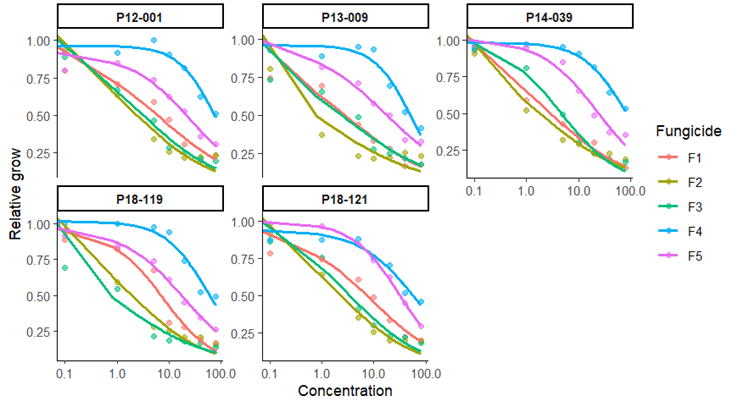
Figure 1 Concentration-relative growth curves for the fungicides evaluated on the five strains of the pathogen. F1: Cyproconazole 12% + Azoxystrobin 20%; F2: Benzovindiflupyr 5% + Picoxystrobin 10%; F3: Tebuconazole 25%; F4: Fluxapyroxad 33.3%; F5: Fluxapyroxad 7.7% + Pyraclostrobin 15.5% + Revysol 11.6%.
The fungicides Benzovindiflupyr 5% + Picoxystrobin 10% and Tebuconazole 25% show steeper slopes in most strains, indicating greater efficacy in reducing relative growth and lower estimated IC50 values. Conversely, the fungicides Fluxapyroxad 33.3% and Fluxapyroxad 7.7% + Pyraclostrobin 15.5% + Revysol 11.6% exhibit greater growth for all strains. The fungicide Cyproconazole 12% + Azoxystrobin 20% shows greater efficacy represented by reduction in relative growth for the older strains (P12-001, P13-009, and P14-039) but not for the more recent strains (P18-119 and P18-121).
Strain P18-119 shows more marked discrimination between fungicides, while the other strains exhibit curves closer to each other, indicating relatively homogeneous sensitivity among them.
Studies conducted by Boaretto et al. (2015) reported that of six Pyricularia oryzae isolates evaluated, five were highly sensitive and one was insensitive to Tebuconazole. Similarly, Cazón, Ascari, Santos, and Emerson Medeiros (2022) obtained IC50 values ranging from 0.003 to 1.188 μg ml⁻¹ for this fungicide, classifying strains as highly sensitive to moderately sensitive, which agrees with this study where four of the studied strains were classified as moderately sensitive and one as highly sensitive to tebuconazole with higher IC50 values (between 0.73 μg ml⁻¹ and 4.68 μg ml⁻¹).
Regarding fungicides belonging to the carboxamide group, Cazón et al. (2022) obtained IC50 values from 3.26 to 136 μg ml⁻¹ for Fluxapyroxad, classifying strains as moderately sensitive to insensitive. In this work, IC50 values for that active ingredient were from 54.25 to 87.05 μg ml⁻¹, being the highest for all evaluated strains.
On the other hand, the mixture of triazoles with strobilurins (Cyproconazole 12% + Azoxystrobin 20%) showed IC50 values between 2.53 to 9.53 μg ml⁻¹. Considering that Castroagudín et al. (2015) observed that the IC50 of the Pyricularia oryzae population for the fungicide Azoxystrobin was greater than 10 μg ml⁻¹, the observed IC50 values for the mixture are considered to be due to the triazole. Nevertheless, it is necessary to evaluate the sensitivity of Paraguayan strains to the active ingredients separately.
The same occurs with the product mixture of carboxamides and strobilurins, based on Benzovindiflupyr 5% + Picoxystrobin 10%, whose IC50 values ranged between 0.65 to 2.19 μg ml⁻¹ for the evaluated strains. Considering that Oliveira et al. (2015) reported cross-resistance to strobilurins in the Pyricularia oryzae population, and that Cazón et al. (2022) report IC50 values from 0.001 to 0.044 μg ml⁻¹ for Benzovindiflupyr, the IC50 values observed in this work are considered high compared to those reported by the aforementioned authors.
The product based on a triple mixture of active ingredients (Fluxapyroxad 7.7% + Pyraclostrobin 15.5% + Revysol 11.6%) showed IC50 values between 18.74 and 32.59 μg ml⁻¹, these values being higher than those observed for the triazole plus strobilurin and carboxamide plus strobilurin mixture products, indicating that the triple mixture might not be more effective for PoT control.
Figure 2 presents the marginal means of conidia ml⁻¹ counts of the studied strains for the evaluated fungicide products. Sporulation of all strains was observed at all concentrations and all evaluated fungicide products. This implies that none of the evaluated products completely inhibits sporulation.
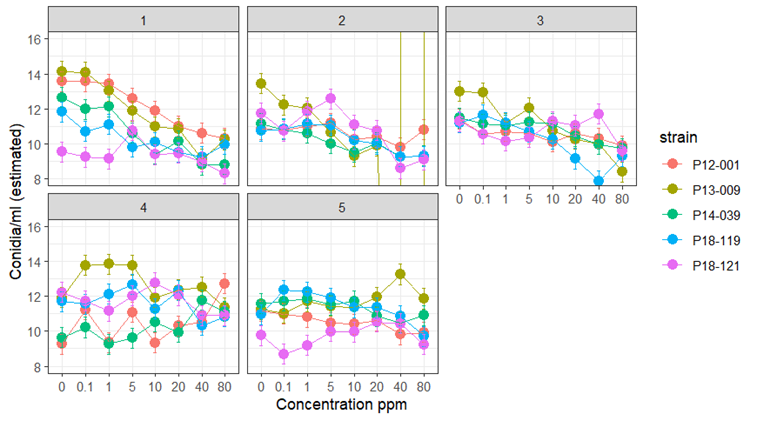
Figure 2 Estimated marginal means of conidia count (ml⁻¹) as a function of fungicide concentration for the five strains studied for each fungicide, fitted using a negative binomial regression model. The dots represent the estimated marginal means from the model. The vertical error bars indicate the 95% confidence intervals for each data point. Panels labeled 1 to 5 represent different fungicides: 1. Cyproconazole 12% + Azoxystrobin 20%; 2. Benzovindiflupyr 5% + Picoxystrobin 10%; 3. Tebuconazole 25%; 4. Fluxapyroxad 33.3%; 5. Fluxapyroxad 7.7% + Pyraclostrobin 15.5% + Revysol 11.6%. The colors distinguish the strains: P12-001 (red), P13-009 (olive green), P14-039 (blue green), P18-119 (light blue), P18-121 (magenta).
For the older strains (P12-001, P13-009, and P14-039), a significant dose-response effect was observed, where increasing fungicide concentrations resulted in a reduction in conidia ml⁻¹ (p < 0.05), but not for the more recent strains (P18-119 and P18-121), which maintain constant sporulation despite increasing concentrations. In general, strain sporulation showed differential sensitivity to the different fungicides. For fungicides 1, 2, and 3, a decreasing trend in conidia ml⁻¹ count was observed with increasing fungicide concentration. While for fungicides 4 and 5, the conidia ml⁻¹ count of most strains remained constant, suggesting that these products have lower control efficacy on pathogen sporulation. None of the fungicides achieved complete inhibition of strain sporulation at the highest concentration studied (80 μg ml⁻¹).
Strain P13-009, one of the oldest in the collection, was more consistent in conidia production at most concentrations, suggesting lower sensitivity (greater tolerance) to the evaluated fungicides. Similarly, the most recently isolated strains (P18-119 and P18-121) showed lower sensitivity to increasing concentrations.
It should be noted that this is the first work evaluating pathogen sporulation against fungicide products, since previous studies generally measure conidia germination (Dorigan et al., 2019; Poloni et al., 2021; D'Avila, Corsi de Filippi, & Café-Filho, 2021). Therefore, it would be important to consider both variables to accurately determine the efficacy of active ingredients for pathogen control.
Considering that commercial products were used to obtain the different concentrations, and also a reduced number of strains, it would be important to repeat this research using the active ingredients separately and a greater number of strains, in order to have a broader overview of what occurs with the pathogen population in Paraguay. Nevertheless, the results achieved in this work are key for monitoring the sensitivity of Paraguayan PoT strains to fungicides used in the field.
Considering the difference in sensitivity of the studied strains to the evaluated products and also that none completely inhibited sporulation (conidia ml⁻¹ quantity), these results should serve as a warning call for producers and field technicians. Special mention should be made of the identification of strains such as P13-009, which continue with high sporulation quantities under all treatments and may be important for future epidemics in the country.
The results of this work will serve as a reference for the sensitivity of Paraguayan PoT strains and continue monitoring the behavior of other strains against different active ingredients recommended for wheat disease control.
CONCLUSION
The Paraguayan Pyricularia oryzae strains studied in this work showed differential sensitivity to the evaluated fungicide products. The different strains demonstrated their ability to continue producing conidia at various concentrations of the used fungicides. None of the fungicide products completely inhibited strain sporulation.
REFERENCES
Boaretto, C., Nunes Maciel, J. L., Durante Danelli, A. L., Boller, W., y Cunha Fernandes, J. M. (2015). Sensibilidade in vitro de Pyricularia oryzae do trigo a fungicidas. EMBRAPA-Trigo. p.46. http://www.alice.cnptia.embrapa.br/alice/handle/doc/1020916 [ Links ]
Carmona, M., y Sautua, F. (2017). La problemática de la resistencia de hongos a fungicidas. Causas y efectos en cultivos extensivos. Agronomía y ambiente, 37 (1), 1-19. http://ri.agro.uba.ar/files/download/revista/agronomiayambiente/2017carmonamarcelo.pdf [ Links ]
Castroagudín, V. L., Ceresini, P. C., de Oliveira, S. C., Reges, J. T., Maciel, J. L., Bonato, A. L., Dorigan, A. F., & McDonald, B. A. (2015). Resistance to QoI Fungicides Is Widespread in Brazilian Populations of the Wheat Blast Pathogen Magnaporthe oryzae. Phytopathology, 105(3), 284-294. https://doi.org/10.1094/PHYTO-06-14-0184-R [ Links ]
Cazón, L. I., Ascari, J. P., Santos, G. B., é Emerson Medeiros, P. (2022) Differencial reponse to DMI, QoI and SDHI fungicides in wheat and signal grass blast populations from Minas Gerais, Brasil. Plant Pathology, 72 (3), 449-467. DOI:10.1111/ppa.13678 [ Links ]
Cruz, C. D., Santana, F., Todd, T., Maciel, J., Kiyuna, J., Baldelomar, D., Cruz, A., Lau, D., Seixas, C., Goulart, A., Sussel, A., Schipanski, C. A., Chagas, D. F., Coelho, M., Montecelli, T. D. N., Utiamada, C., Custodio, A. P., Rivadeneira, M. G., Bockus, W. W., & Valent, B. (2019). A multi-environment assessment of fungicide performance for managing wheat head blast (WHB) in Brasil and Bolivia. Tropical Plant Pathology , 44, 183-191. DOI: https://doi.org/10.1007/s40858-018-0262-9 [ Links ]
Cruz, C.D., & Valent, B. (2017). Wheat blast disease: danger on the move. Tropical Plant Pathology , 42, 210-222. Springer. DOI: 10.1007/s40858-017-0159-z [ Links ]
D`Avila, L.S., Corsi de Filippi, M.C., & Cafe-Filho, A. (2021). Sensitivity of Pyricularia oryzae populations to fungicides over a 26 year time frame in Brazil. Plant disease, 105 (6), 1771-1780. https://doi.org/10.1094/PDIS-08-20-1806-RE [ Links ]
Dominguez, J. A., Sautua, F. J., & Carmona, M. A. (2021). Sensitivity of Bipolaris sorokiniana to strobilurin, triazole, and carboxamide premixes. Archives of Phytopathology and plant protection, 54, 1764-1777. https://doi.org/10.1080/03235408.2021.1938920 [ Links ]
Dorigan, A. F., de Carvalho, G., Poloni, N. M., Negrisoli, M. M., Maciel, J. L. N., & Ceresisni, P. C. (2019). Resistance to triazole fungicides in Pyricularia species is associated with invasive plants from wheat fields in Brazil. Acta Scientiarum Agronomy, 41 (1), e39332. Doi: 10.4025/actasciagron.v41i1.39332 [ Links ]
Edgington, L.V., Khew, K.L., & Barrow, G.L. (1971). Fungitoxic spectrum of benzimidazole compounds. Phytopathology , 61, 42-44. [ Links ]
French, E. R., y Hebert, T. T. (1980). Métodos de investigación fitopatológica. Costa Rica. IICA, 289 p. [ Links ]
Fungicide Resistance Action Comitee (FRAC). (2018). Code List: F ungicides sorted by mode of action (including FRAC Code numbering). http://www.phi-base.org/images/fracCodeList.pdf [ Links ]
Kohli, M., Mehta, Y. R., Guzman, E., De Viedma, L., & Cubilla, L.E. (2011). Pyricularia blast- a threat to wheat cultivation. Czech Journal Genet Plant, 47, 130-134. https://www.agriculturejournals.cz/pdfs/cjg/2011/10/06.pdf [ Links ]
Kohli, M., Cazal, C.C., & Chávez, A. (2020). Integrated management of wheat blast disease, pp. 175-194. In: Kumar, S.; Kashyap, P.L.; & Singh, G.P. (eds). Wheat blast. Boca Raton. FL. CRC Press. https://doi.org/10.1201/9780429470554 [ Links ]
Marangoni, M., Nunes, M., Fonseca, N., & Mehta, Y.R. (2013) Pyricularia blast on white oast- a new threat to wheat cultivation. Tropical Plant Pathology , 38,3 https://doi.org/10.1590/S1982-56762013005000004 [ Links ]
Oliveira, S. C., Castroagudín, V. L., Nunes Maciel, J. L., dos Santos Pereira, D. A., é Ceresini, P. C. (2015). Resistência cruzada aos fungicidas IQo azoxistrobina e piraclostrobina no patógeno da brusone do trigo Pyricularia oryzae no Brasil. Summa Phytopathologica, 41 (4), 298-304. https://www.scielo.br/j/sp/a/9PH99LmWFwZqgw8KL4ff74m/?lang=pt [ Links ]
Pieck, M., Ruck, A., Farman, M., Peterson, G., Stack, J., Valent, B., & Pedley, K. (2017). Genomics-based marker discovery and diagnostic assay development for wheat blast. Plant Disease, (101), 1, 103-109. https://pubmed.ncbi.nlm.nih.gov/30682315/ [ Links ]
Poloni, N. M., Carvalho, G., Nunes Campos Vicentini, S., Dorigan, A. F., Nunes Maciel, J. L., McDonald, B. A. M., Intra Moreira, S., Hawkins, N., Fraaije, B.A, Kelly, D.E, Kelly, S.L., & Ceresini, P.C. (2021). Widespread distribution of resistance to triazole fungicides in Brazilian populations of the wheat blast pathogen. Plant Pathology , 70 (2), 436-448. https://doi.org/10.1111/ppa.13288 [ Links ]
Funding: Paraguayan Chamber of Grain and Oilseed Exporters and Traders (CAPECO - Cámara Paraguaya de Exportadores y Comercializadores de Cereales y Oleaginosas).
Data availability: The complete dataset supporting the results of this study is available upon request to the corresponding author. The dataset is not publicly available because it forms part of future publications.
Responsible editor:Arnaldo Esquivel-Fariña https://orcid.org/0000-0002-7727-5243. Universidad Nacional de Asunción, Facultad de Ciencias Agrarias. San Lorenzo, Paraguay.
Received: August 06, 2025; Accepted: December 05, 2025; Published: December 16, 2025
 Este es un artículo publicado en acceso abierto bajo una licencia Creative Commons
