




Services on Demand
Journal

Article
 text in
 English (pdf)
 Article in xml format
 Article references

 Automatic translation
 Send this article by e-mail
Indicators
-
 Cited by SciELO
Related links
-
 Similars in
SciELO
Share

 Permalink

Investigación Agraria
On-line version ISSN 2305-0683
Investig. Agrar. vol.27 no.2 San Lorenzo 2025 Epub Dec 12, 2025
https://doi.org/10.18004/investig.agrar.2025.2702840
Artículo científico
Physical properties and utilization potential of Eucalyptus urophylla × E. camaldulensis wood as a function of stem height
1
2
 http://orcid.org/0000-0003-3784-0110
1
http://orcid.org/0000-0002-4725-7263
1Universidad Nacional de Asunción, Facultad de Ciencias Agrarias. San Lorenzo, Paraguay.
2Sistema Nacional de Investigadores de Paraguay, Consejo Nacional de Ciencia y Tecnología. Asunción, Paraguay.
Forest plantations with the Eucalyptus genus are widely distributed due to the versatility of species and derived hybrids grouped in this taxon. Paraguay has more than 200,000 hectares planted, predominantly with eucalyptus, and the national forest industry uses a high percentage of wood from exotic species as raw material. To optimize the utilization of these forest resources, it is essential to characterize the physical properties of wood according to its position in the stem. With the objective of determining the physical properties of Eucalyptus urophylla × E. camaldulensis wood at different stem heights and establishing its utilization potential, wood samples were obtained at 25, 35, 45, and 55% of the total height from seven-year-old individuals from a commercial plantation in Caazapá. Moisture content was determined according to UNE EN 13183-1 standard, green and basic apparent specific weight according to NP No. 115 standard, and anisotropy coefficient according to NP No. 116 standard. ANOVA at 5% significance and regression analysis demonstrated that the sampling height level was significant for the anisotropy coefficient and basic apparent specific weight, respectively. These findings suggest that wood can be classified for utilization in the pulp industry and in structural products according to the height of material extraction.
Keywords: density; moisture content; forest industry; eucalyptus; anisotropy
Las plantaciones forestales con el género Eucalyptus se encuentran ampliamente difundidas debido a la versatilidad de las especies e híbridos derivados agrupados en este taxón. Paraguay posee más de 200.000 hectáreas plantadas, predominantemente con eucalipto, y la industria forestal nacional emplea como materia prima un elevado porcentaje de madera proveniente de especies exóticas. Para optimizar el aprovechamiento de estos recursos forestales, es fundamental caracterizar las propiedades físicas de la madera según su posición en el fuste. Con el objetivo de determinar las propiedades físicas de la madera de Eucalyptus urophylla × E. camaldulensis a diferentes alturas del fuste y establecer su potencial de aprovechamiento, se obtuvieron muestras de madera al 25, 35, 45 y 55% de la altura total de individuos de siete años provenientes de una plantación comercial de Caazapá. Se determinó el contenido de humedad según norma UNE EN 13183-1, el peso específico aparente verde y básico según norma NP núm. 115, y el coeficiente de anisotropía según norma NP núm. 116. El ANOVA al 5% de significancia y el análisis de regresión demostraron que el nivel de altura de muestreo fue significativo para el coeficiente de anisotropía y el peso específico aparente básico, respectivamente. Estos hallazgos sugieren que la madera puede ser clasificada para su aprovechamiento en la industria de la celulosa y en productos estructurales según la altura de obtención del material.
Palabras claves: densidad; contenido de humedad; industria forestal; Eucalipto; anisotropía
INTRODUCTION
Worldwide, there are 4,060 million hectares of forest, of which 131 million correspond to forest plantations. South America has the largest area of plantations where introduced species predominate (FAO, 2020). Species of the Eucalyptus genus are native to Australia and widely cultivated in South America. Wood from these species and their hybrids possesses qualities that allow their use as raw material in the paper, construction, and energy industries (charcoal, firewood) (Telles et al., 2018). Certain species are widely used for extracting essential oils from their leaves, with medicinal, industrial, and perfumery applications (Vitti & Brito, 2003). Wood from the Eucalyptus urophylla × E. camaldulensis hybrid stands out for its energy uses (Fioravante Reis & Paludzyszyn Filho, 2011; Barreiros, Ribeiro, Dias, Gouvea, Reis & Silva, 2021), making it the subject of studies characterizing its physical and chemical properties considering factors such as plantation age and site, among others.
Wood possesses certain properties, which are grouped into chemical, anatomical, physical, and mechanical. Knowledge of these allows proper classification based on the final use intended for the material. Physical properties are grouped into moisture content, specific weight (real and apparent), swelling, shrinkage, among others (Suirezs & Berger, 2009). Determination and knowledge of these properties is fundamental, especially in young plantations due to the need to utilize raw material in early stages to obtain various types of products or to evaluate the incidence of plantation spacing on wood, among other factors (Hsing, Paula & Paula, 2016).
Among the most important physical properties for wood characterization are shrinkage, density, and moisture content. Shrinkage is the decrease in wood volume when losing hygroscopic water, below the fiber saturation point, to the anhydrous state. It is a parameter that allows knowing the dimensional stability of raw material in its cutting planes (tangential, longitudinal, and radial), as well as the wood's retractility or shrinkage coefficient (Suirezs & Berger, 2009). The value of dimensional variation in wood's tangential and radial planes is used to calculate the material's anisotropy coefficient. The coefficient is associated with a scale that allows classifying wood according to its tendency to suffer deformations and cracks, qualities of interest according to the use intended for the material (Calvo et al., 2007).
On the other hand, specific weight or density is one of wood's most important qualities. From this, it is possible to classify raw material into heavy, light, or very light wood, which in turn translates to its workability capacity. Furthermore, this property is closely associated with other physical and mechanical characteristics of wood, suggesting the quality or use that can be attributed to the material (Suirezs & Berger, 2009). Wood density, like other properties, is influenced by the site where the species develops (Labbé, Droppelmann, Balocchi & Peredo, 2013). Even in the same species, these characteristics can be expressed differently as a consequence of cultivation site variation (Calvo et al., 2007).
Wood moisture content is the amount of water that constitutes its structure. It is a quality that influences raw material in terms of quality, applications, and wood behavior in events such as resistance to biological agent attack, its physical and mechanical properties, product elaboration, and cellulose yield, among others (Suirezs & Berger, 2009).
According to data published in 2021 by the National Forest Institute (INFONA), Paraguay has an extension of 206,470.33 hectares of plantations, predominantly of Eucalyptus genus species. The same entity reports, in data relative to the 2022 forest industries census, that the highest percentage of raw material used comes from exotic species, with 68% of the total, while the rest corresponds to native species with various applications. These data support the importance of knowledge of wood technological properties for optimal commercial utilization.
Knowledge of physical properties of a species cultivated in a specific site allows guiding its uses and applications in developing new products, as well as making silvicultural decisions to maximize economic benefit of plantations according to their location. In this context, and considering the importance of eucalyptus in Paraguay, the objective of the research was to determine the physical properties of Eucalyptus urophylla × E. camaldulensis wood at different stem heights and establish its utilization potential.
MATERIALS AND METHODS
The study was conducted in a pure even-aged stand of Eucalyptus urophylla × E. camaldulensis, commercially known as VM01 and established in 2015. The stand is located at Curuzú ranch, Coronel Maciel district, Caazapá department, Paraguay, where the average annual minimum temperature is 21.8°C and the maximum is 40.6°C, the average relative humidity is 70.5%, and precipitation is 1,495 mm/year (DINAC, 2022). The initial planting density was 1,315 trees ha⁻¹, with a spacing of 4 m × 1.9 m, managed for energy biomass production without pruning or thinning.
Diameter at breast height (DBH) values were obtained from measurements of 675 trees in the stand (Table 1). Data were recorded in the Inventree® application, exported to Excel format for processing, and grouped for determining frequency distribution and diameter classes. Based on this data, six individuals of E. urophylla × E. camaldulensis representative of different diameter classes were felled.
Table 1 Initial dendrometric variables of Eucalyptus urophylla × E. camaldulensis VM01 individuals selected for the study. Caazapá, Paraguay, 2022.
| Individuals | 1 | 2 | 3 | 4 | 5 | 6 | |
|---|---|---|---|---|---|---|---|
| DBH (cm) | 18,1 | 17,4 | 18,6 | 11,6 | 21,3 | 18,8 | |
| Total height (m) | 22,50 | 22,4 | 23,4 | 16,5 | 21,35 | 23,6 | |
| Diameter classes [LI - LS] (cm) | 11,4 - 13,4 | 15,6 - 19,7 | 19,8 - 21,8 | ||||
| 11,6 | 18,2 | 21,3 | |||||
| Rf (%) | 8 | 48 | 1,2 | ||||
Where: DBH: diameter at breast height, ht: total height, LI: lower limit, LS: upper limit, Rf: relative frequency
A completely randomized design arranged in split plots was used. Table 2 presents the experiment description.
Table 2 Description of split-plot experimental design. Caazapá, Paraguay, 2022.
| Design | Completely randomized split plots | ||
|---|---|---|---|
| Factor | Level | Description | |
| Main plot | |||
| Material genético | Eucalyptus urophylla × Eucalyptus camaldulensis | 6 individuals evaluated | |
| Subplot | |||
| Longitudinal position | 4 levels | Percentage of total stem height (%) | |
| Level 1 | 25% | ||
| Level 2 | 35% | ||
| Level 3 | 45% | ||
| Level 4 | 55% | ||
From each individual, cross-sections were extracted according to the stem division method by Hohenadl (Prodan, Peters, Cox, & Real, 1997) in the established proportions of the total height of each tree in meters. Samples were identified and coded in the field, packed, and sent to the Wood and Derivatives Quality Laboratory of the Forest Engineering Program, FCA/UNA. In the carpentry workshop, the discs were debarked and prepared, after which test specimens were extracted for the corresponding analytical determinations.
All determinations were performed in triplicate for each parameter evaluated, using a Shimadzu UX6200H analytical balance with 0.01 g precision.
Determination of green and basic apparent specific weight
It was determined according to Paraguayan standard NP No. 115 (Wood: Method for determining apparent specific weight) (INTN, 1974). Volume was determined by the water immersion method. Green apparent specific weight was calculated using equation (1):
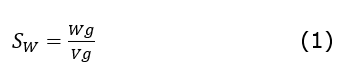
Where:
SW: Green apparent specific weight (g cm⁻³)
Wg: Weight of specimen in green state (g)
Vg: Volume of specimen in green or saturated state (cm³)
Once the volume of specimens in green state was determined, they were placed in an oven at a temperature of 103±2°C until constant weight was obtained. For calculating basic apparent specific weight, equation (2) was used:

Where:
SWb: Basic apparent specific weight (g cm⁻³)
Wo: Weight of specimen in oven-dry state (g)
Vg: Volume of specimen in green or saturated state (cm³)
Determination of moisture content by the oven-drying method
It was performed according to European standard UNE EN 13183-1 (Determination of moisture content of sawn timber by oven-drying method), applying equation (3):

Where:
ω: Moisture content expressed in %
mi: Initial mass of specimen (g)
mo: Oven-dry mass of specimen (g)
Determination of shrinkage anisotropy coefficient
For determining the anisotropy coefficient, rectangular prisms were extracted from the cross-sections in which the tangential, radial, and longitudinal planes were identified. Paraguayan standard NP No. 116 (Wood: Method for determining shrinkage) was used (INTN, 1974).
Total tangential shrinkage was calculated according to equation (4):

Stt: Tangential shrinkage from green state (MC >30%) to oven-dry state (MC = 0%), expressed in %
dgt: Tangential dimension in green state (MC >30%) (cm)
dodt: Tangential dimension in oven-dry state (cm)
Total radial shrinkage was calculated according to equation (5):

Where:
Srt: Radial shrinkage from green state (MC >30%) to oven-dry state (MC = 0%), expressed in %
dgr: Radial dimension in green state (MC >30%) (cm)
dodr Radial dimension in oven-dry state (cm)
With the radial and tangential shrinkage values, the Anisotropy coefficient (Ac) was calculated using equation (6):
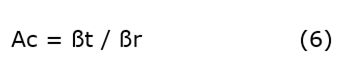
Where:
Ac: Shrinkage anisotropy coefficient
ßt: Tangential shrinkage
ßr Radial shrinkage
Data processing was performed using InfoStat® statistical software. Data were subjected to F and t tests, as well as ANOVA analysis of variance. When interaction between factors (longitudinal position and diameter classification) was identified, they were compared using Tukey's test. Regression models were proposed for those parameters that presented significant differences with respect to stem height percentage, considering a significance level of 5%.
RESULTS AND DISCUSSION
The results obtained for each of the physical properties evaluated are presented below, analyzing the effects of sampling height on each parameter and discussing their implications for the potential utilization of wood.
Determination of green apparent specific weight
The analysis of variance for the green apparent specific weight parameter is presented in Table 3.
Table 3 Green apparent specific weight averages (g·m⁻³) in wood samples of Eucalyptus urophylla × Eucalyptus camaldulensis at 7 years. Caazapá, Paraguay, 2022.
| Height level (% total height) B | |||||
|---|---|---|---|---|---|
| Diameter classes [LI - LS] A | 25 | 35 | 45 | 55 | Total marginal average |
| 11,4 - 13,4 | 1269,59 a | 1329,69 a | 1264,76 a | 1357,04 a | 1305,27 A |
| 15,6 - 19,7 | 1012,55 a | 1021,22 a | 1031,11 a | 1039,77 a | 1026,16 A |
| 19,8 - 21,8 | 1083,22 a | 1119,31 a | 1119,2 a | 1128,8 a | 1112,63 A |
| Treatments | F-value (5%) | Contrasts | F-value (5%) | Regression | T-value (5%) |
| A | 23,23* | Linear | F=2,34 ns | Constant | ns |
| B | 1,24ns | Quadratic | F=2,1x10⁻³ ns | Slope | ns |
| A*B | 0,39ns | Cubic | F=1,37ns | ||
| CV (%) | 5,42 | ||||
Obs.: Means with common letters are not significantly different (p<0.05) for comparisons of means between diameter classes.
Means with common letters are not significantly different (p<0.05) for interactions:
Diameter classes × Height level (% total height).
LI: Lower limit of diameter class.
LS: Upper limit of diameter class.
A: Diameter class factor.
B: Height factor.
AB: Interaction between factors.
F-value: Test statistic.
T-value: Test statistic.
"ns": not significant.
*: significant.
CV (%): coefficient of variation of the ANOVA model.
Determination of basic apparent specific weight
According to ANOVA, the sampling height factor showed significant effect on basic apparent specific weight. The contrast analysis is presented in Table 4.
Table 4 Basic apparent specific weight averages (kg·m⁻³) in wood samples of Eucalyptus urophylla × Eucalyptus camaldulensis at 7 years. Caazapá, Paraguay, 2022.
| Height level (% total height) B | |||||
|---|---|---|---|---|---|
| Diameter classes A [LL - UL] | 25 | 35 | 45 | 55 | Total marginal average |
| 11,4 - 13,4 | 574,54 a | 567,06 a | 592,26 a | 620,33 a | 588,55 A |
| 15,6 - 19,7 | 487,01 b | 479,84 b | 497,88 b | 518,9 b | 495,91 B |
| 19,8 - 21,8 | 513,84 b | 530,24 b | 532,07 b | 547,56 b | 530,93 B |
| Treatments | F-value (5%) | Contrasts | F-value (5%) | Regression | T-value (5%) |
| A | 15,79* | Linear | F=11,97* | Constant | 10,66* |
| B | 4,55* | Quadratic | F=1,64ns | Slope | 1,15ns |
| A*B | 0,32ns | Cubic | F=0,05ns | ||
| CV (%) | 4,55 | r2=0,1162 | |||
Obs.: Means with common letters are not significantly different (p<0.05) for comparisons of means between diameter classes.
Means with common letters are not significantly different (p<0.05) for interactions:
Diameter classes × Height level (% total height).
LL: Lower limit of diameter class.
UL: Upper limit of diameter class.
A: Diameter class factor.
B: Height factor.
AB: Interaction between factors.
F-value: Test statistic.
T-value: Test statistic.
"ns": not significant.
*: significant.
CV (%): coefficient of variation of the ANOVA model.

Figure 1 Regression of basic apparent specific weight variable as a function of stem height of 7-year-old Eucalyptus urophylla × Eucalyptus camaldulensis individuals. Caazapá, Paraguay, 2022.
The regression analysis for the height level factor is presented in Figure 1. The regression line represents a direct relationship between stem height and basic apparent specific weight of wood. That is, for every 10% increase in individual height, basic apparent specific weight will present an increase pattern of 12.6 g cm⁻³. A similar longitudinal increase pattern was observed by Labbé et al. (2013) in E. globulus woods, where they observed a density increase from base to apex of studied individuals, a finding consistent with the results of this work.
Suirezs and Berger (2009) determined a wood classification according to basic apparent density ranges, considering light woods as those with densities between 351 and 550 g cm⁻³, and semi-heavy woods as those with densities between 551 and 750 g cm⁻³. According to these authors and the values obtained in this work, Eucalyptus urophylla × E. camaldulensis wood obtained in the Caazapá area could be classified as light to semi-heavy wood, a result that agrees with what is reported in the literature for other eucalyptus species (Monteoliva, Barotto & Fernández, 2015; Gauna et al. 2022).
Basic apparent specific weight, or basic density, is an important property for cataloging energy biomass quality (Brun et al., 2018; da Cunha et al., 2021). Characterization works for energy utilization purposes are well developed in eucalyptus. Brun et al. (2018) evaluated this parameter in wood from three genetic materials of 4.5-year-old Eucalyptus sp., obtaining values of 490, 500, and 550 g cm⁻³, respectively.
Barbosa et al. (2023) determined an average value of 483 g cm⁻³ for six-year-old E. urophylla × E. camaldulensis wood under coppice management. Quinhones (2011) evaluated physical characteristics of seven-year-old E. urophylla × E. camaldulensis wood, obtaining an average of 560 g cm⁻³ for basic apparent specific weight of the material. Barreiros et al. (2021) obtained an average of 492 g cm⁻³ for clones of the same hybrid with an average age of seven years, classifying the wood as appropriate for energy purposes. Lima et al. (2020) evaluated this property in Eucalyptus spp. clones and suggested that materials with densities greater than 500 g cm⁻³ are ideal for charcoal production. The values of 588.55, 495.91, and 530 g cm⁻³ obtained are consistent with available literature.
It is important to mention that higher basic apparent specific weight is expected to result in higher combustion power. However, high basic wood densities cause greater difficulties in the initial direct fuel burning process, so a density interval between 650 and 800 g cm⁻³ is suggested for medium to hard woods (Barreiros et al., 2021). Protásio et al. (2021) reached a similar criterion from studies of Eucalyptus spp. wood quality parameters, concluding that woods with basic densities less than or equal to 500 g cm⁻³ are not recommendable as raw material for obtaining charcoal for metallurgical purposes.
On the other hand, in technological evaluation of wood as raw material for obtaining kraft cellulose, basic density is used as an important quality parameter, along with other properties such as material chemistry and plantation age, among others (Doldán, Fariña & Tarigo, 2008; de Morais, Longue Júnior, Colodette, Morais & Jardim, 2017). De Morais et al. (2017) determined that basic densities between 460 and 480 g cm⁻³ are adequate indicators for wood from E. grandis and E. urograndis clones aged between one and eight years for pulping purposes.
Values greater than 570 g cm⁻³ indicate a decrease in pulping capacity by the kraft method for eucalyptus woods according to Doldán et al. (2008), who evaluated basic densities of five Eucalyptus spp. species aged between eight and 10 years, obtaining values distributed in ranges from 423 to 559 g cm⁻³. They determined the highest gross cellulose yield average of 54.5% for E. globulus at an average basic density of 520 g cm⁻³ of the material.
While basic wood density is an extremely important parameter when evaluating the quality of genetic material for energy or pulping purposes, this characteristic must be accompanied by other determinations such as calorific capacity, fixed carbon content, chemical characterization, pulping yield, and paper properties, among others, according to the plantation objective.
Determination of anisotropy coefficient
The anisotropy coefficient is obtained by calculating the quotient between shrinkage of the wood's tangential plane and shrinkage in the radial plane, and is a parameter that allows knowing the dimensional stability of wood, important information for structural applications and for the furniture industry. Suirezs and Berger (2009) establish that anisotropy values between 1.2 and 1.5 are considered excellent for uses where warping is not permitted. From 1.6 to 1.9 the wood is considered normal, and it presents limitations in its applications when the anisotropy value is greater than 2.0. The wood shrinkage anisotropy coefficient values presented significant effects according to sampling height levels in the ANOVA analysis. The data are reported in Table 5.
Table 5 Anisotropy Coefficient (Ac) averages in wood samples of Eucalyptus urophylla × Eucalyptus camaldulensis at 7 years. Caazapá, Paraguay, 2022.
| Height level (% total height) B | |||||
|---|---|---|---|---|---|
| Diameter classes A [LL---UL] | 25 | 35 | 45 | 55 | Total marginal average |
| 11,4 - 13,4 | 1,96 a | 2,37 a | 1,9 a | 1,59 a | 1,95 A |
| 15,6 - 19,7 | 1,96 a | 1,75 a | 1,66 a | 1,44 a | 1,70 A |
| 19,8 - 21,8 | 1,88 a | 2,01 a | 1,63 a | 1,7 a | 1,81 A |
| Treatments | F-value (5%) | Contrasts | F-value (5%) | Regression | T-value (5%) |
| A | 0,93ns | Linear | F=9,22* | Constant | 11,37* |
| B | 4,16* | Quadratic | F=1,66ns | Slope | -2.75* |
| A*B | 0,80ns | Cubic | F=1,61ns | ||
| CV (%) | 16,76 | r2=0,4309 | |||
Obs.: Means with common letters are not significantly different (p<0.05) for comparisons of means between diameter classes.
Means with common letters are not significantly different (p<0.05) for interactions: Diameter classes × Height level (% total height).
LL: Lower limit of diameter class.
UL: Upper limit of diameter class.
A: Diameter class factor.
B: Height factor.
AB: Interaction between factors.
F-value: Test statistic.
T-value: Test statistic.
"ns": not significant.
*: significant.
CV (%): coefficient of variation of the ANOVA model.
The regression analysis for the height level factor is presented in Figure 2.
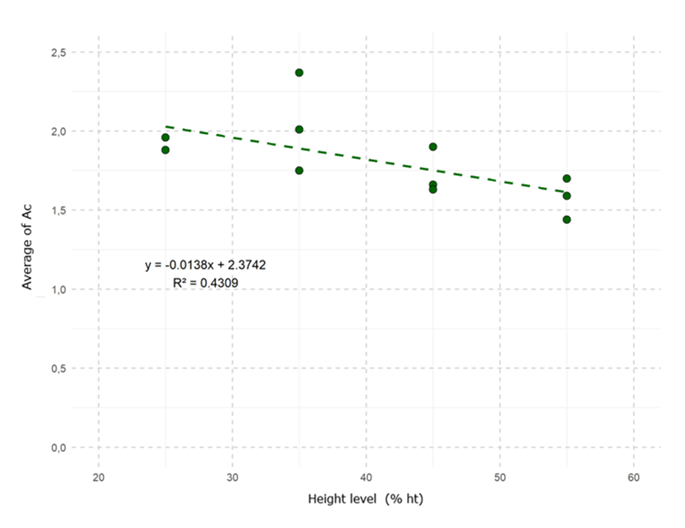
Figure 2 Regression of Anisotropy Coefficient (Ac) variable as a function of stem height of 7-year-old Eucalyptus urophylla × Eucalyptus camaldulensis individuals. Caazapá, Paraguay, 2022.
The regression line shows an inverse trend between stem height and wood anisotropy coefficient. For every 10% increase in individual height, the anisotropy coefficient presents a decrease pattern of 0.11. Calvo et al. (2007) found variations in wood anisotropy coefficient as a function of stem height in 17-year-old Eucalyptus grandis specimens cultivated in Argentina, where the coefficient presented a decreasing trend with increasing height, a finding congruent with the results of this work. Cardoso, Cagno, Cárdenas and Gatto (2013) establish a wood classification according to their anisotropy coefficients: in general, values greater than 2 suggest unstable woods or woods with difficulties according to material applications.
Considering the values obtained in determining the anisotropy coefficient, it can be considered that seven-year-old Eucalyptus urophylla × E. camaldulensis wood is normal to unstable in terms of dimensional stability (Suirezs & Berger, 2009). From the regression analysis, a trend of decreasing anisotropy coefficient with height is observed, suggesting that wood could increase its dimensional stability with stem height. This fact must be corroborated by conducting physical-mechanical tests on wood obtained from the highest zones of the stem.
Wood moisture content
According to the analysis of variance, height level was not a significant source of variation for moisture content. The contrasts are presented in Table 6.
Table 6 Moisture content averages (MC%) in wood samples of Eucalyptus urophylla × Eucalyptus camaldulensis at 7 years. Caazapá, Paraguay, 2022.
| Height level (% total height) | |||||
|---|---|---|---|---|---|
| Diameter classes [LL---UL] | 25 | 35 | 45 | 55 | Total marginal average |
| 11,4 - 13,4 | 115,16 a | 126,45 a | 123,59 a | 116,34 a | 120,39 A |
| 15,6 - 19,7 | 102,04 a | 102 a | 101,56 a | 95,56 a | 100,29 A |
| 19,8 - 21,8 | 115,81 a | 116,21 a | 106,56 a | 105,78 a | 111,09 A |
| Tratamientos | F-value (5%) | Contrasts | F-value (5%) | Regression | T-value (5%) |
| A | 29,04* | Linear | F=1,17 ns | Constant | ns |
| B | 0,82ns | Quadratic | F=1,11ns | Slope | ns |
| A*B | 0,32ns | Cubic | F=0,19ns | ||
| CV (%) | 11,02 | ||||
Obs.: Means with common letters are not significantly different (p<0.05) for comparisons of means between diameter classes.
Means with common letters are not significantly different (p<0.05) for interactions: Diameter classes × Height level (% total height).
LL: Lower limit of diameter class.
UL: Upper limit of diameter class.
A: Diameter class factor.
B: Height factor.
AB: Interaction between factors.
F-value: Test statistic.
T-value: Test statistic.
"ns": not significant.
*: significant.
CV (%): coefficient of variation of the ANOVA model.
Moisture content is closely related to the initial weight of harvested wood (Omonte, Sáez-Carrillo, Ananías & Valenzuela-Hurtado, 2019). From a technological point of view, this parameter is related to density, storage, and transportation, among other factors. Material resistance to attack by xylophagous organisms is associated with the presence of water within wood (Doldán, 2003). Moisture content values greater than 100% in the studied samples suggest that wood from this species possesses high saturation in its green state. In industry, initial wood moisture content is an important factor in drying process decision-making, since the material is prone to suffering deformations, among other phenomena, making its final utilization difficult (Touza & Pedras Saavedra, 2002).
CONCLUSIONS
Moisture content, green apparent specific weight, basic apparent specific weight, and anisotropy coefficient of seven-year-old Eucalyptus urophylla × E. camaldulensis VM01 wood obtained in Coronel Maciel district, Caazapá department were determined. The sampling height factor was significant for the physical parameters anisotropy coefficient and basic apparent specific weight.
The basic apparent specific weight values obtained showed that this species is suitable for use in the charcoal production industry and presents potential for utilization for cellulose extraction purposes according to height. The anisotropy coefficient showed a reduction as stem height increased.
Based on these results, studies on determination of physical-mechanical properties could be expanded to explore possible structural applications of wood from the upper zones of individuals.
ACKNOWLEDGMENTS
To Felber Forestal company for providing the samples evaluated in this work. To Forest Engineers Oscar Vera and Armando Barúa for their support in sampling
REFERENCES
Asociación Española de Normalización (AENOR). (2002). Contenido de humedad de una pieza de madera aserrada. Parte 1: Determinación por el método de secado en estufa. Norma UNE EN 13183-1:2002. Madrid, España: AENOR, 8 p. https://www.une.org/encuentra-tu-norma/busca-tu-norma/norma?c=N0027392 [ Links ]
Barbosa dos Santos Júnior, C., De Mendoza, Z. M. dos S. H., dos Santos Elias, M. P., De Matos, S. E., Borges, P. H. de M., Morais y P. H. de M. (2023). Características tecnológicas do híbrido “Urocam” em regime de talhadia. Brazilian Journal of Development, 9(4), 13918-13928. https://doi.org/10.34117/bjdv9n4-095. [ Links ]
Barreiros, R. M., Ribeiro, G. P., Dias, K. B., Gouvea, C. F., Reis, A. M. F. y Silva, G. C. (2021). Potencialidade energética da madeira de três espécies de eucalipto. São Paulo: Editora Científica Digital, p. 146-164. https://dx.doi.org/10.37885/210203332. [ Links ]
Brun, E. J., Bersch, A. P., Pereira, F.A., Agostinho, S. D., de Barba, Y. R. y Dorini Junior, J. R. (2018). Diameter structure in a community of shrub-tree Caatinga, municipality of Floresta, state of Pernambuco, Brazil (en linea). Floresta, 48(1), 87-92. https://doi.org/10.5380/rf.v48i1.51673 [ Links ]
Calvo, C. F., Cotrina, A. D., Cuffre, A. G., Ott, M., Piter, J. C., Stefani, P . M., Torran, E. A. y Vivian, A. (2007). Propiedades de hinchamiento y contracción en la madera de Eucalyptus grandis de Argentina. Revista Madeira Arquitetura & Engenharia, 8(20), 59-69. https://notablesdelaciencia.conicet.gov.ar/bitstream/handle/11336/75599/CONICET_Digital_Nro.00e584ae-4c45-4472-9fe5-a103e8f8be33_A.pdf?sequence=2&isAllowed=y [ Links ]
Cardoso, A., Cagno, M., Cárdenas, P. y Gatto, F. (2013). Contracción, hinchamiento y peso específico aparente de madera de eucalipto colorado (Eucalyptus tereticornis Smith). INNOTEC, 8(1), 5-12. https://silo.uy/vufind/Record/LATU_48f0b3addecdd21f0452904d0b1e5010 [ Links ]
da Cunha, T. Q. G., Santos, A. C., Novaes, E., Hansted, A. L. S., Yamaji F. M. y Sette, C. R. (2021). Eucalyptus expansion in Brazil: energy yield in new forest frontiers. Biomass and Bioenergy, 144, 105900. https://doi.org/10.1016/j.biombioe.2020.105900. [ Links ]
de Morais, P. H. D., Longue Júnior, D., Colodette, J. L., Morais, E. H. D. C. y Jardim, C. M. (2017). Influência da idade de corte de clones de Eucalyptus grandis e híbridos de Eucalyptus grandis x Eucalyptus urophylla na composição química da madeira e polpação kraft. Ciencia Florestal , 27(1), 237-248. https://doi.org/10.5902/1980509826462. [ Links ]
DINAC (Dirección Nacional de Aeronáutica Civil). (2022). Anuario meteorológico 2022. Asunción: DINAC, 79 p. [ Links ]
Doldán, J. (2003). Indicadores de calidad de madera Eucalyptus grandis de Río Negro, Uruguay: contenido de humedad, densidad, contracción y largo de fibras. Proyecto de Tecnología de Ensayo de Productos Forestales LATU-JICA (1998-2003). Montevideo, Laboratorio Tecnológico del Uruguay, 42 p. (Informe de Investigación.Series Forestales, n° 9). https://catalogo.latu.org.uy/opac_css/index.php?lvl=notice_display&id=3867 [ Links ]
Doldán, J., Fariña, I. y Tarigo, F. (2008). Utilización de Eucalyptus spp. alternativas de plantaciones uruguayas para pulpa Kraft. INNOTEC , (3), 30-34. https://doi.org/10.26461/03.04 [ Links ]
Telles, P. E., Paludzyszyn Filho, E., Magalhães Esteves, W. L. y Burigo Vandresen, P. (2018). Melhoramento genético de eucaliptos subtropicais: contribuições para a espécie Eucalyptus badjensis. Colombo: Embrapa Floresta s http://www.infoteca.cnptia.embrapa.br/handle/item/221 [ Links ]
FAO (Organización de las Naciones Unidas para la Alimentación y la Agricultura). (2020). Evaluación de los recursos forestales mundiales 2020. Roma: FAO. https://doi.org/doi.org/10.4060/ca8753es [ Links ]
Fioravante Reis, C. A. y Paludzyszyn Filho, E. (2011). Estado da arte de plantios com espécies florestais de interesse comercial para o Mato Grosso. Colombo: Embrapa Floresta s. 65 p. (Documentos, 215). https://www.infoteca.cnptia.embrapa.br/bitstream/doc/898075/1/Doc215.pdf [ Links ]
Gauna, J. M., Raffaeli, N., Harrand, L., Tonello, M. L., Harrand, L. , Ciro, M. A... Barotto, A. J. (2022). Potencial de especies, clones puros e híbridos de eucaliptos para elaboración de carbón vegetal. In Jornadas Forestales de Entre Ríos (36, 2022, Concordia, Argentina). https://www.researchgate.net/publication/364348131 [ Links ]
Hsing, T. Y., Paula, N. F. y Paula, R.C. (2016). Características dendrométricas, químicas e densidade básica da madeira de híbridos de Eucalyptus grandis X Eucalyptus urophylla. Ciência Floresta l, 26(1), 273-283. [ Links ]
INFONA (Instituto Forestal Nacional). (2022). Departamento de Industria Forestal. Actualización del Censo de Industrias Forestales. Asunción: INFONA, 5 p. https://nube.infona.gov.py/index.php/s/bXZ3PeiPwBggL3L?path=%2FCENSO%20DE%20INDUSTRIAS%20FORESTALES#pdfviewer [ Links ]
INTN (Instituto Nacional de Tecnología, Normalización y Metrología, Paraguay). (1974). Método de determinación del peso específico aparente. Norma NP n° 115:1974. Asunción : INTN. https://normas.intn.gov.py/cgi-bin/koha/opac-detail.pl?biblionumber=138 [ Links ]
INTN (Instituto Nacional de Tecnología, Normalización y Metrología, Paraguay). (1974). Método de determinación de contracción. Norma NP n° 116:1974. Asunción: INTN. https://normas.intn.gov.py/cgi-bin/koha/opac-detail.pl?biblionumber=139 [ Links ]
Labbé, R., Droppelmann, F., Balocchi, C. y Peredo, M. (2013). Variación de la densidad de la madera y rendimiento pulpable en clones de eucalyptus globulus evaluado con espectroscopía de infrarrojo cercano. Bosque 34(3), 263-272. https://doi.org/10.4067/S0717-92002013000300002. [ Links ]
Lima, M. D. R., Barros Junior, U. O., de Assis, M. R., de Melo, I. C. N. A., de Figueiredo, I. C. R., Protásio, T. P. y Trugilho, P. F. (2020). Variabilidade das densidades básica e energética e estoque de carbono na madeira no fuste de clones de Eucalyptus. Scientia Forestalis, 48(128), e3302. https://doi.org/10.18671/scifor.v48n128.04 [ Links ]
Monteoliva, S. E., Barotto, A. J. y Fernández, M. E. (2015). Anatomía y densidad de la madera en Eucalyptus: variación interespecífica e implicancia en la resistencia al estrés abiótico. Revista de la Facultad de Agronomía, 114(2), 209-217. https://ri.conicet.gov.ar/handle/11336/62448 [ Links ]
Omonte, M., Sáez-Carrillo, K., Ananías, R. A. y Valenzuela-Hurtado, L. (2019). Variación del contenido de humedad verde y de la densidad básica de la madera en árboles de Eucalyptus nitens con dimensiones aserrables. Maderas. Ciencia y Tecnología, 21(3), 413-424. https://doi.org/10.4067/s0718-221x2019005000313 [ Links ]
Prodan, M., Peters, R., Cox, F. y Real, P. (1997). Mensura forestal. San José, Costa Rica, Deutsche Gesellschaft für Technische Zusammenarbeit (GTZ) GmbH: Instituto Interamericano de Cooperación para la Agricultura (IICA), 586 p. https://hdl.handle.net/11324/15038 [ Links ]
Protásio, T. P., Lima, M. D. R., Scatolino, M. V., Silva, A. B., de Figueiredo, I. C. R., Hein, P. R. G. y Trugilho, P. F. (2021). Charcoal productivity and quality parameters for reliable classification of Eucalyptus clones from Brazilian energy forests. Renewable Energy, 164, 34-45..https://doi.org/10.1016/j.renene.2020.09.057 [ Links ]
Quinhones, R. (2011). Relações entre as características da madeira de Eucaliptus sp. e as do carvão produzido a diferentes temperaturas finais de carbonização (Tesis Ph D.) Lavras: Universidade Federal de Lavras, 79 p. [ Links ]
Suirezs, M. T. y Berger, G. (2009). Descripciones de las propiedades físicas y mecánicas de la madera. Posadas, Misiones, Argentina: EdUNaM, 58 p. [ Links ]
Touza, M. y Pedras Saavedra, F. (2002). Una propuesta industrial de secado de madera de eucalipto blanco (Eucalyptus globulus) de Galicia. Productos y Tecnología CIS-Madera, 8, 28-36. https://www.researchgate.net/publication/289460836_Una_propuesta_Industrial_de_Secado_de_Madera_de_Eucalipto_blanco_Eucalyptus_globulus_de_Galicia [ Links ]
Vitti, A. M. S. y Brito, J. O. (2003). Óleo essencial de eucalipto. Documentos florestais (17), 1-26. https://www.ipef.br/publicacoes/acervohistoricoexterno/DocumentosFlorestaisNumero17.pdf [ Links ]
Data availability:The complete dataset supporting the results of this study is available upon request to the corresponding author. The dataset is not publicly available due to its confidential nature.
Editor responsable: Arnaldo Esquivel Fariña https://orcid.org/0000-0002-7727-5243. Universidad Nacional de Asunción, Facultad de Ciencias Agrarias. San Lorenzo, Paraguay.
Received: May 23, 2025; Accepted: October 01, 2025; Published: December 12, 2025
 Este es un artículo publicado en acceso abierto bajo una licencia Creative Commons
