




Services on Demand
Journal

Article
 text in
 English (pdf)
 Article in xml format
 Article references

 Automatic translation
 Send this article by e-mail
Indicators
-
 Cited by SciELO
Related links
-
 Similars in
SciELO
Share

 Permalink

Investigación Agraria
On-line version ISSN 2305-0683
Investig. Agrar. vol.27 no.2 San Lorenzo 2025 Epub Dec 12, 2025
https://doi.org/10.18004/investig.agrar.2025.2702835
Scientific article
Productive response of Phaseolus vulgaris L. to the application of local compost and efficient microorganisms in a semi-arid zone of Ayacucho, Peru
1
*
 http://orcid.org/0000-0001-7810-2531
1
http://orcid.org/0000-0002-1491-8424
1
http://orcid.org/0000-0001-9068-7878
1
http://orcid.org/0000-0002-5234-4345
1Universidad Nacional de San Cristóbal de Huamanga, Facultad de Ciencias Agrarias. Ayacucho, Perú.
2Instituto Nacional de Innovación Agraria, Estación Experimental Agraria Canaán. Ayacucho, Perú.
An alternative to improve crop yields in semi-arid regions is the use of organic fertilizers of natural origin that contribute to nutrient supply through decomposition and improve soil water storage and retention capacity. The objective of this research was to determine the influence of a homemade compost called "San Cristóbal Compound" (SCC) and efficient microorganisms (EM) on red bean yield under semi-arid conditions. The study was conducted at the Canaán Experimental Center of the National University of San Cristóbal de Huamanga, Ayacucho. A 2A×2B factorial experimental design was implemented (A: with and without SCC; B: with and without EM) under a randomized complete block arrangement with four replications. The experimental plots of 20 m² consisted of five furrows spaced 0.80 m apart. Treatments with SCC showed significantly higher yields compared to the control without application. EM also showed positive effects on yield, although to a lesser extent than SCC. The relative increase in grain yield from SCC application was 73.40%, while for crop residues it was 21.96%. EM application increased grain yield by 37.84% and crop residues by 9.91%; the combined application of SCC and EM produced the greatest increases: 109.32% in grain yield and 26.67% in crop residues. It is concluded that both SCC and EM significantly improve bean yield under semi-arid conditions; SCC being more effective, with its effect enhanced when applied in combination with EM.
Keywords: efficient microorganisms; compost; Phaseolus vulgaris; sustainable agriculture; arid zones
Una alternativa para mejorar el rendimiento de cultivos en regiones semiáridas es el uso de abonos orgánicos de origen natural que contribuyan al suministro de nutrientes por descomposición y mejoren la capacidad de almacenamiento y retención de agua del suelo. El objetivo de esta investigación fue determinar la influencia de un compost de preparación casera denominado “Compuesto San Cristóbal” (CSC) y de microorganismos eficientes (ME) en el rendimiento de frijol rojo en condiciones semiáridas. El estudio se desarrolló en el Centro Experimental Canaán de la Universidad Nacional de San Cristóbal de Huamanga, Ayacucho. Se implementó un diseño experimental factorial 2A×2B (A: con y sin CSC; B: con y sin ME) bajo un arreglo de bloques completos al azar con cuatro repeticiones. Las parcelas experimentales de 20 m² estuvieron constituidas por cinco surcos distanciados a 0,80 m. Los tratamientos con CSC mostraron rendimientos significativamente superiores comparados con el testigo sin aplicación. Los ME también evidenciaron efectos positivos en el rendimiento, aunque en menor magnitud que el CSC. El incremento relativo del rendimiento de grano (Irrg) por aplicación del CSC fue 73,40 %, mientras que para rastrojos (Irrr) fue 21,96 %. La aplicación de ME incrementó el rendimiento de grano en 37,84 % y rastrojos en 9,91 %; la aplicación conjunta de CSC y ME produjo los mayores incrementos: 109,32 % en rendimiento de grano y 26,67 % en rastrojos. Se concluye que tanto el CSC como los ME mejoran significativamente el rendimiento del frijol en condiciones semiáridas; siendo más efectivo el CSC, potenciándose su efecto en aplicación conjunta con ME.
Palabras clave: microorganismos eficientes; compost; Phaseolus vulgaris; agricultura sostenible; zonas áridas
INTRODUCTION
Climate change represents a significant threat to bean production in Latin America, with projections indicating yield reductions exceeding 50% in various regions (Ayala-Garay, Acosta-Gallegos and Reyes-Muro, 2021). Given this scenario, Vargas, Watler, Morales and Vignola (2018) recommend implementing practices such as the incorporation of organic matter to prevent and/or reduce this impact on bean production systems.
In this context, organic matter can be applied at rates of five to 10 t ha⁻¹ in bean cultivation (Servicio de Sanidad Animal (SENASA), 2020). The amount of organic materials incorporated into agricultural soils varies between 25 and 50% of the volume, but sometimes reaches 100% (García Gutiérrez and Herrán, 2014). Compost is a versatile source of organic matter that can be prepared from crop organic residues, lime, ashes and manures, also combined with island guano, vermicompost and poultry manure (Arias Restrepo, Rengifo Martínez, y Jaramillo Carmona, 2007; Astulla Puca, 2019).
A complementary strategy to enhance the benefits of organic matter is the incorporation of effective microorganisms (EM), cultures of beneficial bacteria that improve soil structure and fertility, strengthen plants' ability to extract nutrients, and improve crop resistance to pests and diseases (Inter-American Institute for Cooperation on Agriculture (IICA), 2013). In addition to their direct effects on soil and plants, EM also increase photosynthetic activity, water absorption, and reduce maturation times in compost preparation (Tanya Morocho and Leiva-Mora, 2019). Interesting results were observed when EM were applied at a dose of 5% in bean cultivation (Abreu-Romero, Urgelles-Cardoza, Abreu-Romero, Díaz-Rodríguez and Hernández-Gómez, 2021). Under rainfed conditions, Pérez-Borrego and Robleda-Gómez (2021) achieved yields of 1.90 t ha⁻¹ in Cuba, while in the Peruvian tropics a yield of 2,848.81 kg ha⁻¹ was obtained for the dose of 20 mL of EM per liter of water (García Palacios y Suárez Flores, 2024).
Therefore, the application of organic fertilizers, such as San Cristóbal Compound (SCC) and EM solution, constitute potential alternatives to optimize bean yield and mitigate climate challenges. For these considerations, this research work was conducted with the objective of evaluating the influence of organic fertilization, through the use of SCC and an EM solution, on bean yield under rainfed conditions in a semi-arid zone of Peru.
MATERIALS AND METHODS
Location
The work was carried out on agricultural land at the Canaán Experimental Station of the National Institute for Agrarian Research and Innovation (INIA), Ayacucho, at 2,760 m a.s.l., UTM coordinates N 8,544,624.66 E 586,553.49. According to the life zone classification (Holdridge, 1967), the area belongs to a Subtropical Lower Montane dry forest (bs-MBS); with an aridity index (Ai) of 0.4 that typifies it as a semi-arid region (Ai: 0.2-0.5), according to the classification of arid zones of the world (Ministry of the Environment (MINAM), 2011).
Experimental material
a) Local compost: San Cristóbal Compound Fertilizer (SCC)
With the materials and quantities shown in Table 1, a phosphorus-enriched local compost was prepared, which was called "San Cristóbal Compound"; it consisted of soaking barley stubble overnight, for which the barley stubble was submerged in a water container. One hour before starting the fertilizer preparation, molasses and yeast were diluted in 10 L of warm water (40 °C). On a clean surface, the ingredients were placed in layers like a sandwich: manure, stubble, charcoal, ash and soil. Subsequently, 100 L of water were added and all ingredients were mixed homogeneously (turning successively to one side and returning to the initial position). The diluted molasses and yeast were added, and another 50 L of water were added (a new turning was performed, to one side and returning to the initial position). The mixture was covered with burlap and plastic; it was left to rest for five days and the preparation was uncovered to add the rock phosphate, performing a new turning and covering again with the burlap. After two weeks of rest, the SCC fertilizer was considered ready to be used.
Table 1 Components of San Cristóbal Compound fertilizer (for 500 kg)
| Ingredient | Quantity (kg) | Technical specification |
|---|---|---|
| Ground vegetable charcoal | 20 | particles: < 5 mm |
| Poultry manure | 240 | without other manures |
| Barley stubble | 100 | spikes after threshing |
| Sugarcane molasses | 2 | |
| Yeast | 0,5 | Saccharomyces cerevisiae |
| Sifted soil | 80 | particles: < 2 mm |
| Ash | 10 | from baking ovens |
| Rock phosphate | 50 | particles: < 0.2 mm |
| Water | 150 a 200 L | - |
b) 10% EM solution (EM-10)
Derived from EM.1®, a concentrate of microorganisms (photosynthetic bacteria, lactic acid bacteria and yeasts) in a dormant state that is activated for use. For activation, a plastic container with an airtight seal was necessary; and to obtain 10% activated EM, 1 L of EM.1, 1 kg of sugarcane molasses and 8 L of deionized water heated to 40 °C were used, obtaining 10 L of 10% EM solution. After resting for one week, it was used at a rate of 1 L per plot.
Experimental design and treatments
The experiment corresponds to a 2A×2B factorial arrangement (A, SCC application: with and without; B, EM application: with and without) as shown in Table 2, which was conducted using a Randomized Complete Block Design (RCBD) with four treatments and four replications (blocks) each.
Table 2 Treatments resulting from the 2A × 2B factorial arrangement (SCC × EM)
| Treatment | San Cristóbal Compound | EM solution |
| T1 | Without SCC | Without EM |
| T2 | Without SCC | With EM |
| T3 | With SCC | Without EM |
| T4 | With SCC | With EM |
The experimental units (EU) consisted of 5 m × 4 m (20 m²) plots, randomly distributed in four blocks with four treatments each, occupying a cultivated area of 320 m². Each plot consisted of five furrows 5 m long, spaced 0.80 m apart between furrows, where three Red Kidney bean seeds were sown in hills separated by 30 cm.
Experiment installation and cultural practices
After land preparation in the experimental area, on December 20, 2023, the plots (EU) were delimited and treatments were randomly assigned. The application of solid fertilizers in continuous furrows and bean sowing were carried out on December 22, 2023. All experimental units received a base fertilization with island guano (10.3% N, 7.9% P₂O₅, 2.8% K₂O, 11% CaO and 2.6% MgO) at a rate of 1.5 kg per plot equivalent to 750 kg ha⁻¹. According to the treatments, SCC was applied (8 kg per plot at 1.6 kg per furrow) equivalent to 4 t ha⁻¹. Bean seeds were deposited and then the fertilizers and seeds were covered with a spade. The application of EM solution in the corresponding treatments was carried out on January 9, 2024, when all bean plants in the experimental area had already sprouted and consisted of applying EM (EM.1 stock solution diluted to 10%) at a rate of 1 L per plot, equivalent to 500 L of EM solution per hectare (50 L of EM.1 mixed with 50 kg of molasses and 400 L of water).
The first weeding was performed on January 13, 2024; a second weeding and the corresponding hilling were performed on February 8, 2024. On February 16, 2024, the second EM application was carried out.
Four months after sowing, grain yield and stubble biomass were evaluated, for which plants from five hills of the central furrows were harvested very carefully. They were then weighed on a precision analytical balance, and the weights were recorded in the field notebook. Samples were taken to dry in an oven and determine moisture content and dry matter.
Variables and indicators
Independent variables:
Factor A: San Cristóbal Compound (SCC)
SCC application (4 t ha⁻¹)
without SCC
Factor B: Effective microorganisms (EM)
10% EM solution application (500 L ha⁻¹)
without EM
Dependent variables:
Bean grain yield with pods; in kg ha⁻¹ (transformed from kg per plot)
Bean stubble yield; in kg ha⁻¹ (transformed from kg per plot)
Relative grain yield increase index (RGYIi)

Relative stubble yield increase index (RSYIi)

Data processing
Analysis of variance (ANOVA) was performed on the corresponding variables, according to the methodology of Functional Analysis of Variance, FANOVA (Tineo Bermúdez, 2012).
RESULTS AND DISCUSSION
Bean grain yield
Dry grain yields with pods are significantly higher in treatments with SCC compared to the control; values range between 4,417 kg ha⁻¹ (control) and 14,500 kg ha⁻¹ (with 4 t ha⁻¹ SCC and 500 L ha⁻¹ of 10% EM solution). Treatments that received SCC achieved higher yields (10,260 to 12,386 kg ha⁻¹) compared to those that did not receive it (5,917 to 8,156 kg ha⁻¹). The analysis of variance (ANOVA) of bean grain yield (kg ha⁻¹) (Table 3) indicates a highly significant response for the main effects (SCC and EM); this explains that the contribution of SCC significantly influenced the increase in yields; likewise, the contribution of EM resulted in yield improvements.
Table 3 Analysis of variance of bean grain yield (kg·ha⁻¹)
| S.V. | DF | SS | MS | Fc | p-value |
| Block | 3 | 9520624.19 | 3173541.40 | 10,84 | 0,0024** |
| SCC | 1 | 73483470.06 | 73483470.06 | 250,91 | <0,0001** |
| EM | 1 | 19046678.06 | 19046678.06 | 65,03 | <0,0001** |
| SCC×EM | 1 | 13053.06 | 13053.06 | 0,04 | 0,8375ns |
| Error | 9 | 2635838.06 | 292870.90 | ||
| Total | 15 | 104699663.44 |
C.V.: 5,90%. Note: S.V.: Source of variation; DF: Degrees of freedom; SS: Sum of squares; MS: Mean squares; Fc: Calculated F; SCC: Sowing-harvest cycle; EM: Experimental management. ** Highly significant (p<0.01); ns: not significant. C.V.: Coefficient of variation.
The highly significant difference between blocks is explained by the fact that blocks I and II occupied the upper edge with open space without vegetation about 5 m wide; blocks III and IV were in the lower part, surrounded by a black bean and corn crop. The main effects of fertilization with SCC and EM application resulted in a highly significant difference and there was no interaction between them.
According to Table 3, there is a statistical difference for the main effects of the factorial; in the case of SCC, the highest yields (11,323 kg ha⁻¹) correspond to the treatment with SCC, compared to the yield in the treatment without SCC (7,037 kg ha⁻¹). Table 4 of FANOVA (contrast tests) also indicates that the average yield in treatments with SCC is higher than the treatment without SCC (C1); the application of EM equivalent to 500 L ha⁻¹, without SCC (C2) or with SCC (C3) is higher than non-application of EM.
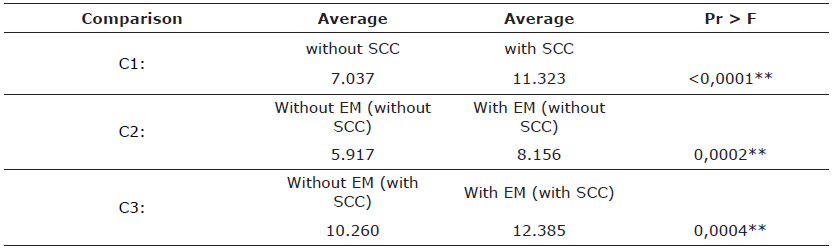
The ratio of yields in treatments with SCC and/or with EM compared to yields in the control (without SCC and without EM) allows obtaining the relative grain yield increase indices (RGYIi), which are shown in Table 5.
Table 5 Relative increase in bean grain plus pod yield, RGYIi (%)
| Treatment | Average | Sign. Tukey | RGYIi (%) |
|---|---|---|---|
| With SCC and with EM | 12.385 | A | 109,32 |
| With SCC and without EM | 10.260 | B | 73,40 |
| Without SCC and with EM | 8.156 | C | 37,84 |
| Without SCC and without EM | 5.917 | D | 0,00 |
Note: Different letters indicate significant differences according to Tukey's test (p < 0.05).
Table 5 shows the values of the relative yield increase indices for bean grain plus pods (RGYIi) corresponding to each treatment. In general, it is observed that RGYIi values are significantly higher in treatments with SCC, with values ranging from 73.40% (without EM) to 109.32% (with EM); likewise, the RGYIi due to the use of EM is important, whose increase in grain yield was 37.84%. It can be assumed that the contribution of SCC allows the crop to have better conditions, such as the provision of nutrients and a greater amount of available water for a longer time, which influences the different biological processes of the soil-water-plant system.
Bean stubble yield
Stubble yields after bean pod harvest are also significantly higher in treatments with SCC compared to the control; values range between 592 kg ha⁻¹ (control) and 834 kg ha⁻¹ (with 4 t ha⁻¹ SCC and 500 L ha⁻¹ of EM). Treatments that received SCC achieved higher yields (803 to 834 kg ha⁻¹) compared to those that did not receive it (659 to 724 kg ha⁻¹). The analysis of variance (ANOVA) of bean stubble yield (kg ha⁻¹) (Table 6) indicates a significant response for the main effects (SCC and EM); this explains that the contribution of SCC influenced yields, as did the contribution of EM.
Table 6 Analysis of variance of bean stubble yield (kg·ha⁻¹)
| S.V. | DF | SS | MS | Fc | p-value |
| Block | 3 | 31428.91 | 10476.30 | 9,88 | 0,0033** |
| SCC | 1 | 65076.01 | 65076.01 | 61,35 | <0,0001** |
| EM | 1 | 9264.06 | 9264.06 | 8,73 | 0,0161* |
| SCC×EM | 1 | 1173.06 | 1173.06 | 1,11 | 0,3204ns |
| Error | 9 | 9547.30 | 1060.81 | ||
| Total | 15 | 116489.34 |
C.V.: 4,31%. Note: ** Highly significant (p < 0.01); ns: not significant; °: not calculated; S.V.: Source of Variation; DF: Degrees of Freedom; SS: Sum of Squares; MS: Mean Squares; Fc: Calculated F-value; C.V.: Coefficient of Variation.
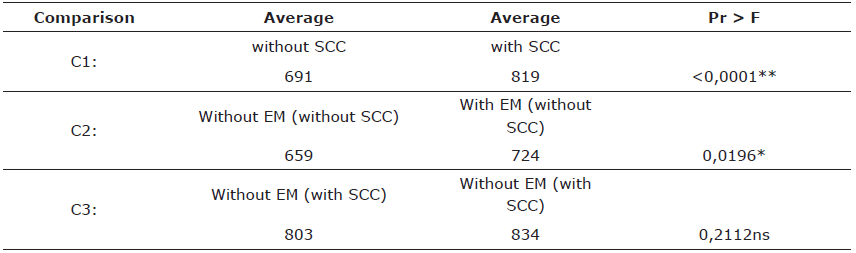
Table 7 of FANOVA (contrast tests) equally indicates that the average yield in treatments with CSC is superior to the treatment without CSC (C1); the application of ME equivalent to 500 L ha⁻¹, without CSC (C2) or with CSC (C3) is superior to the non-application of ME.
The ratio of yields in treatments with SCC and/or with EM compared to yields in the control (without SCC and without EM) allows obtaining the relative stubble yield increase indices (RSYIi), which are shown in Table 8.
Table 8 Relative increase in bean stubble yield (%)
| Treatment | Average | Sign. Tukey | RSYIi (%) | |
| With SCC and with EM | 834 | A | 26,67 | |
| With SCC and without EM | 803 | A | 21,96 | |
| Without SCC and with EM | 724 | B | 9,91 | |
| Without SCC and without EM | 659 | B | 0 |
Note: Different letters indicate significant differences according to Tukey's test (p < 0.05).
Table 8 shows the values of relative stubble yield increases (RSYIi) corresponding to each treatment. In general, it is observed that RSYIi values are higher in treatments with SCC, with values ranging from 21.96% (without EM) to 26.67% (with EM); likewise, the RSYIi due to the use of EM reached 9.91%. These results suggest that the contribution of SCC and EM-10 solution allow the crop to have better conditions for its development.
The quality of SCC, which was obtained through the use of yeasts, could have significantly influenced yields compared to the control, since, in addition to its chemical composition, the presence of beneficial microbial flora could have contributed to the solubilization of soil nutrients, which were utilized by the crop.
According to the results obtained, red bean cultivation achieved better yields due to EM application; however, the response of this crop to SCC application was more significant. Thus, the benefits of these fertilizers are highlighted compared to treatments that did not receive them. Various studies conducted on bean crops emphasize the importance of organic fertilization, such as that of Astulla Puca (2019), who highlights organic fertilizers made from poultry manure, or Inga Sotelo (2023), who demonstrated the effect of organic fertilizers with the presence of biol. Likewise, regarding the use of EM, studies such as those by Calero-Hurtado et al. (2018) and Calero-Hurtado et al. (2019) highlight the benefits of this biological product (EM) for its effects on morphological and productive parameters of bean cultivation.
Under conditions of the central jungle of Peru (Chanchamayo-Junín), García Palacios y Suárez Flores (2024), using 20 mL of EM per liter of water, obtained 2,849 kg ha⁻¹; thereby demonstrating the positive effect of EM on canary bean (P. vulgaris) production. Similarly, Abreu-Romero et al. (2021), in Cuba, using 5% EM achieved a production of up to twelve pods per plant compared to the control with only 5.7 pods per plant, equivalent to 100%; in the case of the present work, a 38% improvement over the control was achieved.
The results found in the present work corroborate those found in other regions and suggest that the main objective of organic fertilization practice in low-fertility soils in semi-arid regions is to improve soil fertility to enhance crop yield.
CONCLUSIONS
The application of local compost San Cristóbal Compound (SCC) and effective microorganisms (EM) proved to be an effective strategy to significantly increase red bean yield under semi-arid conditions in Ayacucho, Peru.
SCC (4 t ha⁻¹) was the most determining factor, increasing grain yield by 73.40% and stubble by 21.96% compared to the control. The application of EM (500 L ha⁻¹) also showed positive effects, although to a lesser extent, with increases of 37.84% in grain and 9.91% in stubble. The synergistic combination of both inputs enhanced the benefits, reaching increases of 109.32% in grain yield and 26.67% in stubble.
These results validate the use of organic fertilizers made with local materials as a viable and sustainable alternative to improve agricultural productivity in semi-arid zones under rainfed conditions, simultaneously contributing to soil fertility and climate change adaptation. It is recommended to promote the preparation and use of SCC in family farming systems, taking advantage of the organic residues available in the area.
ACKNOWLEDGMENTS
The authors acknowledge the financial support from the University of Huamanga. Likewise, the support of the technical staff of the Forage and Livestock Research Program and the National Institute for Agrarian Research and Innovation deserves special recognition. Faculty members from the soil science area and students from the Soil Fertility and Soil Management and Conservation courses also deserve recognition for their support in conducting the experiment.
REFERENCES
Abreu-Romero, A., Urgelles-Cardoza, I., Abreu-Romero, N., Díaz-Rodríguez, A., & Hernández-Gómez, K. (2021). Efecto de los Microorganismos Eficientes (ME) en el crecimiento y desarrollo del cultivo del frijol en condiciones de campo. Hombre, Ciencia y Tecnología, 25 (3), 1-8. Disponible en: http://portal.amelica.org/ameli/jatsRepo/441/4412517011/index.html [ Links ]
Astulla Puca, D. A. (2019). Efecto de abonos orgánicos en el cultivo de Phaseolus vulgaris L. var. Canario en un suelo ácido - Satipo. Universidad Nacional del Centro del Perú. (Tesis para optar el Título Profesional de Ingeniero en Ciencias Agrarias - Especialidad: Agronomía Tropical). Satipo, Perú: Universidad Nacional del Centro del Perú, Facultad de Ciencias Agrarias. https://repositorio.uncp.edu.pe/items/108762e5-4689-4bb0-b1e6-962f658fb110 [ Links ]
Arias Restrepo, J. H., Rengifo Martínez, T. y Jaramillo Carmona, M. (2007). Buenas prácticas agrícolas en la producción de fríjol voluble. Manual Técnico. Organización de las Naciones Unidas para la Agricultura y la Alimentación - FAO. https://www.fao.org/4/a1359s/a1359s00.pdf [ Links ]
Ayala-Garay, A., Acosta-Gallegos, J. A., y Reyes-Muro, L. (2021). El Cultivo del Frijol Presente y Futuro para México. Celaya: Instituto Nacional de Investigaciones Forestales, Agrícolas y Pecuarias. https://vun.inifap.gob.mx/VUN_MEDIA/BibliotecaWeb/_media/_librotecnico/12319_5085_El_cultivo_del_frijol_presente_y_futuro_para_M%C3%A9xico.pdf [ Links ]
Calero-Hurtado, A., Quintero-Rodríguez, E., Olivera-Viciedo, D., Pérez-Díaz, Y., Castro-Lizazo, I., Jiménez, J., y López-Dávila, E. (2018). Respuesta de dos cultivares de frijol común a la aplicación foliar de microorganismos eficientes. Cultivos Tropicales, 39(3), 5-10. http://scielo.sld.cu/scielo.php?script=sci_arttext&pid=S0258-59362018000300001 [ Links ]
Calero-Hurtado, A., Quintero-Rodríguez, E., Pérez-Díaz, A., Olivera-Viciedo, D., Peña-Calzada, K., y Jiménez-Hernández, J. (2019). Efecto entre microorganismos eficientes y fitomas-e en el incremento agroproductivo del frijol. Biotecnología en el Sector Agropecuario y Agroindustrial, 17(1), 25-33. https://revistas.unicauca.edu.co/index.php/biotecnologia/article/view/1201/993 [ Links ]
García Gutiérrez, C. y Herrán, J. A. F. (2014). Manual para la producción de abonos orgánicos y biorracionales. México. Fundación Produce Sinaloa. https://www.ciaorganico.net/documypublic/271_Manual_para_la_produccion_de_abonos_organicos_y_biorracionales.pdf [ Links ]
García Palacios, M. B., y Suárez Flores, J. P. (2024). Efecto de niveles de microorganismos eficientes (EM) en el crecimiento de frijol canario (Phaseolus vulgaris. L.) en Chanchamayo. Universidad Nacional Daniel Alcides Carrión. (Tesis para optar el Título Profesional de Ingeniero Agrónomo). La Merced, Perú: Universidad Nacional Daniel Alcides Carrión, Facultad de Ciencias Agropecuarias. http://repositorio.undac.edu.pe/bitstream/undac/4116/1/T026_45975267_T.pdf [ Links ]
Holdridge, L. R. (1967). Life Zone Ecology. San José, Costa Rica: Tropical Science Center, 206 p. https://www.cabidigitallibrary.org/doi/full/10.5555/19670604180 [ Links ]
Instituto Interamericano de Cooperación para la Agricultura (IICA). (2013). Tecnología de bajo costo: guía de manejo de microorganismos eficientes (ME). Managua, Nicaragua: Proyecto Red SICTA, IICA, Cooperación Suiza en América Central, 20 p. https://bibliotecasemiaridos.ufv.br/jspui/bitstream/123456789/392/1/Texto%20completo.pdf [ Links ]
Inga Sotelo, M. A. (2023). Efecto del uso de abonos orgánicos en la producción sostenible de frijol caupí (Vigna unguiculata L.), en Venado Muerto - Barranca. QuanTUNAB, 2(2), e72. https://revistas.unab.edu.pe/index.php/qunab/article/view/72/81 [ Links ]
Ministerio del Ambiente (MINAM) (2011). La Desertificación en el Perú: Cuarta Comunicación Nacional del Perú a la Convención de Lucha contra la Desertificación y la Sequía. Fondo editorial del MINAM. Lima: Ministerio del Ambiente del Perú. https://www.euroclima.org/images/Publicaciones/Suelos/Peru_4Inf_Desertificacion1.pdf [ Links ]
Pérez-Borrego, Y., y Robleda-Goméz, D. (2021). Aplicación de Humus de lombriz líquido y Microorganismos Eficientes en el cultivo del frijol (Phaseolus vulgaris, L) bajo condiciones de secano. Hombre, Ciencia y Tecnología , 25 (2), 102-108. http://portal.amelica.org/ameli/jatsRepo/441/4412286012/index.html [ Links ]
Servicio Nacional de Sanidad (SENASA). (2020) Guía para la implementación de buenas prácticas agrícolas (BPA) para el cultivo de frijol. Subdirección de inocuidad agroalimentaria. https://repositorio.midagri.gob.pe/bitstream/20.500.13036/1687/1/Gu%C3%ADa%20para%20la%20implementaci%C3%B3n%20de%20Buenas%20Pr%C3%A1cticas%20Agr%C3%ADcolas%20Frijol.pdf [ Links ]
Tanya Morocho, M., y Leiva-Mora, M. (2019). Microorganismos eficientes, propiedades funcionales y aplicaciones agrícolas. Centro Agrícola, 46(2), 93-103. http://scielo.sld.cu/scielo.php?script=sci_arttext&pid=S0253-57852019000200093 [ Links ]
Tineo Bermúdez, A. L. (2012). El Análisis Funcional de la Varianza. Universidad Nacional de San Cristóbal de Huamanga, AMI impresores, Ayacucho, Perú. [ Links ]
Vargas, A., Watler, W., Morales, M. y Vignola, R. (2018). Cultivo del frijol: prácticas efectivas para la reducción de impactos por eventos climáticos en Costa Rica. https://www.mag.go.cr/bibliotecavirtual/F01-8160.pdf [ Links ]
Data availability:The complete dataset supporting the results of this study is available upon request to the corresponding author. The dataset is not publicly available because it contains confidential data.
Responsible Editor: Arnaldo Esquivel-Fariña (https://orcid.org/0000-0002-7727-5243). Universidad Nacional de Asunción, Facultad de Ciencias Agrarias, San Lorenzo, Paraguay.
Received: March 23, 2025; Accepted: September 30, 2025; Published: December 12, 2025
 Este es un artículo publicado en acceso abierto bajo una licencia Creative Commons
