




Services on Demand
Journal

Article
 text in
 English (pdf)
 Article in xml format
 Article references

 Automatic translation
 Send this article by e-mail
Indicators
-
 Cited by SciELO
Related links
-
 Similars in
SciELO
Share

 Permalink

Investigación Agraria
On-line version ISSN 2305-0683
Investig. Agrar. vol.27 no.2 San Lorenzo 2025 Epub Sep 11, 2025
https://doi.org/10.18004/investig.agrar.2025.e2702842
Scientific article
Economic Valuation of Recreational Services of the Cerro Kõi and Chorori Natural Monuments, Areguá, Paraguay
1
 http://orcid.org/0009-0009-0708-3463
1
2
http://orcid.org/0000-0003-1527-1623
1
2
http://orcid.org/0000-0002-0975-0620
¹ Universidad Nacional de Asunción, Facultad de Ciencias Agrarias, Grupo de Investigación Manejo de Recursos Naturales en Paraguay. San Lorenzo, Paraguay.
2 Sistema Nacional de Investigadores de Paraguay, Consejo Nacional de Ciencia y Tecnología. Asunción, Paraguay.
The Cerro Kõi and Chorori Natural Monuments (CKCCNM) constitute a protected wilderness area in Paraguay that stands out for its columnar sandstone outcrops, rare geological formations present in few places in the world. Despite their ecological value, they face economic challenges to ensure their long-term protection and conservation. The advancement of urbanization in surrounding localities has driven a considerable increase in demand for ecosystem services provided by this site. To secure the necessary resources to improve the visitor experience at the CKCCNM through the implementation of a management plan, it is essential to consider their ecotourism potential. The general objective of this research was to economically value the recreational services offered by the CKCCNM through the contingent valuation method. Data collection was conducted through validated surveys applied in the study area, following the recommendations of Amarilla Rodríguez et al. (2023). A non-parametric analysis of the data was performed using the Kriström (1990) model. The main visit motivations were nature tourism, relaxation, and observation of geological formations, constituting examples of cultural ecosystem services. The findings emphasize the need to implement environmental access fees that consider not only visitors' ability to pay, but also principles of equity and institutional trust.
Keywords: non-parametric analysis; protected area; willingness to pay; contingent valuation method
Los Monumentos Naturales Cerro Kõi y Chorori (MNCKC) constituyen un área silvestre protegida en Paraguay que se destaca por sus afloramientos de areniscas columnares, formaciones geológicas raras presentes en pocos lugares del mundo. A pesar de su valor ecológico, enfrenta desafíos económicos para garantizar su protección y conservación a largo plazo. El avance de la urbanización en las localidades aledañas ha impulsado un aumento considerable en la demanda de servicios ecosistémicos proporcionados por este sitio. Para asegurar los recursos necesarios que permitan mejorar la experiencia de los visitantes en los MNCKC mediante la implementación de un plan de manejo, es fundamental considerar su potencial ecoturístico. El objetivo general de esta investigación fue valorar económicamente los servicios recreativos ofrecidos por los MNCKC a través del método de valoración contingente. La recolección de datos se realizó mediante encuestas validadas aplicadas en el área de estudio, siguiendo las recomendaciones de Amarilla Rodríguez et al. (2023). Se efectuó un análisis no paramétrico de los datos utilizando el modelo de Kriström (1990). Las principales motivaciones de visita fueron el turismo de naturaleza, la relajación y la observación de las formaciones geológicas, constituyendo ejemplos de servicios ecosistémicos culturales. Los hallazgos subrayan la necesidad de implementar tarifas ambientales por acceso que consideren no solo la capacidad de pago de los visitantes, sino también principios de equidad y confianza institucional.
Palabras clave: análisis no paramétrico; área protegida; disposición a pagar; método de valoración contingente
INTRODUCTION
The advancement of urbanization in the localities of Areguá, Capiatá, Ypacaraí, Itauguá, and Luque has driven a notable increase in demand for services provided by ecosystems. However, this expansion has not always been accompanied by sustainable planning and management of natural resources, which leads to a series of consequences for nature, such as environmental degradation, disruption of essential ecological processes, and reduction of the biological diversity characteristic of the region.
Protected wilderness areas (PWAs) have as their main purpose the conservation of flora, fauna, and unique and representative scenic beauty of the country. In the classification system of the International Union for Conservation of Nature (IUCN), category III Natural Monument consists of protecting biodiversity, associated habitats, and outstanding specific natural features (Dudley, 2008). This last aspect constitutes, precisely, one of the main objectives for the creation of the Cerro Kõi and Chorori Natural Monuments (SEAM, SENATUR and Municipality of Areguá, 2014).
The CKCCNM are composed of sandstone formations with a surprising columnar jointing. This phenomenon, characteristic of rocks of igneous origin, is rarely found in sedimentary rocks, which explains the uniqueness of these hills (Salinas Franco, 2024). Despite their ecological value, this PWA faces economic challenges to ensure its long-term protection and conservation.
To obtain the necessary resources to improve the visitor experience at the Cerro Kõi and Chorori Natural Monuments, strengthen security, and implement a sustainable management plan, it is a priority to evaluate their ecotourism potential. Ecotourism is considered a modality of nature-based tourism activity, in which the visitor's essential motivation is to observe, learn, discover, and appreciate biological and cultural diversity, with a responsible attitude to protect the integrity of the site; it also seeks to generate social and environmental benefits in local communities and constitute sustainable tourism over time (World Tourism Organization (WTO), 2019).
Environmental economic valuation constitutes a strategic tool from environmental economics to make visible and quantify ecosystem services in monetary terms, in order to recognize their social, ecological, and economic importance. Although this valuation does not necessarily reflect the total economic value (TEV) of ecosystems, it provides a useful approximation for decision-making. In this sense, valuing the recreational services of the CKCCNM allows highlighting their relevance, generating awareness about their contribution, and supporting actions oriented toward their conservation and sustainable management.
While broader environmental valuation approaches that consider non-monetary dimensions exist, this study adopts the environmental economics approach, focused on estimating benefits or costs associated with changes in ecosystems through economic methods (Amarilla Rodríguez et al., 2023).
Melo-Guerrero et al. (2022) highlight that, although tourism in protected areas generates employment, income, and social cohesion through environmental education, its development must respect the carrying capacity of the environment to avoid impacts that may put natural and cultural heritage at risk. Therefore, estimating visitors' maximum willingness to pay is fundamental for guiding sustainable management, investment in improvements, and long-term conservation of the CKCCNM.
The general objective of this research was to economically value the recreational services offered by the CKCCNM through the contingent valuation method. The specific objectives proposed were: (1) characterize visitors according to socioeconomic traits, (2) characterize visits to the CKCCNM, (3) describe the state of services provided by the CKCCNM, (4) identify necessary improvements according to visitors' opinions, and (5) estimate visitors' willingness to pay for recreational services in an improved scenario.
MATERIALS AND METHODS
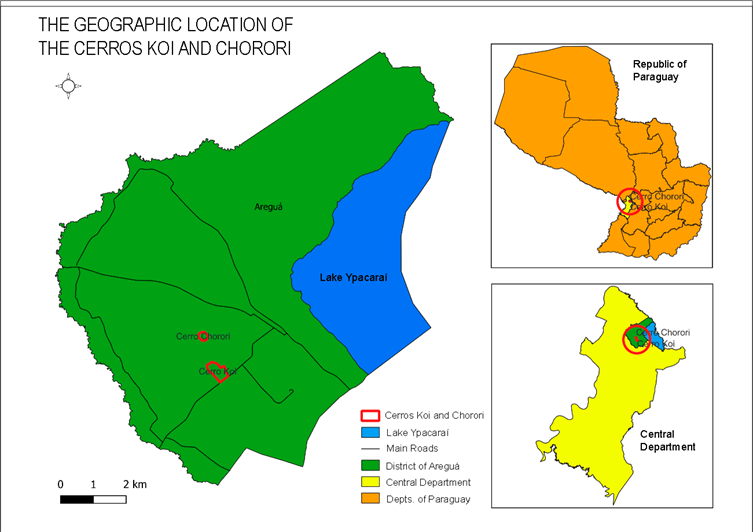
The research was conducted in the protected area called Cerro Kõi and Chorori Natural Monuments (CKCCNM), located in the Central Department, Eastern Region, Paraguay. Its geographical location lies between parallels 25°07' and 26°00' south latitude, and meridians 57°45' and 57°10' west longitude (Figure 1). Cerro Kõi borders to the east with the Areguá-Capiatá route and in the other directions with private properties. For its part, Cerro Chorori is completely surrounded by private properties. It should be noted that both the 12 hectares of Cerro Kõi and the 5 hectares of Cerro Chorori belong, for the most part, to private owners (SEAM, SENATUR & Municipality of Areguá, 2014).
Given the nature of applied research, which seeks to contrast theory with reality in a specific territorial context, the study was developed under a quali-quantitative approach, with a non-experimental and descriptive design (Tamayo, 2009; Hernández Sampieri, Fernández Collado and Baptista Lucio, 2010). A case study was conducted, in which a known methodology-contingent valuation-is applied to a protected area that had not been previously analyzed from this perspective.
For primary data collection, the contingent valuation method was employed, using structured surveys as the data collection instrument. Simple random sampling was applied, with a sample composed of 176 visitors to the CKCCNM, all over 18 years of age. Data collection was conducted during summer, specifically in January and February 2023, coinciding with the season of highest visitor influx.
The following steps were followed in the research process: initially, a pilot test was conducted on 10% of the sample, using an open question about willingness to pay (WTP), in order to obtain a first estimation through calculation of the arithmetic mean. From this preliminary result, five values were defined (suggested amount vector), which were applied in a second test to 20% of the sample, this time using a dichotomous (yes/no) question about WTP. The results of this second test allowed determining the amount vector that was used in the definitive survey. For the analysis of results, the linear interpolation method was applied, a non-parametric technique that does not require restrictive assumptions.
This methodology is based on respondents' affirmative responses to suggested amounts, allowing estimation of WTP. The statistical importance of this cumulative distribution function lies in the fact that the area under the curve represents the average value of willingness to pay (Cisneros, Alpízar and Madrigal, 2007).
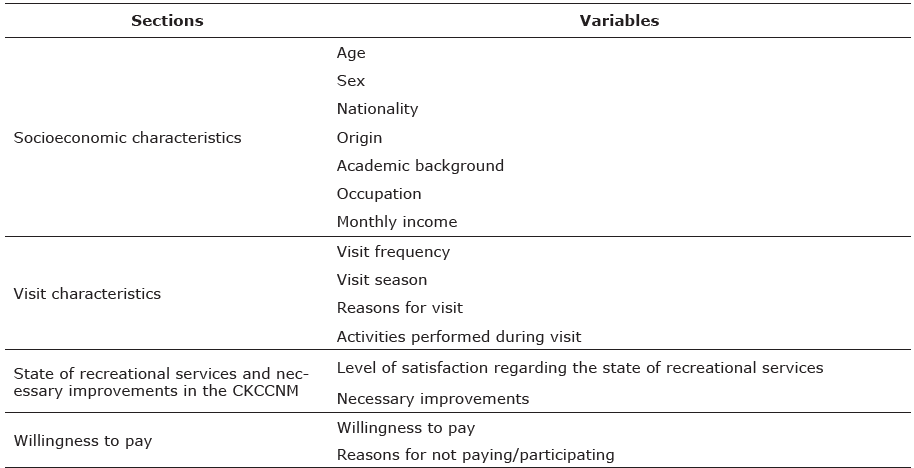
The surveys based on the applied variables (Table 1) included three types of questions: objective data, closed-ended, and multiple choice. They were structured in three sections: an introductory header, a section dedicated to the socioeconomic characteristics of the respondent, and a final part focused on the object of study.
Data analysis included calculation of relative frequencies, as well as measures of central tendency such as mode, arithmetic mean, and median. Data were processed using a Microsoft Excel spreadsheet and subsequently analyzed using the non-parametric model of Kriström (1990).
RESULTS AND DISCUSSION
Socioeconomic characterization of CKCCNM visitors
The majority of CKCCNM visitors are between 18 and 39 years old, with an average age of 32 years. Males predominate (53%) over females (47%). 93% are Paraguayans, mainly from the Central Department (67%) and Asunción (23%), while the remaining 10% come from other regions of the country or are international visitors. Regarding educational level, 49% have university education, followed by 24% with secondary education, 11% with postgraduate studies, 11% with technical training, and 5% with primary education or other cases. Concerning occupation, 48% are employees, 20% independent professionals, 14% students, 5% unemployed and retired, and 13% other employment categories. Regarding income, 39% earn minimum wage, 29% between one and three minimum wages, 15% four or more minimum wages, and 17% less than minimum wage or no salary.
The results obtained on the profile of CKCCNM visitors show a predominance of young people (between 18 and 39 years) with university education. This pattern coincides with that reported by Caballero Fretes (2021) in Ñacunday National Park, where 43% of visitors were between 18 and 30 years old and had a university education level. Likewise, studies in urban protected areas of Latin America, such as those conducted by Osorio García, Monge Amores, Serrano Barquín, and Cortés Soto (2017) in Mexico and Ecuador, highlight that visitors tend to be young adults with motivation for nature tourism.
The high educational level observed in CKCCNM visitors may be related to greater environmental awareness, as suggested by Andrade Navia et al. (2024), who found a significant association between ecotourism experience and the development of environmental awareness in university students from the South Colombian region. This finding suggests that ecotourism could play a relevant role as an environmental education tool, especially among people with medium or higher academic education.
These findings reinforce the importance of considering the visitor profile in planning management and environmental education strategies, in order to promote greater participation and diversification of audiences in the recreational use of PWAs.
Characterization of visits to the CKCCNM
The majority of visitors surveyed (59%) stated they had previously visited the CKCCNM, while the remaining percentage indicated they were visiting for the first time. Regarding the time of year, 79% preferred the spring-summer months. The main reasons for visiting were nature tourism (49%), relaxation (37%), and educational, sports, and other purposes (14%). The most frequent recreational activities included hiking (34%), observation of columnar sandstone formations (26%), appreciation of local flora and fauna (25%), and cultural aspects and others (15%).
These motives and activities indicated by visitors surveyed correspond to the classification of cultural ecosystem services, which in many cases are conservation objectives of the country's PWAs and particularly of the CKCCNM (Millennium Ecosystem Assessment (MEA), 2005; SEAM, SENATUR and Municipality of Areguá, 2014).
These patterns regarding visitor characteristics are consistent with the findings of Osorio García et al. (2017), who, in their comparative study between the Nevado de Toluca Flora and Fauna Protection Area in Mexico and the Cotacachi Cayapas Ecological Reserve in Ecuador, identified that the recreational profile is dominant among PWA visitors. Visitors mainly seek experiences of contact with nature, relaxation, and outdoor activities, such as hiking and landscape observation.
Furthermore, in the study by Pérez Gálvez, López-Guzmán, Orgaz Agüera and Prada-Trigo (2017) on tourists visiting the city of Santo Domingo, Dominican Republic, it was found that visitors' main motivations include the desire to discover new places and disconnect from everyday life, which reflects a search for recreational and relaxation experiences.
The preference for visiting the CKCCNM during summer months also coincides with trends observed in other tourist destinations, where favorable weather conditions and school and work vacations increase visitor influx. For example, in the study by Osorio García et al. (2017), it was observed that visitors to protected areas in Mexico and Ecuador tend to plan their visits during seasons with more favorable weather and greater availability of free time.
State of services offered and necessary improvements in the CKCCNM, according to visitors' opinions
68% of visitors rated their experience as highly satisfactory, while 19% considered it good; 7% described it as average. The remaining cases (6%) reported a nearly unsatisfactory or unsatisfactory experience. These results reflect a generally positive assessment (87%), although with opportunities for improvement identified by visitors.
The main suggested improvements included the installation of restrooms (17%), placement of benches at viewpoints (14%), access to drinking water (8%), improvement of signage and trail maintenance (7%), presence of tour guides and security (7%), and installation of food and beverage sales points with adequate hygiene and ventilation conditions (4%).
The remaining suggestions (43%) included a varied list of recommendations such as maintaining the current natural conditions of the PWA, enabling attractions like zip lines or soccer fields, carrying out plantings or reforestation in sectors showing signs of degradation or traces of previous fires, equipping the PWA administration with first aid supplies, creating nighttime activities such as museums or exhibitions, installing grilling areas for families, and improving lighting.
All these recommendations are considered pertinent in the context of the PWA's management category and may be considered as valid inputs for updating the management plan whose validity expired in 2019. These suggestions also reflect a clear demand for basic infrastructure that could improve the visitor experience and strengthen the PWA's ecotourism potential, considering that ecotourism attracts part of the global tourism market to natural areas and channels income to local conservation enterprises, thus promoting economic development.
These findings are consistent with observations in other recreational public spaces in the country. For example, Sandoval (2021), in his study of the Mariscal José Félix Estigarribia Bike Path in San Lorenzo, reported that the main improvement required by users was security service (20%), followed by restroom maintenance (19%) and installation of drinking fountains (19%). Similarly, Portillo (2020) found that, on the Capiatá Route 1 Bike Path, the installation of restrooms and drinking fountains was identified by respondents as the main need, along with improvements in cleanliness.
These coincidences reinforce the importance of addressing minimum comfort and hygiene conditions in open natural and urban spaces, especially when there is intention to introduce or consolidate ecotourism schemes. Improvement in basic services not only increases visitor satisfaction, but also strengthens the site's attractiveness, its capacity to generate income, and its long-term sustainability.
Willingness to pay for recreational services in an improved scenario
Willingness to pay (WTP) was estimated using the non-parametric model proposed by Kriström (1990), obtaining an average value of 70,681 ₲ and a median of 65,441 ₲ (Equivalent to approximately 9.2 USD for the average and 8.5 USD for the median, calculated according to the exchange rate in effect at the time of estimation (2025)). Figure 2 illustrates the survival function, which represents the cumulative proportion of visitors willing to pay according to suggested amounts.
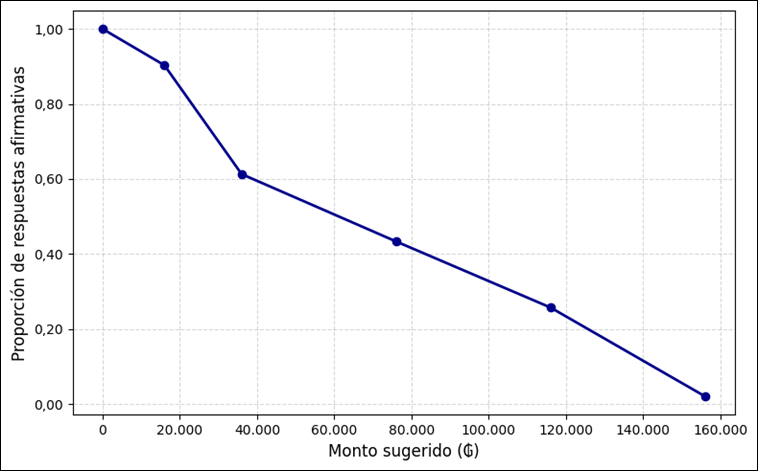
As shown in Table 2, 90% of those surveyed accepted paying 16,000 ₲ for admission to the CKCCNM in a scenario of improved services. As the amount increased, the proportion of affirmative responses decreased progressively: 61% accepted paying 36,000 ₲, 43% accepted 76,000 ₲, 26% accepted 116,000 ₲, and only 2% were willing to pay 156,000 ₲. This decreasing distribution of acceptance allows estimation of a reference value for potential implementation of an access fee based on visitor preferences.
Table 2 Willingness to pay by visitors
| Suggested amount | Number of respondents who received the amount | Number of respondents who responded affirmatively | Proportion of affirmative responses |
| 0 | 100 | 100 | 1 |
| 16,000 ₲ | 31 | 28 | 0.903225806 |
| 36,000 ₲ | 31 | 19 | 0.612903226 |
| 76,000 ₲ | 30 | 13 | 0.433333333 |
| 116,000 ₲ | 35 | 9 | 0.257142857 |
| 156,000 ₲ | 49 | 1 | 0.020408163 |
This value is similar to that reported by Caballero Fretes (2021) in Ñacunday National Park, where the estimated average WTP was 66,000 ₲. Both studies, focused on protected areas of high ecological and scenic value, reflect significant valuation by visitors toward recreational use of these natural spaces.
On the other hand, studies conducted in urban environments reveal lower WTP values. Portillo (2020), in his research on the Capiatá Route 1 Bike Path, estimated an average WTP of 5,200 ₲, while Sandoval (2021), on the Mariscal José Félix Estigarribia Bike Path in San Lorenzo, found a WTP of 6,900 ₲. These differences can be attributed to multiple factors, such as the nature of the environment (urban vs. natural), the type of experience offered (everyday recreation vs. ecotourism), and visitor expectations.
It should be noted that, as has been widely discussed in the literature, willingness to pay and willingness to accept are not symmetrical, due to differences in how people perceive costs and benefits. Additionally, the hypothetical nature of the scenario presented in surveys may influence responses, since participants do not face real decisions when responding, which may affect the validity of the estimates obtained (Mitchell and Carson, 1989).
The comparison shows that visitors are willing to pay higher amounts to access protected or conserved areas with exceptional ecological and landscape attributes, especially if adequate safety conditions, basic services, and infrastructure are guaranteed. These findings support the possibility of implementing a reasonable entrance fee at the CKCCNM, environmentally adjusted and aligned with the value that visitors assign to the site.
On the other hand, it can be considered that less than 2% of visitors expressed unwillingness to pay for access to the CKCCNM, clarifying that this percentage is relative and depends on the reference amount used. Among the main reasons for non-payment expressed are: "it is a high amount" and "it is a public place and authorities should be responsible for its maintenance." These responses reveal not only economic limitations, but also clear expectations about the State's role in providing and maintaining public goods such as PWAs, mainly those that comprise the public subsystem. Likewise, acceptance of a potential charging system is closely linked to confidence that revenues generated will be managed efficiently and transparently for maintenance or improvement of the same site. Therefore, it is essential to establish solid accountability and transparency mechanisms, as indispensable conditions for socially legitimizing any financing scheme and ensuring its long-term sustainability.
It should be noted that since 2019, Ybycuí National Park has had an entrance fee of 20,000 ₲ for adults and 5,000 ₲ for children, as well as other entrance concepts according to vehicle type, camping services and others, according to MADES Resolution No. 418/19 that establishes income collection rates for PWAs under public domain. This entrance fee was subsequently incorporated into Ñacunday and Cerro Corá National Parks and remains in effect.
The results of this study coincide with those reported by Portillo (2020) and Sandoval (2021), who identified economic factors and perceptions about state responsibility as the main reasons for rejecting payment for the use of public spaces. In the case of the bike path studied by Portillo, 57% of survey participants considered the proposed price excessive, while 38% maintained that, since it was a public space, its maintenance should be the municipality's responsibility. Similarly, Sandoval (2021) found that 49% of users opposed payment for economic reasons, and 29% argued that, given that they already contribute with taxes, access to these sites should be guaranteed.
These findings underscore the need for any proposal for access charges or entrance fees to PWAs to consider not only visitors' ability to pay, but also principles of equity and institutional trust. In this sense, it is essential to implement clear communication strategies and participatory mechanisms that strengthen citizen trust, and ensure that collected funds are effectively allocated to improving infrastructure, conserving the area's natural and cultural values, and enriching the visitor experience.
The importance of conducting more research on economic valuation of ecosystem services is also highlighted (Amarilla Rodríguez et al., 2023), with emphasis on valuation of recreational services not only in the country's PWAs, but also in urban green areas.
CONCLUSIONS
The economic valuation of recreational services at the CKCCNM allowed estimation of the maximum amount that could be charged to users as an entrance fee in an improved scenario. Although the final charge amount depends on a political decision, from the perspective of community social welfare, the average charge should not exceed the WTP expressed in this study. Factors such as confidence in institutional management and transparency in fund management are key to ensuring acceptance and sustainability of the scheme. Furthermore, charging can become a strategic tool not only for financing improvements in infrastructure and services, but also for strengthening environmental education and promoting citizen co-management.
ACKNOWLEDGMENTS
The authors express their gratitude to the following entities: the Ministry of Environment and Sustainable Development for permits to conduct research at the CKCCNM, the Faculty of Agricultural Sciences of the National University of Asunción, the National Council of Science and Technology of Paraguay, through the National System of Researchers (SISNI), and all survey participants who provided their time and contribution.
REFERENCES
Amarilla Rodríguez, S. M., Laino, R., Soto, C., Musalem, K., Peralta Kulik, N., Villalba Marin, J., Quevedo Fernández, M. L., y González Villalba, J. D. (2023). Estado del arte sobre el pago por servicios ambientales en Paraguay: dieciséis años de gestión. Ecología Austral, 33, 351-369. https://doi.org/10.25260/EA.23.33.2.0.2037 [ Links ]
Andrade Navia, J. M., Jiménez Zapata, E. M., y Luna Ocampo, W. F. (2024). Ecoturismo y conciencia ambiental: una estrategia de educación ambiental para jóvenes universitarios. Sophia, 20(2). https://dialnet.unirioja.es/descarga/articulo/10215662.pdf [ Links ]
Caballero Fretes, R. J. (2021). Valoración económica de los servicios recreativos del Parque Nacional Ñacunday (Departamento Alto Paraná, Paraguay) según plan de manejo vigente. (Tesis de Maestría en Auditoría y Gestión Ambiental). Ciudad del este, Minga Guazú: Universidad Nacional del Este, 74 p. [ Links ]
Cisneros, J., Alpízar, F., y Madrigal, R. (2007). Valoración económica de los beneficios de protección del recurso hídrico bajo un esquema de pago por servicios ecosistémicos en Copán Ruinas, Honduras. Recursos Naturales y Ambiente, 51-52, pp. 143-152. Disponible en: https://repositorio.catie.ac.cr/handle/11554/7343 [ Links ]
Dudley, N. (Ed.). (2008). Directrices para la aplicación de las categorías de gestión de áreas protegidas. Gland: UICN, 116 p. [ Links ]
Hernández Sampieri, R., Fernández Collado, C., y Baptista Lucio, P. (2010). Metodología de la investigación. 5 ed. México: McGraw Hill, 613 p. [ Links ]
Kriström, B. (1990). A non-parametric approach to the estimation of welfare measures in discrete response valuation studies. Land Economics, 66(2), pp. 135-139. https://doi.org/10.2307/3146363 [ Links ]
MEA (Millennium Ecosystem Assessment). (2005). Ecosystems and human well-being: Synthesis, Vol. 4892. Canada: World Resources Institut, MEA [ Links ]
Melo-Guerrero, E., Hernández-Ortiz, J., Valenzuela-Núñez, L. M. ., Valdivia-Alcalá, R., González-Juárez, A., y Luna-Cervantes, J. O. (2022). Disponibilidad a pagar por servicios turísticos en el Parque Nacional Los Mármoles, México. Ecosistemas y Recursos Agropecuarios, 9(2). https://doi.org/10.19136/era.a9n2.2858 [ Links ]
Ministerio del Ambiente y Desarrollo Sostenible (MADES). (2019). Resolución N° 418/19: Por la cual se establece las tasas de verificación in situ de las solicitudes de declaración legal de las áreas silvestres protegidas bajo dominio privado y las tasas por percepción de ingresos en las áreas silvestres protegidas bajo dominio público, a ser percibidas en el marco de la Ley N° 5146/2014. Asunción: MADES. Disponible en: https://www.mades.gov.py/2021/09/13/tasas-de-verificacion-in-situ-de-las-solicitudes-de-la-declaracion-legal-de-las-areas-silvestres-protegidas-bajo-dominio-privado/ [ Links ]
Mitchell, R. C., y Carson, R. T. (1989). Using surveys to value public goods: The contingent valuation method. Washington : Resources for the Future [ Links ]
Organización Mundial del Turismo (OMT). (2019). UNWTO: Tourism Definitions. Madrid: OMT. [ Links ]
Osorio García, M., Monge Amores, L. E., Serrano Barquín, R. del C., y Cortés Soto, I. Y. (2017). Perfil del visitante de naturaleza en Latinoamérica: prácticas, motivaciones e imaginarios. Estudio comparativo entre México y Ecuador. PASOS. Revista de Turismo y Patrimonio Cultural, 15(3), pp. 713-729. https://doi.org/10.25145/j.pasos.2017.15.047 [ Links ]
Pérez Gálvez, J. C., López-Guzmán, T., Orgaz Agüera, F., y Prada-Trigo, J. (2017). Análisis de los turistas que visitan una ciudad Patrimonio de la Humanidad. El caso de Santo Domingo, República Dominicana. Rosa dos Ventos, 9(4), pp. 605-622 https://doi.org/10.18226/21789061.v9i4p605 [ Links ]
Portillo, P. (2020). Valoración económica de los servicios recreativos de la Ciclovía Ruta 1 de la Ciudad de Capiatá, Paraguay. (Tesis Ingeniería Ambiental). San Lorenzo: Facultad de Ciencias Agrarias, Universidad Nacional de Asunción. 73 p. [ Links ]
Tamayo, M. (2009). El proceso de la investigación científica. 5 ed. México: Limusa. 62 p. [ Links ]
Salinas Franco, N. (2024). Areniscas columnares del Cerro Koĩ: una rareza geológica en Paraguay. En Asociación de Servicios de Geología y Minería Iberoamericanos (ASGMI). Sitios de interés geológico en Iberoamérica, pp. 349-352 [ Links ]
Sandoval, J. (2021). Actualización de la valoración económica de los servicios recreativos de la Ciclovía Mariscal José Félix Estigarribia, San Lorenzo, Paraguay. (Tesis Ing. Amb.). San Lorenzo: Facultad de Ciencias Agrarias, Universidad Nacional de Asunción, 66 p. [ Links ]
SEAM, SENATUR, y Municipalidad de Areguá. (2014). Plan de manejo de los Monumentos Naturales Cerro Koi y Chororí: Periodo 2014-2019. Municipalidad de Areguá. Disponible en: https://informacionpublica.paraguay.gov.py/public/9984389-PlandeManejodeCerroKoiyChororipdf-PlandeManejodeCerroKoiyChorori.pdf [ Links ]
8Data availability: The complete dataset supporting the results of this study is available upon request to the corresponding author.
9Responsible Editor: Arnaldo Esquivel-Fariña (https://orcid.org/0000-0002-7727-5243). Universidad Nacional de Asunción, Facultad de Ciencias Agrarias, San Lorenzo, Paraguay.
Received: June 04, 2025; Accepted: August 01, 2025; Published: September 11, 2025
 Este es un artículo publicado en acceso abierto bajo una licencia Creative Commons
