




Services on Demand
Journal

Article
 text in
 English (pdf)
 Article in xml format
 Article references

 Automatic translation
 Send this article by e-mail
Indicators
-
 Cited by SciELO
Related links
-
 Similars in
SciELO
Share

 Permalink

Investigación Agraria
On-line version ISSN 2305-0683
Investig. Agrar. vol.27 no.2 San Lorenzo 2025 Epub Sep 11, 2025
https://doi.org/10.18004/investig.agrar.2025.e2702839
Scientific article
Sugar industry waste transformed into organic fertilizer: effect of different doses on carrot (Daucus carota L.) growth and yield
1
2
*
 http://orcid.org/0009-0003-1501-9708
2
http://orcid.org/0009-0009-8813-7629
3
http://orcid.org/0000-0002-7820-9037
1 Instituto Paraguayo de Tecnología Agraria, Centro de Investigación Hernando Bertoni, Departamento de Suelos. Caacupé, Paraguay.
2 Universidad Católica Nuestra Señora de la Asunción, Unidad Pedagógica Caacupé. Caacupé, Paraguay.
3 Universidade São Paulo, Escola Superior de Agricultura Luiz de Queiroz. Piracicaba, Brasil.
4 Instituto Paraguayo de Tecnología Agraria, Centro de Investigación Capitán Miranda, Departamento de Suelos. Capitán Miranda, Paraguay.
Carrot is a food source rich in bioactive compounds essential for human nutrition. Being a short-cycle crop, it has high nutritional demands that are commonly satisfied through intensive use of chemical fertilizers, which increase production costs and deteriorate soil health. As a sustainable alternative, the valorization of organic waste for fertilizer production emerges. The objective of this work was to evaluate the effect of different doses of composted organic fertilizer, derived from sugar byproducts, on carrot crop growth and yield. The experiment was conducted at the experimental field of the Paraguayan Institute of Agricultural Technology (IPTA) in Caacupé, Paraguay, using the Shin Kuroda variety under a randomized complete block design with three replications per treatment. Treatments consisted of four increasing doses of organic fertilizer (2, 4, 6, and 8 t ha⁻¹) and a control treatment without fertilization. Plant height, root length and diameter, root weight, and total yield were evaluated. Data were analyzed using analysis of variance (p < 0.05). Results showed that plant height, root weight, and yield were not significantly influenced by the applied organic fertilizer doses. However, significant differences were observed in root diameter and length. It is concluded that the evaluated organic fertilizer doses were not sufficient to completely satisfy the nutritional demands of the carrot crop.
Keywords: organic amendments; circular economy; sustainable horticulture; plant nutrition
La zanahoria es un alimento rico en compuestos bioactivos esenciales para la nutrición humana. Por ser un cultivo de ciclo corto, presenta una alta demanda nutricional que comúnmente se satisface mediante el uso intensivo de fertilizantes químicos, los cuales elevan los costos de producción y deterioran la salud del suelo. Como alternativa sustentable, surge la valorización de residuos orgánicos para la producción de fertilizantes. El objetivo del trabajo fue evaluar el efecto de diferentes dosis de fertilizante orgánico compostado, derivado de subproductos azucareros, sobre el crecimiento y rendimiento del cultivo de zanahoria. El experimento se realizó en el campo experimental del Instituto Paraguayo de Tecnología Agraria (IPTA) en Caacupé, Paraguay, utilizando la variedad Shin Kuroda bajo un diseño de bloques completos al azar con tres repeticiones por tratamiento. Los tratamientos consistieron en cuatro dosis crecientes del fertilizante orgánico (2, 4, 6 y 8 t ha⁻¹) y un tratamiento testigo sin fertilización. Se evaluaron altura de planta, longitud y diámetro de raíz, peso de raíz y rendimiento total. Los datos se analizaron mediante análisis de varianza (p < 0,05). Los resultados mostraron que la altura de planta, peso de raíces y rendimiento no fueron significativamente influenciados por las dosis de fertilizante orgánico aplicadas. Sin embargo, se observaron diferencias significativas en el diámetro y longitud de la raíz. Se concluye que las dosis de fertilizante orgánico evaluadas no fueron suficientes para satisfacer completamente las demandas nutricionales del cultivo de zanahoria.
Palabras clave: enmiendas orgánicas; economía circular; horticultura sostenible; nutrición de plantas
INTRODUCTION
Carrot (Daucus carota L.) is one of the most consumed vegetables worldwide due to its high nutraceutical value provided by carotenoids, fibers, vitamins, and minerals that possess high antioxidant capacity and generate important benefits for food security (Martínez-Saldarriaga, Henao-Rojas, Flórez-Martínez, Cadena-Chamorro, and Yepes-Betancur, 2025; Que et al., 2019). However, being a short-cycle crop, it demands high nutrient requirements to sustain optimal development in terms of growth, yield, and quality (Hailu, Hassen, Hussen, Belete and Alemu, 2024; Oleszkiewicz et al., 2025). To meet these demands, chemical fertilizers have been used intensively over recent decades (Mitsigiorgi et al., 2024). Although the application of these inputs has increased crop yields (Andualem, Kemal, Mekonen, Yenet and Kassa, 2025), their excessive use has generated high costs for producers and triggered serious problems in the agroecosystem (Urra, Alkorta, Mijangos, and Garbisu, 2020; Wu et al., 2025).
Excessive use of chemical inputs leads to soil acidification, loss of organic carbon and microbial biodiversity, and alteration of nutrient cycles through processes such as volatilization, leaching, and erosion (De Carolis et al., 2024; Mitsigiorgi et al., 2024; Windisch et al., 2020). These alterations not only affect soil quality, but also impact water and atmospheric resources, contributing to eutrophication and increased greenhouse gas emissions, which endangers global ecological balance (Villalba Algarin, 2025). Faced with these challenges, it is necessary to explore nutritional management alternatives that mitigate these adverse effects, promoting more sustainable horticultural production in harmony with the natural environment.
The use of agro-industrial waste as organic fertilizers has gained relevance as a viable alternative to restore soil health, promote plant growth, and mitigate environmental impacts (Maomao et al., 2023; Urra et al., 2020). This strategy, aligned with circular economy principles, facilitates the reuse of byproducts from industries such as sugar, which generate large volumes of bagasse rich in organic matter and essential nutrients (Gálvez Torres, Legua Cárdenas, Cruz Nieto, Caro Soto and Inga Sotelo, 2019; García-Ramos, Quirós-Roque and Rosales-Mendoza, 2022; Velasco-Velasco, Gomez-Merino, Hernández-Cázares, Salinas-Ruiz, and Guerrero-Peña, 2017).
Composting, an aerobic treatment, presents significant advantages by requiring less time for the bioconversion of organic waste into biofertilizer, with lower operating costs and a relatively simple process (Srivastava and Chakma, 2023). This treatment transforms waste into amendments that release nutrients gradually, promotes balanced supply for crops, and optimizes soil nutritional efficiency (Velasco-Velasco et al., 2017; Yagüe and Lobo, 2024). Additionally, its use decreases dependence on synthetic fertilizers, improves agricultural profitability, and contributes to environmental sustainability (LI et al., 2017; Wang, Zhu, Zhang and Wang, 2018; Parađiković et al., 2019).
Recent studies have demonstrated that organic fertilizers significantly improve crop agronomic performance, due to increased organic carbon levels and soil enrichment with essential macro and micronutrients, while stimulating microbial diversity (Chen et al., 2023; Dao et al., 2020; El-Mogy et al., 2020; Pinter et al., 2019; Urra et al., 2020; Windisch et al., 2021). Furthermore, these inputs strengthen soil physical structure, improve water retention capacity, and favor a more stable environment for the root system (Chae et al., 2024; Duan et al., 2023). Plants with greater root growth manage to explore environmental resources in deeper soil layers (Villalba Algarin, González, Szostak, and Sanabria Franco, 2024a), which ultimately translates into better plant morphology and yield (Fernandes et al., 2024; Krzyżak et al., 2024; Yagüe & Lobo, 2024).
Organic fertilizers derived from sugar industry waste have shown promising results in various horticultural and agricultural crops (Gálvez Torres et al., 2019; Matheus, 2004). However, limited data are still available on their performance under Paraguay's agro-environmental and productive conditions, particularly in crops such as carrot. This knowledge gap restricts their adoption as a viable alternative for more sustainable fertilization in local productive systems and limits the utilization of these byproducts as organic amendments.
Based on these premises, the hypothesis was posed that sugar industry waste, converted into organic fertilizers through composting, improves both carrot growth and yield, with more marked effects as applied doses increase. To verify this hypothesis, a field experiment was designed whose objective was to evaluate the effect of different doses of composted organic fertilizer, derived from sugar byproducts, on carrot crop growth and yield.
MATERIALS AND METHODS
Experimental area
The experiment was conducted from July to November 2021 at the experimental plot of the Horticultural Research Program, located at the Hernando Bertoni Research Center (CIHB-IPTA), in the City of Caacupé, Paraguay (25°23'16.38'' S, 57°11'22.24'' W). Meteorological data for the period were obtained from the CIHB-IPTA weather station, recording minimum and maximum temperatures of 16.7 °C and 29.2 °C, respectively, with a total accumulated precipitation of 534 mm, whose monthly variations are presented in Figure 1. The soil of the experimental area is classified as Arenic Kandiudult, characterized by a dark reddish-brown color (López Gorostiaga et al., 1995), and its initial chemical properties, determined before the experiment installation, are detailed in Table 1.
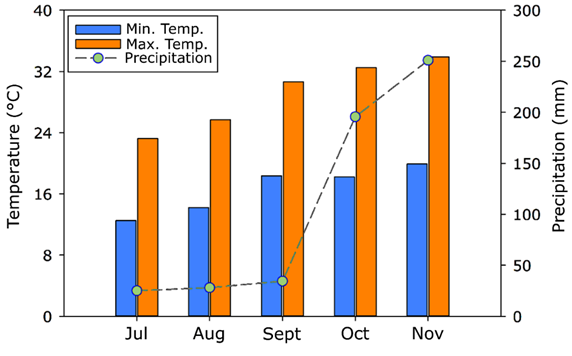
Figure 1 Monthly climatic behavior (minimum, maximum temperature and precipitation) during the experimental period at the Hernando Bertoni Research Center of the Paraguayan Institute of Agricultural Technology, Caacupé, Paraguay, 2021.
Table 1 Chemical characteristics of soil in the experimental area before the start of the experiment
| Depth | pH | SOM | P | Al+3 | Ca+2 | Mg+2 | K+ |
|---|---|---|---|---|---|---|---|
| cm | % | mg dm-3 | ...............cmolc dm-3................. | ||||
| 0-20 | 6,40 | 0,82 | 30,87 | 0,0 | 2,86 | 0,33 | 0,03 |
Note: pH (H₂O); SOM (Soil Organic Matter, modified Walkley-Black); P and K⁺ (Mehlich); Al³⁺, Ca²⁺ and Mg²⁺ (KCl 1 mol·L⁻¹)
Obtaining and characterization of organic fertilizer
The organic fertilizer used in this study was obtained from Cooperativa Manduvira Ltda., located in the city of Arroyos y Esteros. This cooperative produces organic fertilizers from solid waste derived from sugarcane processing, through a composting process without the use of chemical inputs. Raw materials include filter cake (58%), sugarcane bagasse (5%), ash (10%), vegetable protein (10%), minerals (1%), cattle manure (6%), poultry manure (1%), and liquid ecological decomposer inoculants (9%).
Composting is carried out in vertical piles with inoculation of native microorganisms and control of temperature (<70 °C), pH and humidity (20-30%), using mechanical turning to ensure adequate aeration until material maturity is reached. In the final stage, beneficial microorganisms are added to improve the biological quality of the compost. The result is a stable and biologically active product, ready for agricultural use. The main nutritional characteristics of the compost indicate that it possesses 7.45 g/100 g of organic carbon, 4.4 g/100 g of nitrogen, 0.4 g/100 g of phosphorus, 0.3 g/100 g of potassium, 1.7 g/100 g of calcium, and 0.47 g/100 g of magnesium. Chemical characterization of the organic fertilizer was performed through routine analysis in the laboratory at the Hernando Bertoni Research Center of the Paraguayan Institute of Agricultural Technology, Caacupé, Paraguay.
Treatments and experimental design
This study evaluated five treatments consisting of four doses of composted organic fertilizer from sugar industry waste and a control treatment without fertilization. The evaluated levels were: F0 (control, without fertilization), F1 (2 t ha⁻¹), F2 (4 t ha⁻¹), F3 (6 t ha⁻¹), and F4 (8 t ha⁻¹).
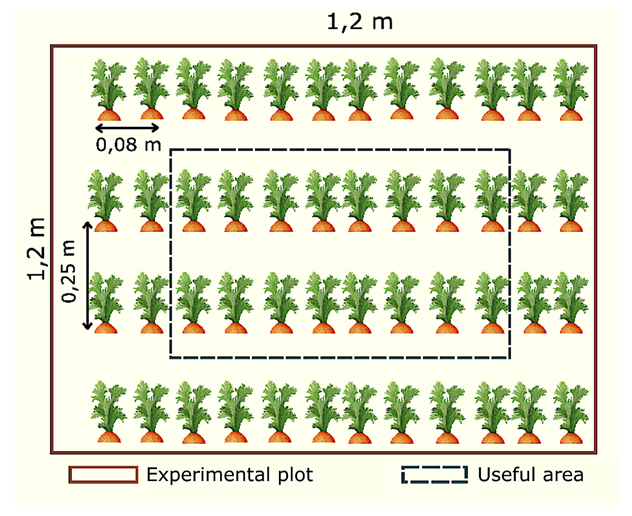
The experimental design was organized under a randomized complete block scheme with three replications per treatment, resulting in a total of 15 experimental plots. Each experimental plot of 1.2 x 1.2 m contained four rows separated 0.25 m from each other and 0.08 m between plants, corresponding to a total of 48 plants per plot and 720 plants in the entire experiment. The useful area was considered to be the two central rows with a surface area of 0.816 m², discarding the lateral rows and 0.16 m at the ends due to border effect (Figure 2).
Crop establishment and evaluation methods
Soil sampling and analysis were performed at the beginning of July 2021. Fifteen days before sowing, the soil was prepared with the help of a rototiller and raised beds of 20 cm height were formed. Following this, the composted organic fertilizer dose, previously weighed according to assigned treatments, was applied and incorporated with a rake. Subsequently, the drip irrigation system was installed.
Carrot sowing, variety Shin Kuroda, was carried out at the end of July. Furrows were opened with a hoe and seeds were deposited manually at 1 cm depth. At 30 days after sowing (DAS), thinning was performed, leaving plant populations as described in the previous section. Throughout the entire crop cycle, periodic monitoring was conducted to ensure optimal irrigation and cleaning conditions. No phytosanitary products were applied at any stage of the crop.
Plant height (cm) was measured at three time points after sowing (30, 60, and 110 DAS, respectively). For this purpose, six plants were randomly selected from the useful area of each plot. Height was measured from soil level to the apex of the aerial part using a measuring tape.
Harvest was performed immediately after the last plant height evaluation (110 DAS). At this stage, six roots were randomly selected from the useful area, and the following variables were measured: root length (cm), determined from the base of the crown to the longest distal extremity; root diameter (cm), measured 2 cm below the crown with a caliper; root weight (g), after washing the roots to remove soil residues and air drying, they were weighed on a precision digital scale; and yield (kg m⁻²), calculated from the average weight of roots obtained in each treatment, extrapolated by multiplying the average weight by the population density established in the experiment.
Statistical analysis
Data were processed using R software (R Core Team, 2020). Normality of residuals was evaluated using the Shapiro-Wilk test. Once this assumption was confirmed, analysis of variance (ANOVA) was performed to determine the effect of treatments on carrot growth and yield variables. When significant differences were identified (p ≤ 0.05), treatment means were compared using Duncan's test at the same significance level. Additionally, for significant variables, regression analysis corresponding to the evaluated doses was performed.
RESULTS AND DISCUSSION
Effect of organic fertilizer on carrot growth parameters
Carrot plant height measured at three stages of the growth cycle is presented in Table 2. Although the highest dose showed heights up to 17% higher at 30 DAS, 16% at 60 DAS, and 13% at 110 DAS compared to other treatments, vegetative growth was statistically similar for all treatments and evaluation stages. These results contrast with those of Hailu et al. (2024), who reported a significant increase in carrot plant height with vermicompost application, but coincide with those of Chillo Yupanqui, Peñafiel Rodríguez, W. and Aruquipa Condori (2024), who observed no significant differences with poultry manure-based fertilizers.
Table 2 Carrot plant height at 30, 60, and 110 days after sowing (DAS) under different doses of composted organic fertilizer made from sugar industry waste.
| Treatments | Plant height (cm) | ||
|---|---|---|---|
| 30 DAS | 60 DAS | 110 DAS | |
| F0 | 5,1 NS | 23,8 NS | 41,2 NS |
| F1 | 5,3 | 24,8 | 40,7 |
| F2 | 4,8 | 23,0 | 37,3 |
| F3 | 5,4 | 23,6 | 40,5 |
| F4 | 5,6 | 26,7 | 42,3 |
| p value | 0,73 | 0,59 | 0,75 |
| CV% | 16,08 | 14,11 | 12,85 |
NS: no significant difference between treatments by Duncan's test (p ≤ 0.05). CV: coefficient of variation.
The limited growth response observed in this study could be attributed to the low compost doses applied, which were insufficient to completely satisfy the nutritional needs of the crop, especially in terms of nitrogen (N) and potassium (K). Although the compost used contained considerable amounts of these nutrients, the concentrations present in the soil were relatively low, particularly for K (Table 1). This macronutrient is fundamental for various biochemical functions in plants and is known to improve the quality of horticultural products by participating in processes such as enzymatic metabolism and synthesis of defense compounds (Sustr, Soukup and Tylova, 2019).
Furthermore, the slow release of N in the compost may have restricted its immediate availability, limiting the growth of the crop's aerial part, which is crucial for sustaining high levels of photosynthesis and accumulating reserves for root development, directly impacting final yield (Guan, Zhang and Chu, 2025; Mishra, Levengood, Fan and Zhang, 2024; Zhou et al., 2022). This suggests that, in addition to increasing applied doses, it might be necessary to enrich the compost with rapid-release sources of N and K or combine it with mineral fertilizers to optimize the availability of these nutrients in degraded soils and satisfy crop demands more effectively.
Influence of organic fertilizer on crop yield parameters
Root length and diameter increased significantly with the applied organic fertilizer doses (p < 0.05). Regarding length, the treatment with the highest dose (F4) showed increases of up to 24.7% compared to the control (F0), reflecting the positive impact of higher concentrations on this variable (Figure 3a). This trend was confirmed by regression analysis, which showed a significant linear association between applied dose and root length (y = 12.418 + 0.313x; R² = 0.73; Figure 3b). When analyzing the equation, it is observed that for each ton of organic fertilizer applied, root length increases on average by 0.313 cm, with dose being responsible for explaining 73% of the observed variation.
Similarly, root diameter also increased with higher doses, with F4 being the treatment with the greatest increases: 34.9% compared to the control and 15.3% compared to F1 (Figure 3c). This positive relationship was supported by regression analysis, which showed a strong linear fit (y = 2.590 + 0.104x; R² = 0.89; Figure 3d). When interpreting the equation, it is observed that carrot diameter increased on average by 0.104 cm for each ton of fertilizer applied, and that 89% of the observed variation in this variable is explained by the dose used.
Both evaluated parameters suggest that higher doses are required to reach the optimum point in the response curve, highlighting the need to conduct local studies on degraded soils to maximize the agronomic potential of the crop. These results are consistent with previous research that has demonstrated positive effects of organic fertilizers on crop root development. For example, Hailu et al. (2024) reported increases of 63% in length and 146% in carrot root diameter with 3 t ha⁻¹ of vermicompost, while Zerga Heterat & Tsegaye (2019) observed increases of 118% in diameter with 75 t ha⁻¹ of compost. These findings support the capacity of organic fertilizers derived from solid waste to significantly improve root structure.
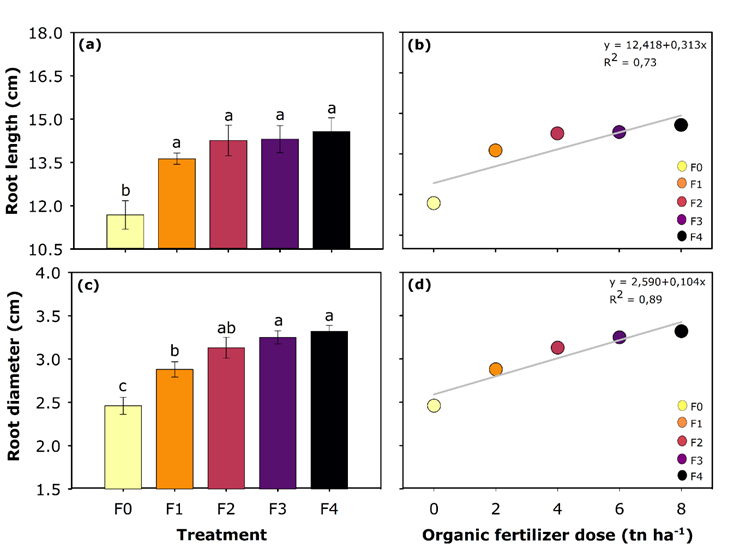
Figure 3 Root length (a-b) and root diameter (c-d) under different doses of composted organic fertilizer made from sugar industry waste. F0 (control, without fertilization), F1 (2 t ha⁻¹), F2 (4 t ha⁻¹), F3 (6 t ha⁻¹), and F4 (8 t ha⁻¹). Vertical lines above bars indicate standard error of means (n = 3). Different letters above bars indicate significant differences between treatments by Duncan's test (p ≤ 0.05).
Both root length and diameter are critical parameters for commercial quality and support of carrot plants (Chillo Yupanqui et al., 2024; Hailu et al., 2024). The positive effect observed with increasing doses of organic fertilizer may be related to the gradual supply of essential nutrients (Oyege and Balaji Bhaskar, 2023). Additionally, the incorporation of organic matter may have partially improved soil structure (Villalba Algarin, 2025), increasing moisture retention and aeration, conditions that favor root development and facilitate nutrient uptake in deeper layers of the soil profile (Salman et al., 2023; Tavali, 2020; Villalba Algarin, Ramírez Paniagua, Sanabria Franco, and da Silva, 2024b). These benefits may have promoted more efficient root growth in treatments with increasing doses of organic fertilizer.
Although increases in root length and diameter were not significantly reflected in root weight and yield, both variables showed a positive linear response with increasing fertilizer doses (Figure 4). Regression analysis showed that, even at the highest doses, yield and root weight continued to increase proportionally (Figure 4b, d), confirming that the applied doses did not saturate the crop's response potential. This suggests that the crop could continue to respond positively to higher applications, possibly because critical thresholds for maximizing productivity have not yet been reached. This trend is consistent with the gradual nutrient release characteristic of organic fertilizers, which may require higher applications to sustain significant increases in biomass and yield, especially in crops with relatively short cycles (Bonanomi, Lorito, Vinale and Woo, 2018).
When analyzing root weight, it was observed that the lowest weight was recorded in F0 (46.6 g), while F4 reached the highest value with 59.3 g (Figure 4a). When interpreting the regression equation, a linear response is observed where for each ton of organic fertilizer applied there is an increase of 1.386 g in root weight (Figure 4b). Although this does not represent a statistically significant difference between means, it could suggest that the applied amounts of organic fertilizer have not been sufficient to completely cover the nutritional demands of the crop and fully activate its productive capacity.
Likewise, when analyzing root yield, it was observed that the lowest value was obtained in the control treatment (F0 = 2.23 kg m⁻²) and reached its maximum point in F4 (2.85 kg m⁻²) (Figure 4c). This linear response was supported by regression analysis, which showed that for each ton of fertilizer applied, the increase in yield was 0.066 kg per square meter (y = 2.366 + 0.066x; R² = 0.79; Figure 4d).
These results partially contrast with those reported in previous studies that found statistically significant increases in root yield with the use of organic fertilizers. For example, Hailu et al. (2024) and Zerga Heterat and Tsegaye (2019) documented substantial improvements in these variables with the highest applied doses. Although a gradual increase was observed here with the studied doses, the degraded soil conditions influenced the agronomic responses of the crop.
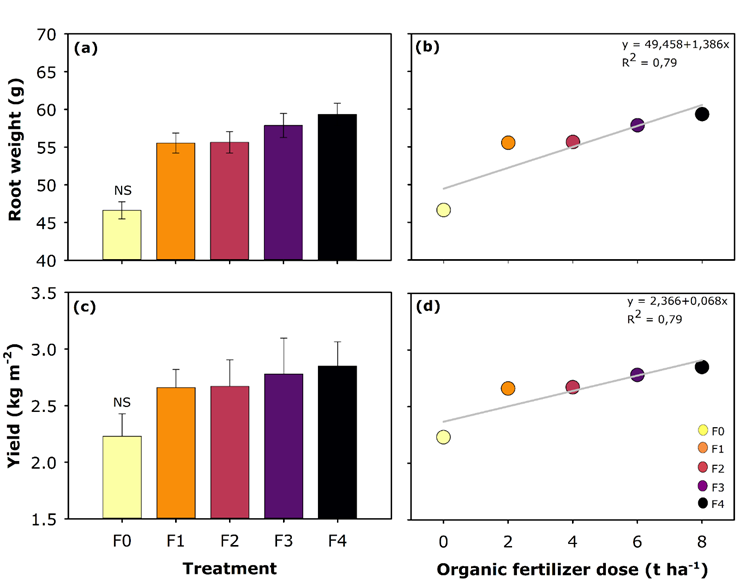
Figure 4 Root weight (a-b) and yield (c-d) of carrot under different doses of composted organic fertilizer made from sugar industry waste. F0 (control, without fertilization), F1 (2 t ha⁻¹), F2 (4 t ha⁻¹), F3 (6 t ha⁻¹), and F4 (8 t ha⁻¹). Vertical lines above bars indicate standard error of means (n = 4). NS: no significant difference between treatments by Duncan's test (p ≤ 0.05).
The use of organic fertilizers in vegetable production has shown mixed results. Some studies reported positive effects on crop productivity and soil quality, while others found limited effects. For example, Núñez Sosa, Liriano González, and López Ceballos (2005) observed that the efficiency of organic amendments can increase when soil organic matter levels are lower. Similarly, Juárez-Rodríguez, Hidalgo-Moreno, Hernández-López, Padilla Cuevas and Etchevers (2024) found that organic fertilizers improved or maintained soil fertility and increased commercial productivity of vegetables, although these effects appear to depend on initial nutrient availability and specific soil characteristics.
The original soil conditions where this study was developed are challenging. Like all highly weathered soils in the region, they present fertility limitations (Table 1), a characteristic normally observed on Paraguayan farms, especially in family farming systems that frequently face limited resources, inputs and implements, in addition to scarce knowledge about good agricultural practices (Derpsch, Lange, Birbaumer and Moriya, 2016). This represents a significant challenge for restoring soil health and closing production gaps.
In this context, the results of this study revealed promising findings: organic fertilizers derived from solid waste from the sugar industry showed clear potential to improve carrot production, supported by the positive linear response in all evaluated variables with increasing applied doses. This trend suggests that, with more adequate management strategies, these fertilizers can offer substantial economic and environmental benefits for producers and the country.
Based on these results, it is suggested that future research evaluate crop response to higher doses, especially considering soil nutrient availability and specific plant requirements. This is fundamental to ensure that applications are precise and effective, maximizing fertilizer benefits. Additionally, combinations with rapid-release sources or the use of additives that accelerate compost mineralization could be explored, promoting more efficient nutrient uptake and higher yields. These approaches could optimize the use of organic fertilizers derived from solid waste and strengthen the sustainability of agricultural systems.
CONCLUSIONS
The use of sugar industry waste converted into organic fertilizers through composting favors carrot root development (length and diameter). However, under the experimental area conditions, the doses used do not influence carrot height, weight, and yield parameters.
In addition to the use of organic waste, highly weathered soils require strategies that synchronize nutrient release with crop demands. These strategies can improve the efficiency of organic fertilizer use derived from sugar industry waste and contribute to more sustainable and productive agricultural systems.
REFERENCES
Andualem, A. M., Kemal, Y. O., Mekonen, D. A., Yenet, F. A., & Kassa, H. W. (2025). Data on effect of NPSB fertilizer rates on growth and yield of carrot (Daucus carrota L.) varieties in Gondar district, Northwestern Ethiopia, Data in Brief, 58, 111232. https://doi.org/10.1016/j.dib.2024.111232 [ Links ]
Bonanomi, G., Lorito, M., Vinale, F., & Woo, S. L. (2018). Organic amendments, beneficial microbes, and soil microbiota: Toward a unified framework for disease suppression. Annual Review of Phytopathology, 56, 1-20. https://doi.org/10.1146/annurev-phyto-080615-100046 [ Links ]
Chae, H. G., Margenot, A. J., Jeon, J. R., Kim, M. S., Jang, K.-S., Yoon, H. Y., Kim, P. J., & Lee, J. G. (2024). Linking the humification of organic amendments with size aggregate distribution: Insights into molecular composition using FT-ICR-MS. Science of the Total Environment, 927, 172147. https://doi.org/10.1016/j.scitotenv.2024.172147 [ Links ]
Chen, J., Li, J., Yang, X., Wang, C., Zhao, L., Zhang, P., Zhang, H., Wang, Y., & Li, C. (2023). The Effects of Biochar-Based Organic Fertilizer and Mineral Fertilizer on Soil Quality, Beet Yield, and Sugar Yield. Agronomy, 13(9). https://doi.org/10.3390/agronomy13092423 [ Links ]
Chillo Yupanqui, C. P., Peñafiel Rodríguez, W., & Aruquipa Condori, R. (2024). Comportamiento productivo de dos variedades de zanahoria (Daucus carota L.) con diferentes niveles de abono orgánico en el Centro Experimental Cota Cota. Cibum Scientia, 3(1), pp. 90-98. https://doi.org/10.53287/ougz5529as70g [ Links ]
Dao, A., Alvar Beltan, J., Gnanda, A., Guira, A., Nebie, L., & SanouJacob.> (2020). Effect of different planting techniques and sowing density rates on the development of quinoa. African Journal of Agricultural Research, 16(9), pp. 1325-1333. https://doi.org/10.5897/ajar2020.14904 [ Links ]
De Carolis, C., Iori, V., Narciso, A., Gentile, D., Casentini, B., Pietrini, F., Grenni, P., Barra Caracciolo, A., & Iannelli, M. A. (2024). The Effects of Different Combinations of Cattle Organic Soil Amendments and Copper on Lettuce (cv. Rufus) Plant Growth. Environments - MDPI, 11(7), 134. https://doi.org/10.3390/environments11070134 [ Links ]
Derpsch, R., Lange, D., Birbaumer, G., & Moriya, K. (2016). Why do medium- and large-scale farmers succeed practicing CA and small-scale farmers often do not? - experiences from Paraguay. International Journal of Agricultural Sustainability, 14(3), pp. 269-281. https://doi.org/10.1080/14735903.2015.1095974 [ Links ]
Duan, C., Li, J., Zhang, B., Wu, S., Fan, J., Feng, H., He, J., & Siddique, K. H. M. (2023). Effect of bio-organic fertilizer derived from agricultural waste resources on soil properties and winter wheat (Triticum aestivum L.) yield in semi-humid drought-prone regions. Agricultural Water Management, 289, 108539. https://doi.org/10.1016/j.agwat.2023.108539 [ Links ]
El-Mogy, M. M., Abdelaziz, S. M., Mahmoud, A. W. M., Elsayed, T. R., Abdel-Kader, N. H., & Mohamed, M. I. A. (2020). Comparative Effects of Different Organic and Inorganic Fertilisers on Soil Fertility, Plant Growth, Soil Microbial Community, and Storage Ability of Lettuce. Agriculture (Pol’nohospodarstvo), 66(3), pp. 87-107. https://doi.org/10.2478/agri-2020-0009 [ Links ]
Fernandes, P., Pinto, R., Correia, C., Mourão, I., Moura, L., & Brito, L. M. (2024). Impact of Kiwifruit Waste Compost on Soil Bacteriome and Lettuce Growth. Agriculture (Switzerland), 14(8), 1409. https://doi.org/10.3390/agriculture14081409 [ Links ]
Gálvez Torres, E., Legua Cárdenas, J., Cruz Nieto, D., Caro Soto, F. , & Inga Sotelo, M. I. (2019). Evaluación de Abono Orgánico de Vinaza y Bagazo de la Caña de Azúcar para la producción ecológica de rabanito (Raphanus sativus L.). Aporte Santiaguino, 12(2), pp. 214-227. Disponible en: http://revistas.unasam.edu.pe/index.php/AS_V10N2/article/view/172 [ Links ]
García-Ramos, C. M., Quirós-Roque, V. A., & Rosales-Mendoza, L. E. (2022). Los residuos generados en la producción de la industria azucarera en los últimos 25 años. Revista Iberoamericana de Bioeconomía y Cambio Climático, 8(16), 1979-1991. https://doi.org/10.5377/ribcc.v8 i16.15041 [ Links ]
Guan, C., Zhang, D., & Chu, C. (2025). Interplay of light and nitrogen for plant growth and development. The Crop Journal, 13 (3), pp. 641-655. https://doi.org/10.1016/j.cj.2025.01.005 [ Links ]
Hailu, F., Hassen, S., Hussen, S., Belete, E., & Alemu, T. (2024). Evaluation of different fertilizer sources for sustainable carrot production in Tehuledere district, northern Ethiopia. Heliyon, 10(8 ), e29693. https://doi.org/10.1016/j.heliyon.2024.e29693 [ Links ]
Juárez-Rodríguez, L., Hidalgo-Moreno, C. I., Hernández-López, F., Padilla Cuevas, J. & Etchevers, J. D. (2024). Manejo sustentable del suelo para producción de verduras orgánicas en el Estado de México. Revista Mexicana de Ciencias Agrícolas, 15 (6), p. 1-11. https://doi.org/10.29312/remexca.v15i6.3395 [ Links ]
Krzyżak, J., Rusinowski, S., Szada-Borzyszkowska, A., Pogrzeba, M., Stec, R., Janota, P., Lipowska, B., Stec, K., Długosz, J., & Sitko, K. (2024). A novel agrosinters support growth, photosynthetic efficiency and reduce trace metal elements accumulation in oilseed rape growing on metalliferous soil. Environmental Pollution, 363, 125095. https://doi.org/10.1016/j.envpol.2024.125095 [ Links ]
LI, H., Feng, W-ting, HE, X. hua, ZHU, P., GAO, H. jun, SUN, N., & XU, M. (2017). Chemical fertilizers could be completely replaced by manure to maintain high maize yield and soil organic carbon (SOC) when SOC reaches a threshold in the Northeast China Plain. Journal of Integrative Agriculture, 16(4), pp. 937-946. https://doi.org/10.1016/S2095-3119(16)61559-9 [ Links ]
López Gorostiaga, O., González Erico, E., Llamas G., P. A., Molinas M., A. S., Franco S., E. S., García, S., y Rios, E. (1995). Estudio de reconocimiento de suelos. Capacidad de uso de la tierra y propuesta de ordenamiento territorial preliminar de la región oriental del Paraguay. Asunción: Ministerio de Agricultura y Ganadería, 246 p. [ Links ]
Maomao, H., Songyan, T., Qinyuan, Z., Jingnan, C., Ying, X., Qiu, J., & Fenglin, Z. (2023). Long-term fermented organic fertilizer application reduce urea nitrogen-15 loss from plastic shed agricultural soils. Annals of Agricultural Sciences, 68 (2), pp. 108 -117. Disponible en: https://doi.org/10.1016/j.aoas.2023.11.002 [ Links ]
Martínez-Saldarriaga, J., Henao-Rojas, J. C., Flórez-Martínez, D. H., Cadena-Chamorro, E. M., & Yepes-Betancur, D. P. (2025). Methodological framework for supporting phytochemical bioprospecting re-search: A case study on carrot (Daucus carota L.) crop by-products. Heliyon, 11(3), e41822 Disponible en: https://doi.org/10.1016/j.heliyon.2025.e418 22 [ Links ]
Matheus L., J. E. (2004). Evaluación agronómica del uso de compost de residuos de la industria azucarera (biofertilizante) en el cultivo de maíz (Zea mays L.). Bioagro, 16(3), pp. 219-224. [ Links ]
Mishra, S., Levengood, H., Fan, J., & Zhang, C. (2024). Plants Under Stress: Exploring Physiological and Molecular Responses to Nitrogen and Phosphorus Deficiency. Plants, 13(22), 3144. Disponible en: https://doi.org/10.3390/plants13223144 [ Links ]
Mitsigiorgi, K., Ntroumpogianni, G. C., Katsifas, E. A., Hatzinikolaou, D. G., Chassapis, K., Skampa, E., Stefi, A. L., & Christodoulakis, N. S. (2024). Lettuce (Lactuca sativa L.) Cultures and the Bioactivity of Their Root Microflora Are Affected by Amended Soil. Plants , 13(13), pp. 18 72. Disponible en: https://doi.org/10.3390/plants131318 72 [ Links ]
Núñez Sosa, S. D. B., Liriano González, G. R., y López Ceballos, C. C. (2005). Evaluación de biofertilizantes (Azospirillum y Micorrizas) y diferentes niveles de materia orgánica en bolsa y organóponico, en el cultivo de la zanahoria (Daucus carota L.). Revista Centro Agrícola, 32(2), pp. 5-10. [ Links ]
Oleszkiewicz, T., Sala-Cholewa, K., Godel-Jędrychowska, K., Kurczynska, E., Kostecka-Gugała, A., Petryszak, P., & Baranski, R. (2025). Nitrogen availability modulates carotene biosynthesis, chromoplast biogenesis, and cell wall composition in carrot callus. Plant Cell Reports, 44(2), 31. https://doi.org/10.1007/s00299-024-03420-7 [ Links ]
Oyege, I., & Balaji Bhaskar, M. S. (2023). Effects of Vermicompost on Soil and Plant Health and Promoting Sustainable Agriculture. Soil Systems, 7(4), 101 https://doi.org/10.3390/soilsystems7040101 [ Links ]
Pinter, I. F., Fernández, A. S., Martínez, L. E., Riera, N., Fernández, M., Aguado, G. D., & Uliarte, E. M. (2019). Exhausted grape marc and organic residues composting with polyethylene cover: Process and quality evaluation as plant substrate. Journal of Environmental Management, 246, pp. 695-705. https://doi.org/10.1016/j.jenvman.2019.06.027 [ Links ]
Parađiković, N., Teklić, T., Zeljković, S., Lisjak, M., & Špoljarević, M. (2019). Biostimulants research in some horticultural plant species-A review. Food and Energy Security, 8 (2), 1-17. https://doi.org/10.1002/fes3.162 [ Links ]
Que, F., Hou, X. L., Wang, G. L., Xu, Z. S., Tan, G. F., Li, T., Wang, Y. H., Khadr, A., & Xiong, A. S. (2019). Advances in research on the carrot, an important root vegetable in the Apiaceae family. Horticulture Research, 6(1), 69. https://doi.org/10.1038 /s41438 -019-0150-6 [ Links ]
Salman, M., Inamullah Jamal, A., Mihoub, A., Saeed, M. F., Radicetti, E., Ahmad, I., Naeem, A., Ullah, J., & Pampana, S. (2023). Composting Sugarcane Filter Mud with Different Sources Differently Benefits Sweet Maize. Agronomy , 13(3), 748 . https://doi.org/10.3390/agronomy13030748 [ Links ]
Srivastava, A. N., & Chakma, S. (2023). Assessment of in situ stabilization and heavy metal toxicity reduction of sugar mill pressmud through pilot scale composting. Environmental Monitoring and Assessment, 195(8 ), 1-15. https://doi.org/10.1007/s10661-023-11564-4 [ Links ]
Sustr, M., Soukup, A., & Tylova, E. (2019). Potassium in Root Growth and Development. Plants (Basel, Switzerland), 8 (10), 435. https://doi.org/10.3390/plants8100435 [ Links ]
Tavali, I. E. (2020). Short-term effect of compost amendment on the fertility of calcareous soil and basil growth. Communications in Soil Science and Plant Analysis, 52(2), pp. 172-182. https://doi.org/10.1080/00103624.2020.1854292 [ Links ]
Urra, J., Alkorta, I., Mijangos, I., & Garbisu, C. (2020). Commercial and farm fermented liquid organic amendments to improve soil quality and lettuce yield. Journal of Environmental Management , 264, 110422. https://doi.org/10.1016/j.jenvman.2020.110422 [ Links ]
Velasco-Velasco, J., Gomez-Merino, F.C., Hernández-Cázares, J., Salinas-Ruiz, J. R. y Guerrero-Peña, A. (2017). Residuos orgánicos de la agroindustria azucarera: Retos y Oportunidades. AGROProductividad, 10(11), pp. 99-104. Disponible en: https://go.gale.com/ps/anonymous?id=GALE%7CA530914355&sid=googleScholar&v=2.1&it=r&linkaccess=abs&issn=&p=IFME&sw=w [ Links ]
Villalba Algarin, C. A. (2025). Avanzando hacia una agricultura climáticamente inteligente : el papel del carbono orgánico en las funciones del suelo , los servicios ecosistémicos y la sostenibilidad de agroecosistemas. Investigacion Agraria, 27(1), e2701825. https://doi.org/10.18004/investig.agrar.2025.2701825 [ Links ]
Villalba Algarin, C. A., González, A. C., Szostak, J. E. y Sanabria Franco, M. F. (2024a). Explorando el estado del arte de la labranza y su impacto en la calidad del suelo y la productividad agrícola : una revisión crítica de los últimos 20 años. Investigación Agraria, 26(2), pp. 111-124. https://doi.org/10.18004/investig.agrar.2024.diciembre.2602806 [ Links ]
Villalba Algarin, C. A., Ramírez Paniagua, I. R., Sanabria Franco, M. F., y da Silva, C. D. (2024b). Comportamiento agronómico bajo diferentes densidades de siembra del sésamo negro (Sesamum indicum L.) en la Región Sur del Paraguay. Investigación Agraria , 26(1), pp. 22-28. https://doi.org/10.18004/investig.agrar.2024.junio.2601768 [ Links ]
Wang, Y., Zhu, Y., Zhang, S., & Wang, Y. (2018). What could promote farmers to replace chemical fertilizers with organic fertilizers? Journal of Cleaner Production, 199, pp. 882-890. https://doi.org/10.1016/j.jclepro.2018.07.222 [ Links ]
Windisch, S., Sommermann, L., Babin, D., Chowdhury, S. P., Grosch, R., Moradtalab, N.,… & Neumann, G. (2020). Impact of Long-Term Organic and Mineral Fertilization on Rhizosphere Metabolites, Root-Microbial Interactions and Plant Health of Lettuce. Frontiers in Microbiology, 11. https://doi.org/10.3389/fmicb.2020.597745 [ Links ]
Wu, S., Li, K., Diao, T., Sun, Y., Sun, T., & Wang, C. (2025). Influence of continuous fertilization on heavy metals accumulation and microorganism communities in greenhouse soils under 22 years of long-term manure organic fertilizer experiment. Science of the Total Environment , 959. https://doi.org/10.1016/j.scitotenv.2024.178294 [ Links ]
Yagüe, M. R., y Lobo, M. C. (2024). Valorization of organic residues for lettuce production minimizes nitrogen loss in soil in comparison to mineral fertilization. Journal of Plant Nutrition, 47(10), pp. 1680-1696. https://doi.org/10.1080/01904167.2024.2319161 [ Links ]
Zerga Heterat, K., & Tsegaye, B. (2019). Effect of Different Rates of Compost Application on Growth Performance and Yield Components of Carrot (Daucus carrota L.) in Gurage Zone, Ethiopia. International Journal of African and Asian Studies, 54, pp. 24-31. https://doi.org/10.7176/jaas/54-03 [ Links ]
Zhou, S., Song, Z., Li, Z., Qiao, R., Li, M., Chen, Y., & Guo, H. (2022). Mechanisms of nitrogen transformation driven by functional microbes during thermophilic fermentation in an ex situ fermentation system. Bioresource Technology, 350, 126917. https://doi.org/10.1016/j.biortech.2022.126917 [ Links ]
8Data availability: The complete dataset supporting the results of this study is available upon request to the corresponding author. The dataset is not publicly available due to the project continuing to collect data from different periods and seasons.
Received: May 07, 2025; Accepted: August 01, 2025; Published: September 11, 2025
 Este es un artículo publicado en acceso abierto bajo una licencia Creative Commons
