




Services on Demand
Journal

Article
 text in
 English (pdf)
 Article in xml format
 Article references

 Automatic translation
 Send this article by e-mail
Indicators
-
 Cited by SciELO
Related links
-
 Similars in
SciELO
Share

 Permalink

Investigación Agraria
On-line version ISSN 2305-0683
Investig. Agrar. vol.27 no.1 San Lorenzo 2025 Epub June 30, 2025
https://doi.org/10.18004/investig.agrar.2025.2701836
Scientific article
Evaluation of the effectiveness and environmental impact of pre-emergent herbicides for weed control in sugarcane (Saccharum spp.)

1 Instituto de Investigaciones de la Caña de Azúcar. La Habana, Cuba.
To evaluate the effectiveness and environmental impact of different pre-emergent herbicide treatments for weed control in sugarcane, two field experiments were conducted at different locations from April 2020 to June 2021. A floristic survey of weed species was performed to determine taxonomic composition and frequency of occurrence. Seven herbicide treatments were evaluated: Unipix GD70 (Imazapic), Merlín Total SC60 (Isoxafluotole + Indaziflan), Mayoral LS35 (Imazapic + Imazapyr), Palmero GD75 (Isoxafluotole), Palmero GD75 + Mayoral LS35, Merlín GD75 + Mayoral LS35, and Merlín GD75 (Isoxafluotole) as the standard treatment, along with an untreated control. Environmental impact coefficients and total costs per hectare were calculated for each treatment. The floristic survey revealed that weed species share close phylogenetic relationships, facilitating management through similar control practices. All herbicide treatments provided excellent weed control. Regarding environmental impact, 50% of treatments posed low risk while the remaining 50% posed very low risk. Unipix GD70 demonstrated the best cost-benefit ratio with the lowest cost per hectare per weed-free day, maintaining weed-free conditions for 90 days post-application. These results expand integrated weed management strategies as alternatives to the conventional Merlín GD75 treatment (0.200 kg ha⁻¹), providing more efficient and environmentally sustainable options for sugarcane weed control.
Keywords: imazapic; isoxafluotole; integrated management; environmental impact coefficient; cost-benefit; sustainable agricultura
Con el objetivo de evaluar la efectividad y el impacto ambiental de diferentes tratamientos herbicidas preemergentes para el control de especies arvenses en caña de azúcar, se establecieron dos experimentos de campo en diferentes localidades durante el período abril 2020 - junio 2021. Se realizó un inventario florístico de las plantas arvenses para determinar la composición taxonómica de las especies y su frecuencia de aparición. Se evaluaron siete tratamientos herbicidas: Unipix GD70 (Imazapic), Merlín Total SC60 (Isoxafluotole + Indaziflan), Mayoral LS35 (Imazapic + Imazapyr), Palmero GD75 (Isoxafluotole), Palmero GD75 + Mayoral LS35, Merlín GD75 + Mayoral LS35, y Merlín GD75 (Isoxafluotole) como testigo estándar, además de un testigo absoluto sin aplicación de herbicidas. Para cada tratamiento se calculó el coeficiente de impacto ambiental y se evaluó el costo total por hectárea. El inventario florístico confirmó que las especies arvenses presentan una relación filogenética cercana, lo cual facilita su manejo mediante prácticas de control similares. Todos los tratamientos herbicidas evaluados lograron un control excelente de las especies arvenses. En cuanto al impacto ambiental, el 50% de los tratamientos presentaron un nivel de riesgo bajo y el 50% restante un riesgo muy bajo. El tratamiento Unipix GD70 mostró la mejor relación costo-beneficio con el menor costo por hectárea por días libres de malezas, manteniendo el cultivo limpio durante 90 días posteriores a la aplicación. Los resultados obtenidos permiten ampliar las estrategias de manejo integrado de malezas como alternativas al tratamiento convencional Merlín GD75 (0.200 kg ha⁻¹), ofreciendo opciones más eficientes y ambientalmente sostenibles para el control de arvenses en caña de azúcar.
Palabras clave: imazapic; isoxafluotole; manejo integrado; coeficiente de impacto ambiental; costo-beneficio; agricultura sostenible
INTRODUCTION
The Cuban sugarcane agroindustry faces multiple challenges that significantly affect productivity, including rural depopulation, pest presence, deficiencies in cultural practices, and adverse climatic conditions such as drought, factors that favor the proliferation of weed species. Unwanted plants constitute the second leading cause of yield reduction in sugarcane, causing losses ranging from 33% to 66% in harvests, reaching up to 97.5% due to their constant competition for resources such as water, nutrients, and light (Rodríguez Tassé, Barbosa García, Puchades Isaguirre, Rodríguez Rodríguez & García Perú, 2020; Barrera Fontanet, Cervera Duverger & Barquié Pérez, 2020).
Weed management is crucial following planting or harvest to prevent losses in cane and sugar production, and has evolved from manual methods to the use of machinery and herbicides (Comastri, 2022). Chemical control is essential due to the large extension of crops and labor shortages (Naranjo Landero, Obrador Olán, García López, Valdez Balero & Domínguez Rodríguez, 2020). Pre-emergent herbicides are efficient and economical, preventing seed germination through their residual action and are widely used in both irrigated and rainfed crops (Miranda, 2021).
However, continuous and indiscriminate use of herbicides can generate ecological imbalances and favor the development of resistance in weed species (Jáquez-Matas, Pérez-Santiago, Márquez-Linares & Pérez-Verdín, 2022). Environmental impact assessment enables identification, avoidance, and minimization of negative effects from agricultural activities, with prevention being more efficient than subsequent remediation. In this context, the use of indices to evaluate the environmental risk of herbicides becomes fundamental for increasing the sustainability of management strategies, allowing comparison of different programs and selection of the most environmentally sound products (Jáquez-Matas et al., 2022).
The Environmental Impact Quotient (EIQ) is a tool developed by the Integrated Pest Management Program at Cornell University that allows comparison of different herbicides or management programs through a dimensionless numerical value. This index considers physical and chemical properties of pesticides, ecotoxicological aspects, and effects on human health (Kovach, Petzold, Degni & Tette, 1992).
The objective of this study was to evaluate the effectiveness, environmental impact, and costs of different pre-emergent herbicide treatments for weed control in sugarcane cultivation.
MATERIALS AND METHODS
The study was conducted in two sugarcane production units (UPC) in Santiago de Cuba province: UPC Juan José Verdecía in Julio Antonio Mella municipality and UPC Niguabo in Dos Ríos municipality, both located in Palma Soriano (Cauto plain or Tayaba valley) at coordinates 20°12′50″N 75°59′31″W.
The research was conducted between April 2020 and June 2021, evaluating both plant cane and ratoon with three cuts, using varieties C86-12 and C90-530. The experiments were established on two soil types: Mollisol and Pellic Vertisol, according to the Cuban soil classification system (Hernández et al., 2015).
To determine the taxonomic composition and frequency of occurrence of weed species, a floristic inventory was conducted at the research sites using the visual method of Martínez, Zuaznábar-Zuaznábar & Rodríguez-García (2022). Fields were traversed diagonally and major weed species were recorded. Taxonomic identification was performed using specialized manuals cited by Martínez et al. (2024) and Rodríguez (2007) and the automated PC Malezas system, which includes information on 35 common species in sugarcane and a photographic gallery of these weeds (Instituto de Investigaciones de la Caña de Azúcar (INICA), 2020).
With the phytosociological data obtained, the frequency of occurrence (FA) of weed species was determined according to Amador, Mederos, Bojórquez, Díaz & Partida (2013). Species were classified according to their frequency of occurrence following Martínez et al. (2022): Accidental (0-24.9%), Infrequent (25-49.9%), Moderately frequent (50-74.9%), and Very frequent (>75%).
Two field studies were conducted to evaluate different herbicide treatments (Table 1). The experimental design was randomized complete blocks with five replications and plots of four rows 7.5 m long, with a surface area of 48 m² per experimental unit. An untreated control without herbicide application and a standard control with isoxafluotole (Merlín GD75) were included. Treatments were evaluated after planting and following crop harvest, applied with a 16 L Matabi manual backpack sprayer with deflector nozzle at 2 bar pressure to ensure uniform distribution of the solution.
Table 1 Herbicide treatments evaluated in the different experiments.
| No. | Treatment | Active ingredient | Dose (kg·ha⁻¹) | Supplier |
| 1 | Untreated control | ---- | - | -- |
| 2 | Merlín GD75 (standard control) | Isoxaflutole | 0.200 | Bayer C. S. |
| Experiment 1 (UPC J.J. Verdecía) | ||||
| 3 | Unipix GD 70 | Imazapic | 0.200 | UPL |
| 4 | Merlín Total SC60 | Isoxafluotole + Indaziflan | 0.25 | Bayer C. S. |
| 5 | Mayoral LS35 | Imazapic + Imazapyr | 0.5 | ADAMA |
| Experiment 2 (UPC Niguabo) | ||||
| 6 | Palmero GD75 | Isoxafluotole | 0.230 | ADAMA |
| 7 | Palmero GD75 + Mayoral LS35 | Isoxafluotole + Imazapic + Imazapyr | 0.115 + 0.25 | |
| 8 | Merlín GD75 + Mayoral LS35 | Isoxafluotole + Imazapic + Imazapyr | 0.115 + 0.25 | |
Herbicide effectiveness was determined at 30, 60, and 90 days after application (DAA) through visual evaluation according to Domínguez (2008). The percentage of weed species control was classified according to the scale proposed by ALAM (1974) (Table 2). Crop phytotoxicity was evaluated at 7, 14, 21, and 28 days after application, using the nine-point scale of the European Weed Research Society (EWRS) (CIBA-GEIGY, 1981).
Table 2 Evaluation scale for weed control percentage according to ALAM (1974)
| Index (%) | Control grade |
| 0 - 40 | None or poor |
| 41 - 60 | Regular |
| 61 - 70 | Sufficient |
| 71 - 80 | Good |
| 81 - 90 | Very good |
| 91 - 100 | Excellent |
An analysis of variance was performed to study differences between treatments and replications in the different evaluations, excluding the untreated control. Data were verified for normality and homogeneity of variances, transforming when necessary, according to x = 2 arcsin√p. For multiple comparisons, Tukey's test (p = 0.05) was used, employing STATISTICA version 8.0 software (STATSOFT, 2007).
The amount of active ingredient (AAI) reaching the soil was calculated considering the percentage of active ingredient of each herbicide and the applied dose (Taylor, 2020), using the formula:
AAI = % Active Ingredient (a.i.) × application dose
To determine the environmental impact coefficient, the Environmental Impact Quotient (EIQ) index was used following the methodology of Kovach et al. (1992). The field EIQ was calculated from the percentage of active ingredient and the applied dose. For treatments with mixtures, the field EIQs of each ingredient were summed. Environmental impact comparison was performed according to the coefficient of each herbicide, since according to Kovach et al. (1992), baseline EIQ values should not be compared because impact depends on dose and percentage of active ingredient. Environmental risk classification followed that proposed by Stewart, Nurse, Van Eerd, Vyn & Sikkema (2011), where higher numerical values of the index indicate greater environmental impact.
The total cost of each treatment was evaluated considering herbicide prices. Cost per hectare and per weed-free days was calculated by multiplying the price of each product by the dose used and dividing by the days of effective control.
RESULTS AND DISCUSSION
The floristic inventory identified 12 weed species distributed across five botanical families (Table 3). The Poaceae family was the most abundant, representing 58.3% of the total, with predominant species such as Dichanthium annulatum, Cynodon dactylon, and Sorghum halepense. The Convolvulaceae family represented 16.6% with two species. It is important to note that 50% of the identified species present a perennial vegetative cycle, a characteristic that significantly complicates their control according to Núñez-Rodríguez, Pablos-Reyes, Maceo-Ramírez, Alarcón-Méndez & Nápoles-Vinent (2020).
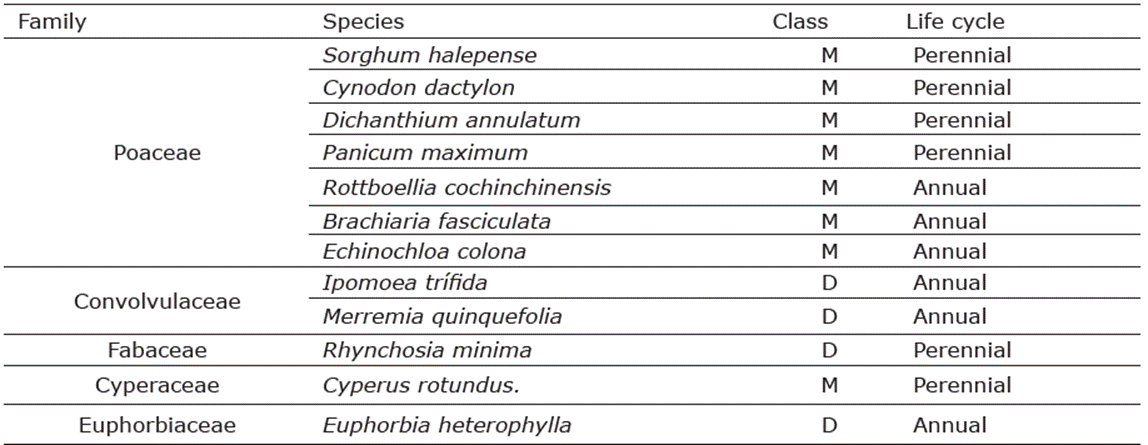
The identified plants from the Poaceae and Euphorbiaceae families have been previously reported as species present in Cuban agricultural ecosystems by Blanco Valdés, Leyva Galán & Castro Lizazo (2014). Barrera et al. (2019) obtained similar results in their study from the 2006-2015 decade, where they reported the presence of 14 botanical families with predominance of Poaceae (44%) and Euphorbiaceae (9.8%). De Moya Guerra, Martínez Hernández & García (2021) indicated that the Asteraceae and Poaceae families are among 50% of the most harmful weed species worldwide. Aulestia Calala et al. (2021) also reported Poaceae as one of the families present in Ecuadorian agricultural ecosystems. The species R. cochinchinensis, C. rotundus, C. dactylon, E. colona, and S. halepense recorded in this study are among the 16 species with highest incidence and damage to crops worldwide according to Cabrera, Ansonnaud & Varela (2020).
The frequency of occurrence from the floristic inventory is presented in Figure 1. In the very frequent category (>75%), only R. cochinchinensis was classified. As moderately frequent (50-74.9%), I. trifida, R. minima, C. dactylon, and C. rotundus were recorded. The species S. halepense, M. quinquefolia, D. annulatum, E. heterophylla, B. fasciculata, E. colona, and P. maximum were classified as infrequent (25-49.9%).
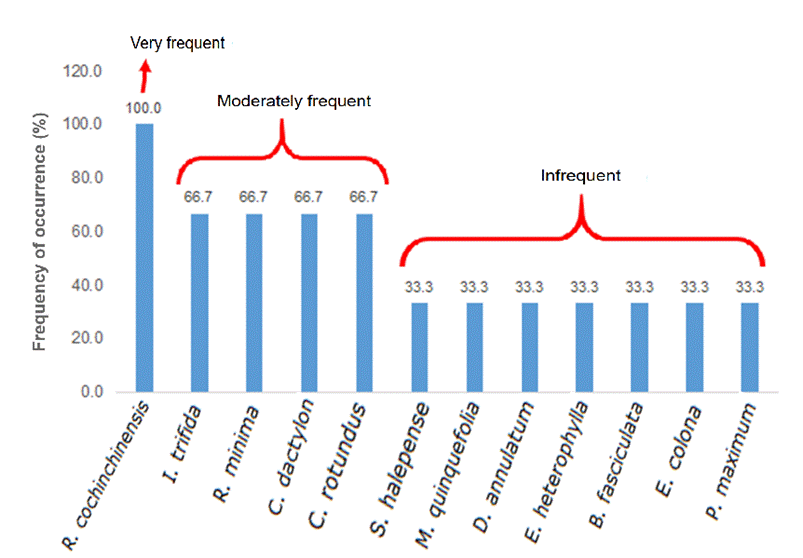
The study results coincide with those obtained by Barrera et al. (2020), who analyzed weed frequency in Guantánamo during the 2006-2011 period, finding that R. cochinchinensis, C. dactylon, and I. trifida were above 25%. Martínez Ramírez (2019) also evaluated changes in weed composition associated with sugarcane cultivation and identified frequency patterns similar to those observed in this study. In the evaluated areas, a predominance of weed species in the infrequent category was evident, followed by moderately frequent and very frequent, respectively. Núñez-Rodríguez et al. (2020) reported the same trend, with predominance of the infrequent category.
All treatments evaluated at UPC Juan José Verdecía showed good control of weed species (Table 4), without significant differences between them. The Mayoral LS35, Merlín Total SC60, and Unipix GD70 treatments demonstrated effectiveness at all evaluation times, suggesting that viable alternatives exist for weed control in sugarcane, in addition to the conventional Merlín GD75 treatment.
Table 4 Control percentage in the different evaluations conducted at UPC Juan José Verdecía.
| No. | Treatment | Dose (kg or L·ha⁻¹) | Control Percentage (%) | ||
| 30 DDA | 60 DDA | 90 DDA | |||
| 1 | Untreated control | - | 0.00 | 0.00 | 0.00 |
| 2 | Merlín GD75 | 0.200 | 95.5 | 94.2 | 90.0 |
| 3 | Unipix GD70 | 0.200 | 99.2 | 94.2 | 90.0 |
| 4 | Merlín Total SC60 | 0.25 | 95.5 | 94.3 | 90.1 |
| 5 | Mayoral LS35 | 0.5 | 95.3 | 94.2 | 89.9 |
| Standard error | --- | 2.96 | 4.24 | 4.55 | |
| CV | --- | 0.252 | 0.376 | 0.399 | |
Legend: DAA = days after application; CV = coefficient of variation
The herbicides used in this study were effective in controlling all predominant weed species. According to Sánchez Zorrilla (2020), the herbicide Merlín Total SC60 showed efficacy in weed control in sugarcane for 90 days after application.
The herbicide treatments studied showed excellent control of species such as R. cochinchinensis, C. rotundus, C. dactylon, I. trifida, D. annulatum, and R. minima. With the application of Merlín Total SC60 herbicide, the lowest percentage of weeds was obtained, followed by Mayoral LS35 and Merlín GD75. The species R. minima, D. annulatum, and I. trifida showed greater coverage with Unipix GD70, although good control of C. dactylon, C. rotundus, D. annulatum, and R. minima was verified. Rodríguez Tassé et al. (2020) also demonstrated effective management of these species when using Merlín Total SC60 and Mayoral LS35 herbicides.
When evaluating the phytotoxicity of products applied to sugarcane (cultivar C86-12), no negative symptoms were found in the crop. Araújo, Marinho & Sobrinho (2020) compared several pre-emergent herbicides and observed that they caused little or no phytotoxicity to the sugarcane crop.
At UPC Niguabo, all herbicide treatments achieved good weed control compared to the untreated control, without significant differences between them (Table 5). Control was similar when using Palmero GD75 at 0.230 kg ha⁻¹ and Merlín GD75 at 0.230 kg ha⁻¹. The mixtures of Palmero GD75 (0.115 kg ha⁻¹) with Mayoral LS35 (0.25 L ha⁻¹) and Merlín GD75 (0.115 kg ha⁻¹) with Mayoral LS35 (0.25 L ha⁻¹) offered similar control, with a slight tendency to be superior to individually applied treatments, although without statistically significant differences.
Table 5 Control percentage in the different evaluations conducted at UPC Niguabo.
| No. | Treatment | Dose (kg or L ha⁻¹) | Control Percentage (%) | ||
| 30 DDA | 60 DDA | 90 DDA | |||
| 1 | Untreated control | - | 0.00 | 0.00 | 0.00 |
| 2 | Merlín GD75 (estándar) | 0.230 | 96.4 | 96.9 | 97.0 |
| 3 | Palmero GD75 | 0.230 | 96.5 | 96.8 | 96.9 |
| 4 | Palmero + Mayoral LS35 | 0.115 + 0.25 | 97.2 | 97.5 | 97.9 |
| 5 | Merlín GD 75 + Mayoral LS35 | 0.115 + 0.25 | 97.3 | 97.4 | 97.9 |
| Error estándar | --- | 4.61 | 6.35 | 6.92 | |
| CV | --- | 0.336 | 0.424 | 0.474 | |
Legend: DAA = days after application; CV = coefficient of variation
This study demonstrated that it is possible to control various weed species using pre-emergent herbicides with the same active ingredient, but from different suppliers, either alone or in combination. Rodríguez Tassé et al. (2020) verified that Merlín Total SC60 and Mayoral LS35 achieved effective control for up to 120 days without affecting agricultural yield when using recommended doses. Vargas (2021) evaluated the effectiveness of the herbicide isoxaflutole (GD75) for weed control and concluded that the product prevents weed development for up to 120 days after application in sugarcane.
The evaluated treatments achieved good control of various weed species, highlighting the low coverage percentage observed in R. cochinchinensis and C. rotundus. The most effective combinations were Palmero GD75 (0.115 kg ha⁻¹) with Mayoral LS35 (0.25 L ha⁻¹) and Merlín GD75 (0.115 kg ha⁻¹) with Mayoral LS35 (0.25 L ha⁻¹). The species with highest coverage at 90 days was P. maximum. Previous studies also showed that Guateque GD75 (isoxaflutole GD75) controls E. colona and P. oleracea, frequent species in sugarcane, at doses of 0.150, 0.175, and 0.200 kg ha⁻¹ (Martínez et al., 2022).
During the evaluated period, herbicide treatments showed high selectivity with the sugarcane crop, as no damage symptoms were observed in the crop. Gómez Vásquez (2020) mentions that proper application of herbicides before weed growth allows good control without damaging the crop. Herrera-Murillo & Picado-Arroyo (2023) also indicate that pre-emergent application achieves effective control without causing crop damage.
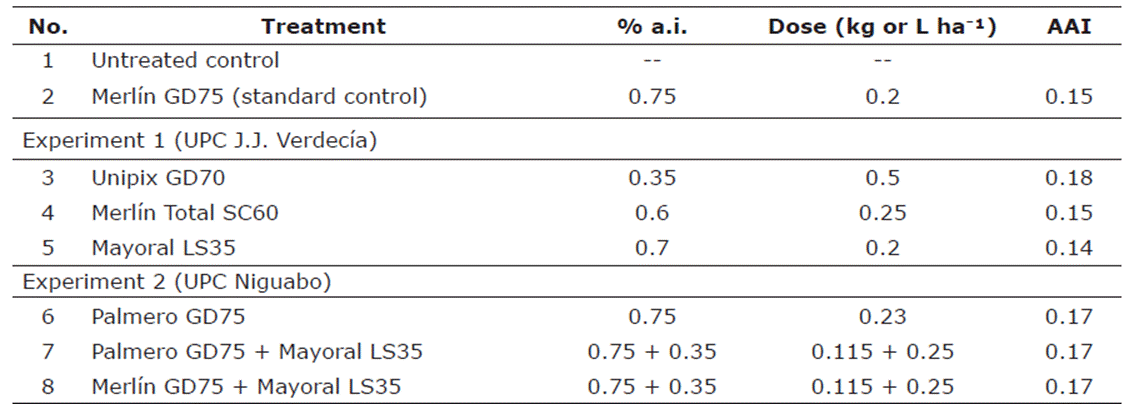
The amount of active substance effective in weed control that reaches the soil per hectare is small, in some cases due to low percentages of active ingredients and in others due to the low dose applied (Table 6). The lowest amounts were presented by Mayoral LS 35, Merlín GD 75, and Merlín Total SC 60.
Table 6 Amounts of active ingredient (a.i.) reaching the soil.
AAI: Amount of Active Ingredient; a.i.: active ingredient
The Unipix GD70 treatment presented the highest amount of active ingredient reaching the soil, with an AAI value = 0.18, equivalent to 0.01 g of the product per m². Rodríguez, Barbosa García, Gracia Perú, Zamora Fuentes & Rodríguez Hechavarria (2019) found that the Mayoral LS35 herbicide only contributes between 0.140 and 0.175 L of active ingredient per hectare, suggesting a low risk of retention in crops and soils.
The environmental impact coefficient of the herbicide treatments indicates that 50% of treatments present low risk and the other 50% present very low risk (Table 7). The products Merlín GD75 and Palmero GD75 presented the lowest level of environmental risk, being classified as very low.
Table 7 Environmental Impact Coefficient and field EIQ of each herbicide treatment applied.
| No. | Treatment | EIQ | AAI | Field EIQ | Risk level |
| 1 | Untreated control | -- | -- | -- | |
| 2 | Merlín GD75 (standard control) | 24 | 0.15 | 3.6 | Very low |
| Experiment 1 (UPC J.J. Verdecía) | |||||
| 3 | Unipix GD70 | 43.5 | 0.18 | 7.6 | Low |
| 4 | Merlín Total SC60 | 39.5 | 0.15 | 5.9 | Low |
| 5 | Mayoral LS35 | 21.2 | 0.14 | 3.0 | Very low |
| Experiment 2 (UPC Niguabo) | |||||
| 6 | Palmero GD75 | 24 | 0.17 | 4.1 | Very low |
| 7 | Palmero GD75 + Mayoral LS35 | 45.75 | 0.17 | 7.9 | Low |
| 8 | Merlín GD75 + Mayoral LS35 | 45.75 | 0.17 | 7.9 | Low |
EIQ: Environmental Impact Quotient; AAI: Amount of Active Ingredient
It is essential to have tools that evaluate these risks through simple indicators to optimize herbicide use (Barrantes, 2022). The EIQ index constitutes a useful tool for measuring the environmental impact of herbicides used in sugarcane (Fernández Aurazo, 2021). This index allows evaluation of treatment effects in agroecosystems, quantification of chemical product use, comparison of different pesticides, and selection of those with lower environmental impact.
The economic feasibility evaluation demonstrated that all evaluated treatments presented low costs per hectare per weed-free days (Table 8). The lowest cost per hectare per weed-free days was obtained with the Unipix GD70 treatment. The Merlín Total SC60 treatment had the highest cost.
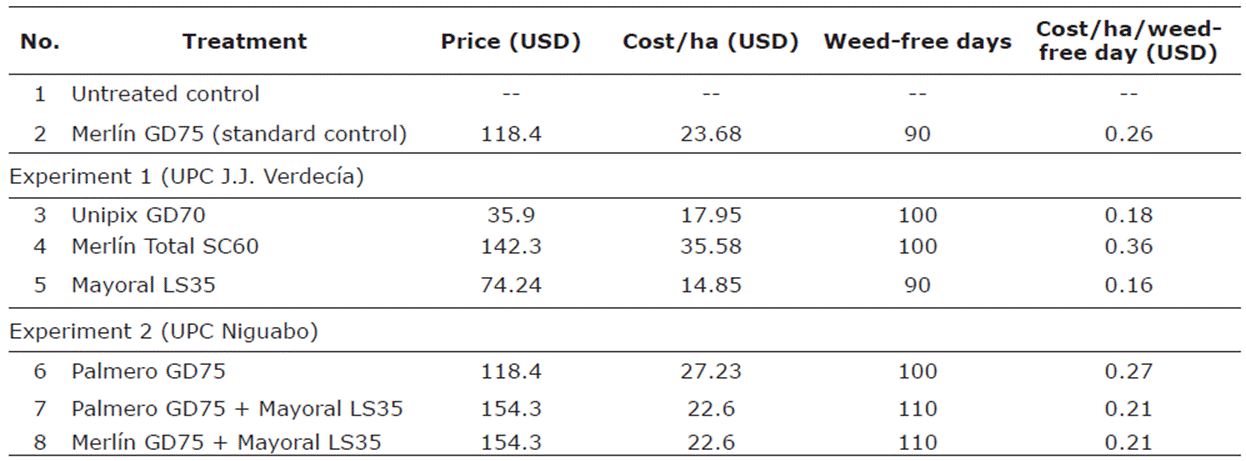
Weed control during the first 120 days of a plantation is very important, because the losses it can cause in yield can exceed 50% according to Zafar, Tanveer, Cheema & Ashraf (2010). In a study on herbicides in sugarcane cultivation, it was found that treatments with higher doses also cost more, but kept the field clean for longer periods, which could increase expenses (Rodríguez Tassé et al., 2020).
This study demonstrated that the use of new pre-emergent herbicides controls weeds very well, without damaging the sugarcane. Chemical alternatives are proposed to reduce weeds in the initial stages of the crop, with low environmental impact and lower cost.
CONCLUSIONS
The floristic inventory confirmed the predominance of the Poaceae family, particularly the species R. cochinchinensis.
All evaluated treatments presented excellent control of weed species in pre-emergence in sugarcane cultivation, which allows expanding chemical management strategies in relation to the conventional Merlín GD75 treatment (0.200 kg ha⁻¹).
The treatments Merlín GD75, Unipix GD70, and Palmero GD75 presented very low environmental risk, while Mayoral LS35, Merlín Total SC60, and treatment combinations showed low risk, indicating that the evaluated herbicides are environmentally sustainable.
The Unipix GD70 treatment (0.200 kg ha⁻¹) presented the lowest cost per hectare per weed-free days (0.16) with 90 days of control after application, which is economically feasible.
REFERENCES
Amador, I. D., Mederos, M., Bojórquez, G., Díaz, T. y Partida, L. (2013). Diagnóstico del enmalezamiento en zonas agrícolas cubanas de cultivos de ciclos cortos. En Manejo y control de malezas en Latinoamérica. Asociación Latinoamericana de Malezas, p. 213-218. [ Links ]
Araújo, R., Marinho, A. y Sobrinho, R. (2020) Seletividad de herbicidas aplicados, empré-emergência, na fase de estabelecimento da cana-de-açúcar. Scientific Electronic Archives, 13 (6), 16-24.http://dx.doi.org/10.36560/1362020968 [ Links ]
Aulestia Calala, G. J., Chuchuca Chacha, A. E., Cunalata Caguana, G. E., Jaguaco Cumbajin, E. B., Sánchez Guanopatin, E. M., Solórzano Bonoso, E. L. y Ulloa González, G. B. (2021). Poaceae. Guía fotográfica de las plantas útiles en la familia Poaceae en el Ecuador. Universidad Técnica COTOPAXI. Facultad de Ciencias Agropecuarias y Recursos naturales. Ecoturismo, 37 p. Disponible en: https://es.slideshare.net/slideshow/familia-poaceae-77087486/77087486 [ Links ]
Barrantes, A. L. (2022). Ingredientes activos en plaguicidas. TSI Life Science. Tecnosoluciones. https://tecnosolucionescr.net/blog/617-ingredientes-activos-en-plaguicidas [ Links ]
Barrera, M., Peña, L., Cobas, A., Terrero, J., Cervera, G., Barquié, O. y Peña, M. (2019). Avances del Control Integral de Malezas, 10 años después de la implementación del Servicio de Recomendaciones. Revista Cuba y Caña, 22 (1) 1028-6527, 25-36 [ Links ]
Barrera Fontanet, M., Cervera Duverger, G. y Barquié Pérez, O. (2020). Especies leñosas, exóticas e invasoras, en áreas cañeras de la provincia Guantánamo. Revista Centro Agrícola, 47 (4), pp. 81-89. [ Links ]
Blanco Valdés, Y., Leyva Galán, A., y Castro Lizazo, I. (2014). Determinación del período crítico de competencia de arvenses en el cultivo del maíz (Zea mays L.). Cultivos Tropicales, 35 (3), 62-69. http://scielo.sld.cu/pdf/ctr/v35n3/ctr07314.pdf [ Links ]
Cabrera, D., Ansonnaud, R. J., y Varela, A. E. (2020). Análisis de la comunidad de malezas en dos edades de corte del cultivo de caña de azúcar (Sacharum officinarum L.). Revista Agronómica del Noroeste Argentino, 40 (1), 31-38. [ Links ]
CIBA-GEIGY. (1981). Manual para ensayos de campo en protección vegetal. 2da ed. Basilea, Suiza: Editorial CIBA-Geigy, 205 p. [ Links ]
Comastri, L. (2022). Cuatro maneras de control de malezas en el cultivo de sorgo. Santacruz de la Sierra, Bolivia: Totalpec. Disponible en: https://totalpec.com/blog/146/cuatro-maneras-decontrol-de-malezas-en-el-cultivo-de-sorgo. [ Links ]
De Moya Guerra, N., Martínez Hernández, N. J., y García, A. F. (2021). Diversidad taxonómica de opiliones en la vertiente occidental de la Sierra Nevada de Santa Marta, Magdalena, Colombia. Boletín Científico Centro de Museos. Museos de Historia Natural, 25(2), 157-180. https://doi.org/10.17151/bccm.2021.25.2.10 [ Links ]
Domínguez Valenzuela, J. A. (2008). Metodologías para la evaluación de herbicidas en campo. Dpto. de Parasitología Agrícola, Universidad Autónoma Chapingo, Chapingo, Edo. de México. Recuperado de: http://publico.senasica.gob.mx/includes/asp/download.asp?IdDocumento=19766&IdUrl=31600&objeto=Documento&IdObjetoBase=19766&down=true [ Links ]
Fernández Aurazo, O. (2021). Impacto Ambiental del control de malezas en Maíz Choclero (Zea mays L.) en la provincia de Cutervo - Cajamarca, 2017. (Tesis presentada para optar el Grado Académico de Maestro en Ciencias con mención en Ingeniería Ambiental). Ruiz Universidad Nacional Pedro Gallo https://repositorio.unprg.edu.pe/handle/20.500.12893/10355 [ Links ]
Gómez Vásquez, A. R. (2020). Control de malezas gramíneas y cyperáceas pre-emergentes en Caña de Azúcar (Saccharum officinarum). (Trabajo presentado como requisito para la obtención del título de Ingeniero Agrónomo). Milagro, Ecuador. Universidad Agraria del Ecuador. [ Links ]
Herrera-Murillo, F., y Picado-Arroyo, G. (2023). Evaluación de herbicidas preemergentes para el control de arvenses en camote. Agronomía Costarricense, 74(1), 59-71. http://dx.doi.org/10.15517/rac.v47i1.53949 [ Links ]
Jáquez-Matas, S., Pérez-Santiago, G., Márquez-Linares, M. y Pérez-Verdín, G. (2022). Impactos económicos y ambientales de los plaguicidas en cultivos de maíz, alfalfa y nogal en Durango, México. Revista Internacional de Contaminación Ambiental, 38, 219-233. https://doi.org/10.20937/RICA.54169 [ Links ]
Kovach, J., Petzold, J., Degni, E. & Tette, J. (1992) A Method to measure the environmental impact of pesticides. New York Lifes and Sciences Bulletin, 139, 1-8 [ Links ]
Martínez, R., Zuaznabar, R., Betancourt, Y. et al. (2024). Actualización de la flora de arvenses asociadas a la caña de azúcar en Cuba. Revista Ingeniería Agrícola, Vol. 14, No. 3, julio-septiembre 2024, E-ISSN: 2227-8761. [ Links ]
Martínez Ramírez, R. (2019). Cambios en la frecuencia de las especies de malezas asociadas al cultivo de la caña de azúcar en cuba, en los últimos 5 años de cultivo. https://www.researchgate.net/publication/332973966 [ Links ]
Martínez, R., Zuaznábar-Zuaznábar, R., y Rodríguez-García, J. (2022). Efectividad en el control de malezas y fitotoxicidad de Guateque GD 75 en caña de azúcar. Ingeniería Agrícola, 12(2), pp. 60-64 [ Links ]
Naranjo Landero, S., Obrador Olán, J. J., García López, E., Valdez Balero, A., & Domínguez Rodríguez, V. I. (2020). Arvenses en un suelo cultivado con caña de azúcar con fertilización mineral y abono verde. Polibotánica (50), 119-135. [ Links ]
Núñez-Rodríguez, G., Pablos-Reyes, P., Maceo-Ramírez, Y., Alarcón-Méndez, O., y Nápoles-Vinent, S. (2020). Identificación de arvenses por su frecuencia de aparición y evolución en el cultivo de caña de azúcar (Saccharum spp.) En el municipio de Contramaestre, Santiago de Cuba. Ciencia en su PC, 1, (4), pp. 45-54. [ Links ]
Instituto de Investigaciones de la Caña de Azúcar (INICA). (2020). Programa para el control de malezas en caña de azúcar. Software Versión 2.4.0. Departamento de INICA. La Habana: INICA. [ Links ]
Miranda, V. P. de. (2021). Metabolização de herbicidas inibidores do fotossistema ii em cultivares de cana-de-açúcar. (Dissertação para obtenção do título de Mestreem Agronomia). Faculdade de Ciências Agronômicas da Unesp Câmpus de Botucatu. [ Links ]
Rodríguez Tassé, D., Barbosa García, R. N., Puchades Isaguirre, Y., Rodríguez Rodríguez, R., & García Perú, A. (2020). Efectividad de Mayoral® y Merlín Total® aplicados con el sistema Cosecho- Aplico®, combinado con la Fertilización en caña de azúcar. Revista Centro Agrícola , 47(3), pp. 14-22. [ Links ]
Rodríguez, D., Barbosa García, R., Gracia Perú, A., Zamora Fuentes, J. y Rodríguez Hechavarria, F. (2019). Cosecho-aplico, alternativa eficaz y sustentable para el control de malezas. Revista Cuba y Caña , 22 (1) https://www.researchgate.net/publication/378393765_COSECHO-APLICO_ALTERNATIVA_EFICAZ_Y_SUSTENTABLE_PARA_EL_CONTROL_DE_MALEZAS [ Links ]
Rodríguez, J. (2007). Las malezas y el agroecosistema. Unidad de Malezas, Departamento de Protección Vegetal, Centro Regional Sur, Facultad de Agronomía, Universidad de la República Oriental del Uruguay. Disponible en: http://www.pv.fagro.edu.uy/Malezas. [ Links ]
Sánchez Zorrilla, D. G. (2020). Eficacia y fitotoxicidad de varios herbicidas para el control de arvenses en dos variedades de caña de azúcar Saccharum sp. (Tesis para optar por el título de Ingeniero Agrónomo). Guayaquil: Facultad de Ciencias Agrarias Universidad de Guayaquil. https://biblioteca.semisud.org/opac_css/index.php?lvl=author_see&id=306155. [ Links ]
STATSOFT (2007). Inc. STATISTICA (Data Analysis Software System), version 8.0. Disponible en: https://statistica.software.informer.com/8.0/ [ Links ]
Stewart, C. L., Nurse, R. E., Van Eerd, L., Vyn, R. J. & Sikkema, P. H. (2011). Weed control, environmental impact, and economics of weed management strategies in glyphosate-resistant soybean. Weed Technology, 25 (4), pp. 535-541. [ Links ]
Taylor, M. D. (2020). Pesticide rate and dosage calculations. En Georgia Pest, Management Handbook-2020 Commercial Edition. Vol. 1., pp. 31-50. UGA Extension Special Bulletin 28 [ Links ]
Vargas, R. (2021). Evaluación del herbicida Merlin, solo o combinado con otros herbicidas, en el control de arvenses de la Caña de Azúcar en la UBPC Walter Mulet Pupo del municipio Cacocum. (Trabajo de Diploma en opción al título de Ingeniero Agrónomo). Facultad de Ciencias Naturales y Agropecuarias. Universidad de Holguín. Recuperado de: https://repositorio.uho.edu.cu/handle/uho/8856 [ Links ]
Zafar, M., Tanveer, A., Cheema, Z. A. y Ashraf, M. (2010). Weed-crop competition effects on growth and yield of sugarcane planted using two methods. Pakistan Journal of Botany, 42 (2), pp. 815-823. [ Links ]
Hernández, J. A., Pérez, J. J. M., Bosch, I. D., Castro, S. N. (2015). Clasificación de los suelos de Cuba. Instituto Nacional de Ciencias Agrícolas, Mayabeque, Cuba. 91 p. ISBN 978-959-7023-77-7 [ Links ]
Data availability:
The complete dataset supporting the results of this study is available upon request from the corresponding author. The dataset is not publicly available because the data are confidential and restricted.
Editor responsable:
Arnaldo Esquivel-Fariña https://orcid.org/0000-0002-7727-5243. Universidad Nacional de Asunción, Facultad de Ciencias Agrarias. San Lorenzo, Paraguay.Received: March 31, 2025; Accepted: June 13, 2025; Published: June 31, 2025
 Este es un artículo publicado en acceso abierto bajo una licencia Creative Commons
