




Services on Demand
Journal

Article
 text in
 English (pdf)
 Article in xml format
 Article references

 Automatic translation
 Send this article by e-mail
Indicators
-
 Cited by SciELO
Related links
-
 Similars in
SciELO
Share

 Permalink

Investigación Agraria
On-line version ISSN 2305-0683
Investig. Agrar. vol.27 no.1 San Lorenzo 2025 Epub June 30, 2025
https://doi.org/10.18004/investig.agrar.2025.2701838
Scientif article
Influence of maturity stage on nutritional quality and production cost of corn silage in San Pedro de Ycuamandyyú, Paraguay
1
*
 http://orcid.org/0000-0003-0749-0826
1
http://orcid.org/0009-0005-4953-6417
1
http://orcid.org/0000-0002-8017-9084
1 Universidad Nacional de Asunción, Facultad de Ciencias Agrarias, Departamento de Producción Animal. San Pedro, Paraguay.
2 Universidad Nacional de Asunción, Facultad de Ciencias Agrarias. San Lorenzo, Paraguay.
The objective of this study was to evaluate the bromatological composition and production cost of corn silage (Zea mays L.) harvested at different maturity stages. The research was conducted in the district of San Pedro de Ycuamandyyú between January and July 2023. A completely randomized design was used with three treatments corresponding to different maturity stages of the crop at harvest and ensiling (T1 = ¼ milk line (ML), T2 = ½ ML, T3 = – ML), with five replications each. Each replication consisted of a polyethylene microsilo with a capacity of 70 kg. Data were subjected to ANOVA using Fisher's test (α = 0,05), and means with significant differences were compared using Tukey's test (α = 0,05). The – ML treatment showed superior values for DM (31,10%), TDN (70,55%), NFC (37,63%), and IVDMD (69,33%), and excellent CP content (7,67%). Likewise, this treatment recorded lower levels of NDF (44,92%), ADF (25,12%), LIG (1,69%), and ADIN (6,16% CP), in addition to the lowest production cost per kilogram of FM (329 Gs) and DM (1.059 Gs). Based on these results, it is recommended to harvest and ensile when the corn crop reaches the – ML stage to optimize nutritional value and production cost.
Keywords: Zea mays L.; conserved forage; nutritional quality; cost
El objetivo del estudio fue evaluar la composición bromatológica y el costo de producción del ensilaje de maíz (Zea mays L.) cosechado en diferentes estadios de madurez. La investigación se realizó en el distrito de San Pedro de Ycuamandyyú, entre enero y julio de 2023. Se utilizó un diseño completamente al azar con tres tratamientos correspondientes a distintos estadios de madurez del cultivo al momento de la cosecha y ensilado (T1= ¼ de línea de leche (LL), T2= ½ LL, T3= – LL), con cinco repeticiones cada uno. Cada repetición consistió en un microsilo de polietileno con capacidad de 70 kg. Los datos fueron sometidos a ANAVA por el test de Fisher (α = 0,05) y las medias con diferencias significativas fueron comparadas por el test de Tuckey (α = 0,05). El tratamiento con – LL presentó valores superiores de MS (31,10%), NDT (70,55%), CNF (37,63%) y DIVMS (69,33%), y excelente contenido de PB (7,67%). Asimismo, este tratamiento registró menores niveles de FDN (44,92%), FDA (25,12%), LIG (1,69%) y PIDA (6,16% PB), además del menor costo de producción por kilogramo de MV (329 Gs) y de MS (1.059 Gs). Conforme a estos resultados, se recomienda cosechar y ensilar cuando el cultivo de maíz alcance el estadio de – LL para optimizar el valor nutritivo y el costo de producción.
Palabras claves: Zea mays L.; forraje conservado; calidad nutricional; costo
INTRODUCTION
Forage conservation is key to addressing forage scarcity in livestock systems during critical periods, while also allowing for increased stocking rates in pastures and improved productivity. Among the available techniques, silage stands out as the most effective, preserving the nutritional value of forage and improving its digestibility (Macedo, Neto, Silva, & Santos, 2019; Motta et al., 2020; Kung et al., 2018).
Among the species used for this purpose, whole-plant corn stands out for its high biomass production, energy value, and ease of use in total mixed rations (Jiang et al., 2022), combined with a favorable fermentative profile due to its high soluble carbohydrate content, low buffering capacity, and balanced epiphytic flora (Grolli Carvalho, Martin, Santos, Müller, & Piran Filho, 2016; Neumann, Poczynek, Leão, Figueira, & Souza, 2018).
A determining factor in corn silage quality is the maturity stage of the plant at harvest, as it directly influences forage yield as well as biochemical processes during storage, affecting both fermentative and nutritional quality (Nazli, Halim, Abdullah, Hussin, & Samsudin, 2019).
In this regard, harvesting at immature stages, when the plant has high moisture content, often causes greater nutrient losses through effluents. Conversely, harvesting at overly advanced stages reduces starch and fiber digestibility, which can negatively affect voluntary intake by animals (Liu et al., 2023; Nazli et al., 2019).
Unlike other forages, the nutritional value of corn does not decrease linearly with maturity, due to the dilution of fiber present in leaves and stems by grain development (Souza et al., 2022; Silva-Filho et al., 2022). However, discrepancies persist regarding the optimal harvest timing.
Various authors have proposed different criteria to define this optimal point. For example, Weirich Neto, Garbuio, Souza, Delalibera, and Leitão (2013) recommend harvesting when the plant reaches between 30 and 35% dry matter. Others, such as Vilela et al. (2008), Souza et al. (2019), and Souza et al. (2022), suggest that the ideal moment occurs when the milk line reaches half of the grain (½ ML), while Marafon et al. (2015) and Nazli et al. (2019) extend this range between ½ and – ML.
In addition to nutritional quality, another essential aspect in silage production is its cost, as evaluating associated expenses allows for improved resource management and maximization of system profitability (Rocha, Drewry, Willett, & Luck, 2022).
In this context, the present work aimed to evaluate the nutritional quality and cost of whole-plant corn silage harvested at different maturity stages.
MATERIALS AND METHODS
The study was conducted on a farm located in the district of San Pedro de Ycuamandyyú, San Pedro department, Paraguay (23°44´S; 56°46´W), between January and July 2023. During crop development, average climatic conditions were: mean temperature of 22,34 °C, relative humidity of 78,32%, and accumulated precipitation of 129 mm (Figure 1).
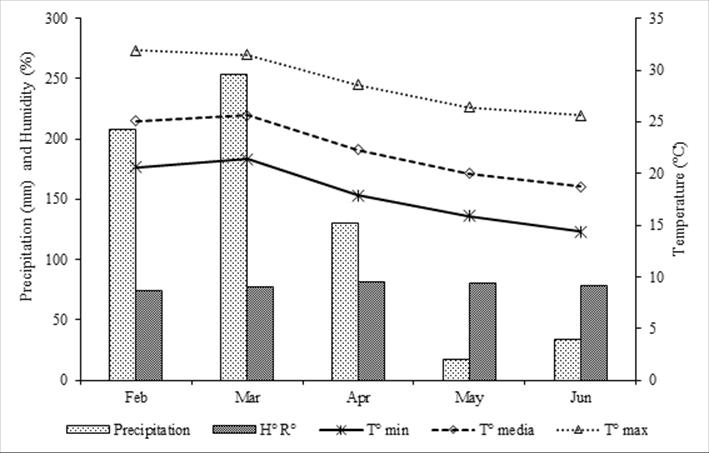
Figure 1 Record of minimum, mean, and maximum temperatures, relative humidity, and accumulated precipitation during crop development. San Pedro de Ycuamandyyú, 2023.
The soil where the crop was established corresponds to an Alfisol, classified as Mollic Paleudalf with sandy loam texture and weak structure (López et al., 1995). In January 2023, sampling was performed for physicochemical soil analysis (Table 1).
Table 1 Soil analysis results corresponding to the plot where the corn crop was established. San Pedro de Ycuamandyyú, 2023.
| pH | M.O. | P | S | Ca++ | Mg++ | K+ | Na+ | Al+++ | H + Al | CIC | V | |
| H2O | % | --mg dm3-- | --------------------cmol dm3------------------------ | % | ||||||||
| 5,93 | 1,11 | 6,11 | 3,10 | 1,93 | 0,34 | 0,14 | 0 | 0 | 1,89 | 4,30 | 56,02 | |
CIC: cation exchange capacity; V: base saturation percentage.
Based on the analysis results, 500 kg ha⁻¹ of dolomitic lime (ECCE = 95%) was applied using a lime spreader, with the objective of raising base saturation to 60%. One month after liming, soil preparation was performed with a 16-disc heavy harrow, and then four subplots of 2.500 m² were delimited for each treatment.
Planting was performed with a mechanical planter equipped with an external fluted rotor seed metering system and a roller-type fertilizer metering system. It was adjusted for planting with 20 cm spacing between plants and 45 cm between rows, resulting in a density of 111.111 plants ha⁻¹, using 20 kg ha⁻¹ of seed from a short-cycle commercial hybrid.
Simultaneously, 130 kg ha⁻¹ of formulated NPK fertilizer (15-15-15) was applied according to soil analysis recommendations. Pest and weed control was performed with 0,35 L ha⁻¹ of an insecticide mixture (Thiamethoxam, Bifenthrin, and Lufenuron) and 1,5 L ha⁻¹ of glyphosate.
At 90 days after planting, 10 ears per treatment were randomly extracted and split longitudinally in half to determine the milk line stage and optimal harvest timing.
Harvesting was performed at 15 cm above ground level and chopping into particles between 1 and 2 cm using a single-row pull-type forage harvester with a 12-knife rotor chopping system, hydraulically driven feed roller collection system, and 50 HP power requirement.
The harvested forage was inoculated with Lactobacillus spp. (1 × 10¹⁰ CFU g⁻¹) at a rate of 2 g t⁻¹ of fresh forage, then loaded and compacted in black polyethylene microsilos with 70 kg capacity and hermetically sealed to maintain an anaerobic environment.
The microsilos were opened 28 days after sealing, 1 kg samples were taken from each treatment with their respective replications and sent to a laboratory for nutritional quality analyses.
Hydrogen potential (pH) and dry matter (DM) were evaluated according to Silva and Queiroz (2002); in vitro dry matter digestibility (IVDMD) according to Di Marco (2011); crude protein (CP), ash (Ash), and ether extract (EE) according to Association of Official Analytical Chemists (2007); neutral detergent fiber (NDF), acid detergent fiber (ADF), and lignin (LIG) according to Van Soest et al. (1991); neutral detergent insoluble protein (NDIP) and acid detergent insoluble protein (ADIP) according to Licitra et al. (1996); total digestible nutrients (TDN) according to Weiss (1993), and non-fiber carbohydrates (NFC) according to Sniffen et al. (1992).
The production cost (PC) of silage from 1 ha of corn crop surface was determined in dollars (1 USD = 7.286 Gs) following the methodology proposed by Durán and Scoponi (2005) and Arce (1999), considering:
Direct costs (DC): land preparation (soil analysis, liming, and harrowing), planting and fertilization (inputs and labor), phytosanitary management (insecticides and herbicides), and harvesting and ensiling activities, calculated according to rates from a specialized company.
Indirect costs (IC): machinery depreciation (tractor, planter, and sprayer) and property tax.
The cost per kg of fresh matter (FM) and dry matter (DM) was obtained by dividing the total PC by yields. Fresh matter yield was estimated with 1 m² samples at four sites per treatment, extrapolated to hectare. Dry matter yield was calculated by multiplying FM by the DM percentage.
Results were subjected to analysis of variance (ANOVA) using Fisher's test (α = 0,05). When significant differences were detected, means were compared using Tukey's test at 5%. All analyses were performed using InfoStat® statistical software.
RESULTS AND DISCUSSION
The DM content showed significant variations (p<0,05) as a function of corn maturity stage. When ensiling the crop at ½ and – ML stages, adequate DM values were obtained for optimal fermentation (Table 2), falling within the recommended range of 30 to 35% as reported by Marafon et al. (2015). In contrast, at the ¼ ML stage, DM content was below this threshold, which could favor undesirable fermentations and consequently compromise silage quality (Liu et al., 2023).
Table 2 Dry matter (DM), hydrogen potential (pH), mineral matter (MM), crude protein (CP), non-fiber carbohydrates (NFC), ether extract (EE), and total digestible nutrients (TDN) of corn silage harvested at different maturity stages. San Pedro de Ycuamandyyú, 2023.
| Maturity stage | |||||
|---|---|---|---|---|---|
| Variables | ¼ ML | ½ ML | – ML | CV (%) | |
| DM (%FM) | 20,50 c | 29,39 b | 31,10 a | 1,70 | |
| pH | 3,87 b | 4,19 a | 4,19 a | 1,58 | |
| MM (%DM) | 7,30 a | 5,90 b | 5,07 c | 5,14 | |
| CP (%DM) | 8,77 a | 7,95 b | 7,67 c | 1,00 | |
| NFC (%DM) | 19,67 c | 34,03 b | 37,63 a | 3,82 | |
| EE (%MS) | 4,11 | 4,69 | 4,72 | 9,60 | |
| TDN (%DM) | 57,51 c | 67,24 b | 70,55 a | 2,14 | |
Means in rows followed by the same letter do not differ statistically (P>0,05).
CV: Coefficient of variation.
ML: Milk line in the grain.
The pH value in the ¼ ML treatment was significantly lower (p<0,05) compared to the others. This is due to the higher concentration of soluble carbohydrates present in the plant at this maturity stage, which generate more intense fermentation that in turn produces a rapid pH decline (Behling Neto et al., 2017).
On the other hand, Santos et al. (2010) maintain that forages with higher DM contents tend to stabilize at higher pH values, which would also explain the behavior observed in the present study. Despite differences between treatments, all pH values remained within the optimal range established (3,80 to 4,20) according to McDonald, Henderson, and Heron (1991).
Regarding MM and CP content, a significant decrease (p<0,05) was recorded with advancing maturity stage, being higher in the ¼ ML treatment (Table 2). In contrast, NFC and TDN values increased as the plant matured, with the – ML treatment standing out. In the case of EE, no significant differences were observed (p>0,05).
These decreases in MM and CP can be attributed to a dilution effect, caused by the increase in DM content (Vilela et al., 2008; Dahmardeh et al., 2009). Nevertheless, CP levels still exceed the minimum required by ruminal microbiota (7%) for its maintenance (Lazzarini et al., 2009). Similar trends were reported by Marafon et al. (2015) in relation to MM and by Vilela et al. (2008) regarding CP.
Regarding the increase in NFC and TDN in the ½ ML and – ML treatments, this is due to the higher proportion of grains in the plant structure (Diniz Buso, Machado, Ribeiro, & Silva, 2018; Souza et al., 2022). Similarly, Souza et al. (2022) and Nazli et al. (2019) also observed increases in NFC and TDN contents in corn silages harvested at different maturity stages.
The values of NDF, ADF, LIG, and ADIP decreased significantly (p<0,05) with advancing maturity stage, with higher values observed in ¼ ML and the lowest in – ML, with the ½ ML stage being intermediate (Table 3). In contrast, IVDMD increased with maturity, with superior values in the – ML treatment. However, no statistical differences were found in NDIP content (p>0,05).
Table 3 Neutral detergent fiber (NDF), acid detergent fiber (ADF), lignin (LIG), neutral detergent insoluble protein (NDIP), acid detergent insoluble protein (ADIP), and in vitro dry matter digestibility (IVDMD) of corn silage harvested at different maturity stages. San Pedro de Ycuamandyyú, 2023.
| Maturity stage | |||||
|---|---|---|---|---|---|
| Variables | ¼ ML | ½ ML | – ML | CV (%) | |
| NDF (%DM) | 60,15 a | 47,43 b | 44,92 c | 2,00 | |
| ADF (%DM) | 36,79 a | 26,97 b | 25,12 c | 1,54 | |
| LIG (%DM) | 4,39 a | 2,28 b | 1,69 c | 10,81 | |
| NDIP (%CP) | 12,66 | 11,56 | 11,31 | 14,56 | |
| ADIP (%CP) | 8,30 a | 7,09 b | 6,16 c | 3,85 | |
| IVDMD (%) | 60,24 c | 67,89 b | 69,33 a | 0,54 | |
Means in rows followed by the same letter do not differ statistically (P>0,05).
CV: Coefficient of variation.
ML: Milk line in the grain.
The decrease in fibrous components is due to the increase in ear proportion in the plant structure, as well as the higher starch content in grains as maturation advances (Dahmardeh et al., 2009; Souza et al., 2022). This aspect is important, since fiber negatively affects digestibility and energy value of forage (Yu et al., 2003).
Similar behaviors have been reported by Marafon et al. (2015) and Nazli et al. (2019), who also found reductions in NDF and ADF values in corn silages at different maturation stages, although without significant variations in lignin content.
Regarding the decrease in ADIP, this can also be explained by a dilution effect. This is relevant, since this protein fraction is not utilizable by the animal, as it is bound to ADF (Detmann et al., 2012; Gaviria Rivera & Barahona, 2015). This suggests that, with greater maturity, the proportion of available and utilizable protein is higher.
Regarding the increase in IVDMD at more advanced maturity stages, this is associated with lower ADF content (Table 3) and higher NFC content (Table 2), as indicated by Van Soest (1994) and Krämer-Schmid, Lund, and Weisbjerg (2016). Similarly, Souza et al. (2019) reported improvements in DM digestibility in corn ensiled at more advanced maturation stages.
The total cost values for silage production from a corn crop on one hectare surface (Table 4) increase as the crop maturity stage advances. Specifically, harvesting and ensiling at the ½ ML maturity stage implied a 2,5% increase compared to the ¼ ML stage; while at the – ML stage, the increase was 5%.
Table 4 Production cost (USD) per hectare of corn silage, per kg of FM, and per kg of DM according to maturity stages. San Pedro de Ycuamandyyú, 2023.
| Maturity stage | |||
|---|---|---|---|
| Concepts | ¼ ML | ½ ML | – ML |
| Direct cost (DC) | 1.618,85 | 1.660,03 | 1.701,21 |
| Land preparation | 113,94 | 113,94 | 113,94 |
| Planting and fertilization | 102,96 | 102,96 | 102,96 |
| Phytosanitary control | 33,33 | 33,33 | 33,33 |
| Weed control | 16,47 | 16,47 | 16,47 |
| Chopping/cutting | 116,68 | 116,68 | 116,68 |
| Ensiling¹ | 1.235,47 | 1.276,65 | 1.317,83 |
| Indirect cost (IC) | 34,64 | 34,64 | 34,64 |
| Property tax | 20,59 | 20,59 | 20,59 |
| Depreciation (machinery) | 14,05 | 14,05 | 14,05 |
| Total cost (DC + IC) | 1.653,49 | 1.694,67 | 1.735,86 |
| Yield (kg·FM·ha⁻¹) | 36.000 | 37.200 | 38.400 |
| Yield (kg·DM·ha⁻¹) | 7.380 | 11.119 | 11.942 |
| Cost per kg produced (FM) | 0,046 | 0,045 | 0,045 |
| Cost per kg produced (DM) | 0,224 | 0,152 | 0,145 |
¹ Ensiling cost already includes silo bag price and inoculant.
These increases are mainly attributed to the higher cost of the ensiling process, which is directly related to the volume of ensiled forage, that is, the greater the volume, the higher the associated cost. In this regard, the ½ ML and – ML maturity stages recorded higher biomass productions (Table 4). Paniagua-Alcaráz et al. (2022) also reported higher total costs of sorghum silage when higher yields are recorded.
Conversely, when analyzing production costs per kilogram of silage in FM, a decreasing trend is observed. In the ½ ML treatment, the reduction was 0,9%, while in – ML it reached 1,82%. Although the differences are not markedly significant, they do reflect a slight improvement in process efficiency.
However, when analyzing the cost per kg of ensiled DM, the reductions were 31,98% at the ½ ML stage and 35,11% at – ML, due to the higher productivities obtained in corn cultivation at these stages, compensating for the investment made, where the – ML stage resulted most economical. Souza et al. (2022) also reported a reduction in PC per kg of DM of ensiled corn harvested at more advanced maturity stages.
CONCLUSION
Based on the results obtained under the conditions in which the present study was developed, it is concluded that DM, NFC, TDN, and IVDMD increased significantly, while NDF, ADF, LIG, and ADIP decreased as maturation advanced (from ¼ ML to – ML), obtaining better values at the – ML maturation stage. Similarly, CP content decreased significantly with maturity, but remained above the threshold required by ruminal microbiota. The – ML stage presented higher production cost; however, to produce 1 kg of FM and DM, these costs were compensated by the high productivity obtained, resulting in the most economical among treatments. Consequently, the – ML stage is the most appropriate time to harvest and ensile whole-plant corn, due to its better forage nutritional quality and greater cost efficiency.
REFERENCES
Arce, H. S. (1999). Presupuestos, costos y decisiones de empresas agropecuarias. Buenos Aires, Argentina: Ediciones Macchi. [ Links ]
Association Analytical Chemists. (2007). Official methods of analysis. 18th ed.: AOAC International, p. 21 - 22. [ Links ]
Behling Neto, A., Pereira dos Reis, R. H., Silva Cabral, L., Gonçalves Abreu, J. G., Sousa, D.P., e Sousa, F. G. (2017). Nutritional value of sorghum silage of different purposes. Ciência e Agrotecnologia, 41(3), 288-299. https://doi.org/10.1590/1413-70542017413038516 [ Links ]
Dahmardeh, M., Ghanbari, A., Syasar, B., & Ramrodi, M. (2009). Effect of intercropping maize (Zea mays L.) with cowpea (Vigna unguiculata L.) on green forage yield and quality evaluation. Asian Journal of Plant Sciences, 8, 235-239. https://doi.org/10.3923/ajps.2009.235.239 [ Links ]
Detmann, E., Souza, M. A., Valadares-Filho, S. C., Queiroz, A. C., Berchielli, T. T., Saliba, E. O. S., Cabral, L. S., Pina, D. S., Ladeira, M. M., & Azevedo, J. A. G. (2012). Métodos para análise de alimentos. Visconde do Rio Branco, Suprema: Suprema, 214 p. [ Links ]
Di Marco, O. (2011). Estimación de calidad de los forrajes. Sitio Argentino de Producción Animal, Producir XXI, 20(240), 24-30. [ Links ]
Diniz Buso, W. H., Machado, A. S., Ribeiro, T. B., e Silva, L. O. (2018). Produção e composição bromatológica da silage de híbridos de milho sob duas alturas de corte. Revista de Agricultura Neotropical, 5(4), 74-80. https://doi.org/10.32404/rean.v5i4.2682 [ Links ]
Durán, R., & Scoponi, L. (2005). El gerenciamiento agropecuario en el siglo XXI: Bases para una competitividad sustentable. Buenos Aires, Argentina: Osmar D. Buyatti. [ Links ]
Gaviria, X., Rivera, J., y Barahona, R. (2015). Calidad nutricional y fraccionamiento de carbohidratos y proteína en los componentes forrajeros de un sistema silvopastoril intensivo. Pastos y Forrajes, 38(2), 194-201. [ Links ]
Grolli Carvalho, A. F., Martin, T. N., Santos, S., Müller, T. M., e Piran Filho, F. A. (2016). Perfil agronômico e bromatológico de silagem de milho no sudoeste do Paraná. Revista de la Facultad de Agronomía, 114(2), 149-159. [ Links ]
Jiang, M., Ma, Y., Khan, N., Khan, M. Z., Akbar, A., Khan, R. U., Kamran, M., & Khan, N. A. (2022). Effect of spring maize genotypes on fermentation and nutritional value of whole plant maize silage in northern Pakistan. Fermentation, 8 (1), 587. https://doi.org/10.3390/fermentation8020587 [ Links ]
Krämer-Schmid, M., Lund, P., & Weisbjerg, M. R. (2016). Importance of NDF digestibility of whole crop maize silage for dry matter intake and milk production in dairy cows. Animal Feed Science and Technology, 219, 68-76. https://doi.org/10.1016/j.anifeedsci.2016.06.007 [ Links ]
Kung, L., Shaver, R. D., Grant, R. J. & Schmidt, R. J. (2018). Silage review: Interpretation of chemical, microbial, and organoleptic components of silages. Journal of Dairy Science, 101, 4020-4033. https://doi.org/10.3168/jds.2017-13909 [ Links ]
Lazzarini, I., Detmann, E., Sampaio, C. B., Paulino, M. F., Valadares Filho, S. C., Souza, M. A., & Oliveira, F. A. (2009). Dinâmicas de trânsito e degradação da fibra em detergente neutro em bovinos alimentados com forragem tropical de baixa qualidade e compostos nitrogenados. Arquivo Brasileiro de Medicina Veterinária e Zootecnia, 61 (3), 635-647. https://doi.org/10.1590/S0102-09352009000300017 [ Links ]
Licitra, G., Hernandez, T. M., & Van Soest, P. J. (1996). Standardizations of procedures for nitrogen fractionation of ruminant feeds. Animal Feed Science and Technology , 57, 347-358. https://doi.org/10.1016/0377-8401(95)00837-3 [ Links ]
Liu, X., Li, D., Ge, Q., Yang, B. y Shenghang, L. (2023). Efectos del período de cosecha y la proporción de mezcla sobre las características y calidad del ensilaje mixto de alfalfa y maíz. Animal Feed Science and Technology , 306, 115796. https://doi.org/10.1016/j.anifeedsci.2023.115796 [ Links ]
López, O., González, E., Llamas, P., Molinas, A., Franco, E., García, S., & Ríos, E. (1995). Estudio de reconocimiento de suelos, capacidad de uso de la tierra y propuesta de ordenamiento territorial preliminar de la Región Oriental del Paraguay (284 págs.). Asunción, Paraguay: MAG/Banco Mundial. https://www.geologiadelparaguay.com/Estudio-de-Reconocimiento-de-Suelos-Regi%C3%B3n-Oriental-Paraguay.pdf [ Links ]
Macedo, A. J. S., Neto, J. M. C., Silva, M. A., & Santos, E. M. (2019). Potencialidades y limitaciones de las plantas forrajeras para ensilaje: Revisión. Revista Brasileña de Higiene y Sanidad Animal, 13(2), 320-337. [ Links ]
Marafon, F., Neumann, M., Carletto, R., Wrobel, F. L., Mendes, E. D., Spada, C. A., & Faria, M. V. (2015). Nutritional characteristics and losses on fermentation of corn silage, harvested in different reproductive stages with different grain processing. Semina: Ciências Agrárias, 36 (2), 917-932. [ Links ]
McDonald, P., Henderson, A. R., & Heron, S. J. E. (1991). The Biochemistry of Silage. Marlow: Chalcombe Publications. 340p. [ Links ]
Motta, A. C. V., Araujo, E. M., Broadley, M. R., Young, S. D., Barbosa, J. Z., Prior, S. A., & Schmidt, P. (2020). Minerals and potentially toxic elements in corn silage from tropical and subtropical Brazil. Revista Brasileira de Zootecnia, 49, e20190214. [ Links ]
Nazli, M. H., Halim, R. A., Abdullah, A. M., Hussin, G., & Samsudin, A. A. (2019). Potential of four corn varieties at different harvest stages for tropical silage production in Malaysia. Asian Australasian Journal of Animal Science (AJAS), 32 (2), 224-232. [ Links ]
Neumann, M., Poczynek, M., Leão, G. F. M., Figueira, D. N., & Souza, A. M. (2018). Desempenho de híbridos de milho para silagem cultivados em diferentes localidades com três densidades populacionais. Revista Brasileira Milho e Sorgo, 17 (1), 49-62. [ Links ]
Paniagua-Alcaráz, P. L., Ocampos, D. A., Franco-Ibars, R., Fatecha-Fois, D., Salas-Mayeregger, J., Portillo, G. A., & Silva, M. (2022). Comportamiento productivo y costo de producción del sorgo forrajero (Sorghum bicolor L. Moench) bajo condiciones de fertilización e irrigación. Archivos Latinoamericanos de Producción Animal, 30(4), 347-357. https://doi.org/10.53588/alpa.300407 [ Links ]
Rocha, E. M. C., Drewry, J. L., Willett, R. M., & Luck, B. L. (2022). Assessing kernel processing score of harvested corn silage in real-time using image analysis and machine learning. Computers and Electronics in Agriculture, 203 (12), 107415. https://doi.org/10.1016/j.compag.2022.107415 [ Links ]
Santos, R. D. dos, Pereira, L. G. R., Neves, A. L. A., Araújo, G. G. L. de, Voltolini, T. V., Brandão, L. G. N., Aragão, A. S. L., e Dórea, J. R. R. (2010). Características de fermentação da silagem de seis variedades de milho indicadas para a região semiárida brasileira. Arquivo Brasileiro de Medicina Veterinária e Zootecnia , 62(6), 1423-1429. https://doi.org/10.1590/S0102-09352010000600019 [ Links ]
Silva Filho, A. S., Serante, S. C., Castro, W. J. R., Silva, T. B. R., Negrão, F. M., Oliveira, M. A., Semim, C. S., Ferreira, C. M., Ferraz, A. P. F., Andrade, S. P., e Oliveira, W. C. M. (2022). Produtividade e características estruturais de cultivares de milho para produção de silagem. Revista Brasileira de Higiene e Sanidade Animal, 16(1), 1-7. https://doi.org/10.5935/1981-2965.20220003 [ Links ]
Silva, D. J., & Queiroz, A. C. (2002). Análises de alimentos (métodos químicos e biológicos). 3rd ed. ViçosaEditora UFV, 235p. [ Links ]
Sniffen, C. J., O’Connor, J. D., Van Soest, P. J., Fox, D. G., & Russell, J. B. (1992). A net carbohydrate and protein system for evaluating cattle diets: II. Carbohydrate and protein availability. Journal of Animal Science, 70, 3562-3577. https://doi.org/10.2527/1992.70113562x [ Links ]
Souza, A. M., Neumann, M., Rampim, L., Almeida, E. R., Matchula, A. F., Cristo, F. B., & Faria, M. V. (2022). Effect of storage time on the chemical composition of whole and grainless corn plant silage harvested at different maturity stages. Revista Brasileira de Zootecnia , 51, e20200180. https://doi.org/10.37496/rbz5120200180 [ Links ]
Souza, W. F. de, Costa, K. A. de P., Guarnieri, A., Severiano, E. da C., Silva, J. T. da, Teixeira, D. A. A., Oliveira, S. S., & Dias, M. B. de C. (2019). Production and quality of the silage of corn intercropped with Paiaguas palisadegrass in different forage systems and maturity stages. Revista Brasileira de Zootecnia , 48, e20180222. https://doi.org/10.1590/rbz4820180222 [ Links ]
Van Soest, P. J. (1994). Nutritional ecology of the ruminant (2ª ed.). Ithaca, NY: Cornell University Press. [ Links ]
Van Soest, P. J., Robertson, J. B., & Lewis, B. A. (1991). Methods for dietary fiber, neutral detergent fiber, and non-starch polysaccharides in relation to animal nutrition. Journal of Dairy Science , 74, 3583-3597. https://doi.org/10.3168/jds.S0022-0302(91)78551-2 [ Links ]
Vilela, H. H., Rezende, A. V., Vieira, P. F., Andrade, G. A., Evangelista, A. R., e Almeida, G. B. S. (2008). Valor nutritivo de silagens de milho colhido em diversos estádios de maturação. Revista Brasileira de Zootecnia , 37 (7), 1192-1199. https://doi.org/10.1590/S1516-35982008000700008 [ Links ]
Weirich Neto, P. H., Garbuio, P. W., Souza, N. M. de, Delalibera, H. C., & Leitão, K. (2013). Fragment size of corn silage according to the dry matter and forage harvester adjustments. Engenharia Agrícola, 33(4), 764-771. [ Links ]
Weiss, W. P. (1993). Predicting energy value of feeds. Journal of Dairy Science , 76, 1802-1811. https://doi.org/10.3168/jds.S0022-0302(93)77512-8 [ Links ]
Yu, P., Meier, J., Christensen, D. A., Rossnagel, B., & McKinnon, J. J. (2003). Using the NRC-2001 model and the DVE/OEB system to evaluate nutritive values of Harrington (malting-type) and Valier (feed-type) barley for ruminants. Animal Feed Science and Technology , 107, 45-60. https://doi.org/10.1016/S0377-8401(03)00062-2 [ Links ]
Data availability: The data presented in this study are available upon request from the corresponding author. The dataset is not publicly available due to confidentiality reasons.
Responsable editor: Arnaldo Esquivel-Fariña https://orcid.org/0000-0002-7727-5243. Universidad Nacional de Asunción, Facultad de Ciencias Agrarias. San Lorenzo, Paraguay.
Received: April 22, 2025; Accepted: June 06, 2025; Published: June 30, 2025
 Este es un artículo publicado en acceso abierto bajo una licencia Creative Commons
