




 English (pdf)
 Article in xml format
 Article references

 Automatic translation
 Send this article by e-mail
 Cited by SciELO
 Similars in
SciELO

 Permalink


INTRODUCTION
Sesame (Sesamum indicum L.) is the oldest oilseed known to man and belongs to the Pedaliaceae family (Zech-Matterne, Tengberg e Van Andringa, 2015).
Botanically, depending on the variety, sesame is classified as an annual or perennial plant, with height varying from 0.5 to 3 m, erect stem with or without branches, with or without hair, and quadrangular or cylindrical section, with a reasonable level of heterophily, petiolate pubescent leaves, complete and axillary flowers, gamopetalous and zygomorphic, with capsule-like fruit and loculicidal dehiscence (Beltrão, Freire & Lima, 1994). This plant is a source of good quality edible and medicinal oil. The seeds are composed of lipids with a content that varies from 50 to 60%, about 19% protein, 21% total carbohydrates, and 6% total fibers (Queiroga, Gondim, Almeida & Alburquerque, 2017).
Sesame crops requires only 500-650 mm of precipitation annually and is tolerant to drought conditions during its vegetative stage (Boureima, Eyletters, Diouf, Diop & Van Damme, 2011). Its species include branched and straight-stemmed plants, with cycles ranging from 80 to 180 days that adapt to different soil and climatic conditions. Sudan is the largest sesame grain-producing country with 1.52 million tons per year (FAO, 2022).
In Paraguay, this crop began to be commercially cultivated at the end of the 1990s, and it is estimated that in the 2021/2022 crop season, it produced 66,000 tons in an area of 41,000 ha with an average yield of 608 kg ha-1 (Enciso & León, 2022). The adaptability of sesame was one of the main reasons that generated interest among researchers in studying it, seeking improvements for its cultivation in different regions. This species has a social function in the rural environment since it is mainly produced by small and medium farmers in regions where the lack of water becomes an obstacle to the cultivation of other crops (Araújo, Borges, Silva, Araújo & Torres, 2014).
This plant requires simple agricultural practices, which makes this crop an excellent option for small farmers. Furthermore, variety selection is critical to obtain competitive yields. Particularly in the eastern region of Paraguay, where an increase in sesame production has been reported, the data related to variety adaptation in the region are very scarce, making it necessary to implement field trials testing available sesame varieties. In this context, the present work aimed to study the agronomic performance and oil content of five sesame varieties in eastern Paraguay.
MATERIALS AND METHODS
Field trials were conducted from October 2022 to February 2023. The experiments were established at two locations: the Instituto Paraguayo de Tecnología Agropecuaria (IPTA) in Ybyrarobana (24°16'80" S, 55°01'01" W) on October 23, and at Che Reseda farm in Saltos del Guairá (24°05'01" S, 54°19'29" W) on October 24. The experimental design was a randomized complete block with five treatments (sesame varieties: Inia, Negro, KO7, SH1, and Escoba) and five replications. Daily temperature and precipitation data were recorded using an automatic weather station at IPTA (Figure 1).
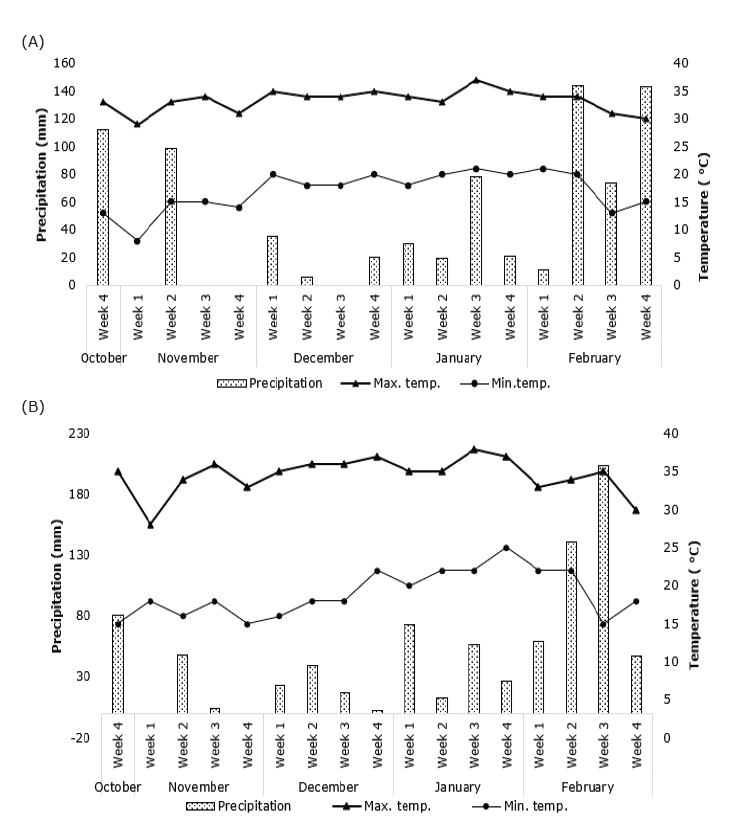
Figure 1. Precipitation, maximum and minimum temperatures during the growing period of sesame in Saltos del Guairá (A) and Ybyrarobana (B). 2022/23.
In both experimental sites, the soil was prepared by plowing followed by two cross harrowings to decompress and break up clods. The area was demarcated according to the varieties assigned to each block, and furrows were dug using hoes according to the plot spacing. Each plot consisted of six 5-m-long rows, with 0.45 m between rows and 0.20 m between plants. Seeds were sown by hand on October 24 and harvested at physiological maturity. Physical and chemical soil analyses (Table 1) were performed at both sites.
Table 1 Physical and chemical analysis of 0-20 cm soils for sesame planting in Saltos del Guairá and Ybyrarobana. 2022. Paraguay.
| M.O. | pH (H20) | P | K+ | Mg ++ | Clay | Silte | Sand | ||
| % | mg dm-3 | cmolc dm-3 | % | ||||||
| Saltos del Guaira | 1,14 | 5,41 | 2,82 | 0,2 | 0,58 | 15,7 | 13,6 | 70,65 | |
| Ybyrarobana | 1,73 | 5,8 | 4,04 | 0,11 | 0,3 | 28,00 | 21,00 | 51,00 | |
Fertilizers were applied in the planting furrow at sowing, using nitrogen (25 kg ha-1), single superphosphate (40 kg ha-1), and potassium chloride (20 kg ha-1), following recommendations from the Instituto Agronómico de Pernambuco fertilization manual (Cavalcante, 2008). Weed control consisted of two manual weedings. Crop management and pest control were performed as needed. Plants were harvested on sunny days by cutting them at the base, bundling them with twine, and stacking them on plastic sheets in the field to prevent seed loss. The plants were then sun-dried for seven days to facilitate capsule dehiscence.
The following variables were evaluated: plant height (measured from ground level to the uppermost leaf tip); number of capsules per plant (average of 10 randomly selected plants at harvest); and thousand-seed weight (determined from four 100-seed samples weighed on an electronic balance with 0.001 g precision) following RAS methodology (Ministério da Agricultura, Pecuária e Abastecimiento, 2009). Grain yield was determined by weighing the total grain production per plot and converting to kg ha-1. For oil content determination, ground seeds (2 g) were placed in paper cartridges in duplicate for each experimental unit. Oil was extracted using petroleum ether in a Soxhlet apparatus for 6 h following IUPAC methodology (1979). After extraction, the cartridges were dried at 60°C for 24 h to ensure complete solvent evaporation. Data were analyzed using analysis of variance, and means were compared using Tukey's test at p ≤ 0.05.
RESULTS AND DISCUSSION
Analysis of variance revealed significant environment × variety interactions for grain yield and oil content (p ≤ 0.05; Table 2).
Table 2 Summary of analysis of variance for the traits plant height in cm (PH), number of capsules per plant (NCP), thousand grain weight in g (TGW), yield in kg ha-1 and oil content (%) (OC) in five sesame varieties in two environments in the agricultural year 2022/23.
| SV | DF | Mean squares | ||||
| PH | NCP | TGW | YIELD | OC | ||
| Environment | 1 | 16535,43** | 32273,24* | 0,3* | 1966961,60* | 2,13ns |
| Varieties | 4 | 2641,76* | 1044,30 ns | 1,86** | 694604,51 ns | 10,38ns |
| E x V | 4 | 186,00 ns | 1552,62 ns | 0,02 ns | 243108,42* | 2,19* |
| Error | 32 | 94,3 | 698 | 0,16 | 84764,81 | 0,65 |
| Average | 147,33 | 119,41 | 2,77 | 1074,8 | 27,85 | |
| C.V. | 6,77 | |||||
ns: no significative; ** p < 0.01; * p < 0.05
Significant differences in plant height were observed among sesame varieties (p < 0.05). Escoba was the tallest variety, reaching 174.50 cm (Table 3). Similarly, Moreno (2006) reported Escoba as the tallest variety with 199.00 cm in a study of four sesame varieties. Torres and De Cristaldo (2008) and Paredes Alfonzo y Rodríguez Espínola (2013) also reported greater heights for Escoba, averaging 226 and 235 cm, respectively. These differences in plant height across studies likely reflect variations in environmental conditions and crop management practices.
Mean number of capsules per plant across varieties was 119.50, with no significant differences among varieties (p > 0.05). The SH1 variety produced the highest number of capsules per plant (Table 3). In comparison, Oviedo De Cristaldo (2007) reported 168 and 150 capsules per plant for Inia and Escoba varieties, respectively. Mazzani (1999) identified capsule number per plant as one of the main yield components in sesame.
Thousand-seed weight ranged from 2.10 to 3.82 g, with no significant differences among varieties (p > 0.05; Table 3). Similar values (2.4-3.9 g) were reported by Olowe and Adeoniregun (2010) in their evaluation of five sesame varieties.
Mean grain yield was 1,071.9 kg ha-1, with no significant differences among varieties (p > 0.05). Cabral and Oviedo De Cristaldo (2008) reported higher yields (1,875 kg ha-1) for the Inia variety. Similarly, Moreno (2006) found that Escoba produced the highest yields (1,533 kg ha-1) in their evaluation of four varieties. Silva, Fernandes, Bezerra, Arriel and Cardoso (2014) emphasized that achieving high yields in sesame requires effective crop management practices. According to Beltrão et al. (2001), obtaining yields of 1500 kg ha-1 depends on multiple factors including climate, genetic potential, soil quality, fertilization, and pest management.
Oil content did not differ among varieties, averaging 27.85% (Table 3). Egbekun and Ehieze (1997) reported that oil content in sesame varies with genotype, environmental conditions, plant maturity, harvest timing, and extraction method. Multi-location trials with additional varieties are needed to provide robust recommendations for small-scale farmers. Identifying varieties with high yield potential, pest resistance, and drought tolerance would help reduce input dependency and improve crop management efficiency. Such improvements could enhance food security and farm income, supporting sustainable agricultural development in rural communities.
Table 3 Plant height (PH), number of capsules per plant (NCP), thousand grain weight (TGW), yield and oil content (OC) of five sesame varieties planted in Saltos del Guaira and Yvyrarobana. Paraguay. 2022/2023.
| Varieties | PH (cm) | NCP | TGW (g) | Yield (kg ha-1) | OC (%) | |
|---|---|---|---|---|---|---|
| Escoba | 174,50 a | 121,80 | 2,10 c | 929,88 | 28,32 | |
| Negro | 145,10 b | 114,86 | 3,02 ab | 1131,00 | 26,74 | |
| SH1 | 143,60 b | 133,70 | 2,80 b | 1400,00 | 28,66 | |
| INIA | 142,90 b | 105,80 | 3,20 a | 712,00 | 26,76 | |
| KO7 | 130,60 b | 121,10 | 3,82 b | 1201,50 | 28,78 | |
| Mean | 147.34 | 119,50 | 3.00 | 1074.90 | 27.85 | |
| DMS | 27,10 | 78,33 ns | 0,30 | 980,30 ns | 2,94 ns |
ns: no significative. Means followed by the same lowercase letter in the column do not differ by Tukey test at the level of 5%.
CONCLUSIONS
The Escoba variety had the highest plant height. The highest thousand-grain weights were observed in INIA and Negro varieties. The average number of capsules, grain yield, and oil content were 119.5 units, 1,074 kg ha-1, and 27.85%, respectively. Further research should involve multi-season trials to assess sesame varieties across varying regional climates and soil types, focusing on those with high yields, pest and disease resistance, and drought tolerance.

