




 Spanish (pdf)
 Article in xml format
 Article references

 Automatic translation
 Send this article by e-mail
 Cited by SciELO
 Similars in
SciELO

 Permalink


INTRODUCTION
School Feeding Programmes (PAE) are social programmes that seek to increase enrolment rates, decrease dropout and absenteeism, and improve the academic performance of vulnerable children1. These programmes have been shown to increase school attendance, help children learn more effectively, and boost academic achievement, especially when accompanied by other measures such as deworming and micronutrient-fortified biscuits or vitamin supplements2-5. For this reason, these programmes are increasingly becoming part of national social protection policies and systems. Currently, almost every country in the region implements an the Encuesra Pernanente de Hogares Contínua (ECHP), and around 85 million children receive breakfast, snack or lunch at school, with an annual investment of approximately USD 4.3 billion, mainly from national budgets6. In some countries, analyses have shown that enrolment in schools that receive food assistance is twice as high as in schools that do not2.
In Paraguay, the PAEP was created through Law No. 5.210/2014 on ‘School Feeding and Health Control’, with the objective of promoting entry, permanence, regular attendance, improvements in performance, and the reduction of inequality and poverty7. This programme provides for the direct delivery of safe, nutritious and culturally acceptable food rations to children enrolled in the public and subsidised education system8.
The Paraguayan State is in charge of this programme through the Ministry of Education and Sciences (MEC), which is the governing body at the national level and executor of the programme in the capital. Execution is decentralised to the governors' offices and municipalities of the 17 departments9. Adequate coverage favours the presence of children in schools. An evaluation of the programme by the Ministry of Finance (2017) revealed that among the benefits identified are increased attendance even on days with adverse weather conditions, a greater number of effective school days, increased enrolment in schools with PAEP, greater parental participation and lower dropout rates, among others10.
The fact that budget execution in a given governorate is high does not imply that coverage is high. Coverage in 2022, expressed as the number of beneficiary pupils, in urban areas was 96.9% with school attendance for 5- to 9-year-olds; 98.8% for children and adolescents aged 10 to 14 and 73.3% for 15- to 19-year-olds. Meanwhile, in rural areas, the school attendance rate was 95.4 per-cent for 5-9-year-olds, 96.1 per cent for 10- to 14-year-olds, and 64.7 per cent for 15 to 19-year-olds11.
School exclusion is one of the major scourges of Paraguayan education, affecting thousands of children who, for various reasons, are forced to drop out of school. In Paraguay, 6 out of 10 children who enroll in first grade drop out of secondary school before reaching the third year of secondary school12. Therefore, the PAE is an important factor in preventing school dropouts.
Despite the importance of this programmed in promoting school attendance, there are few studies available that evaluate the scope, effectiveness and coverage of this programme. Thus, for example, the delivery of nutritional supplements has always had problems in terms of budget execution and timely arrival in the incorporated schools, especially to cover all school days8. A single study was accessed to evaluate the coverage of school meals in 4 departments of Paraguay during the years 2016 to 2018, which showed that, except in the Department of Cordillera, there was a decrease in beneficiaries in 2018. Another important result was that only 2/3 of the registered beneficiaries were included and provided for just over half of the school year9.
The analysis of indicators on school meals is very important, as it involves the evaluation of a public policy implemented for almost 10 years, which not only strengthens the educational component but also contributes to the improvement of household food security13, so the objective of this paper is to describe the coverage of school meals obtained from the Encuesta Permanente de Hogares Continua (EPHC) in Paraguay during the years 2017 to 2021.
METHODOLOGY
The study was descriptive, cross-sectional, temporally retrospective. The geographical scope was the departments of Central, San Pedro, Caaguazú, Caazapá, Itapúa, Alto Paraná and Asunción, which corresponds to 67.17 % of the total population of the country. Therefore, the sample taken is representative of the country as it covers the Departments with the largest population. The EPHC excludes the population of the Western Region, due to the heterogeneous population density. The temporal scope was from 2017 to 2021.
The sampling carried out by the National Statistics Institute (INE) for the EPHC constitutes a sampling design corresponding to a probabilistic design by clusters with probability proportional to size, two-stage and stratified in the first stage. It is two-stage, since in the first stage the census segments or Primary Sampling Units (PSUs) are selected within each stratum and, in a second stage, the dwellings or Secondary Sampling Units (SSUs) are selected. The selected PSUs remain fixed for a period of 5 years and only the dwellings are renewed from one year to the next. Approximately 5,000 households in the different selected departments are surveyed every quarter, obtaining information on 20,000 persons. The PSUs remain fixed for 5 years, so that the methodology does not undergo any changes, which makes it suitable for comparisons between variables14.
The source of data was the INE website, through the open data of the EPHC. The objective of this survey is to generate indicators related to employment, unemployment, income and other social, health and economic characteristics, which allow us to know the evolution of the well-being of the Paraguayan population15.
The population residing in collective dwellings, which include hotels, boarding houses and other guesthouses, was excluded, although families who, forming an independent group, reside within these establishments, such as the directors of the centres, caretakers, doormen, among others, are included.
The variables were grouped into demographic variables (age, sex, department and area of residence), schooling variables (currently attending an educational institution, sector of the institution attended) and variables related to school snack (whether they receive breakfast or snack, whether they receive lunch or dinner).
The sample was weighted for the analysis, using EPI INFO 7.0.
This research has the approval of the Ethics Committee of the Faculty of Chemical Sciences of the National University of Asunción according to Resolution 1063/2023 of 01 December 2023.
RESULTS
During the years 2017 to 2021, 9,012,061 surveys were conducted, with an annual average of 1,802,412 surveys.
Analysing the average annual number in relation to socio-demographic data, 52 % (934,784) were male, 62 % (1,125,235) were aged 5 to 12 years, with 97 % (1,751,189) under 18 years. 98.6 % (1,777,663) were single, 29 % (519,945) resided in the Central Department and 12 % (213,58) in the Alto Paraná Department. Sixty per cent (1,079,261) of the surveyed population resided in urban areas. Regarding the academic characteristics of the population, 81 % (1,467,488) belonged to public sector institutions, with 69 % (1,238,366) of the beneficiaries in Basic School Education (Table 1).
Table 1: Socio-demographic and academic characteristics of the beneficiary receiving school food programs, Paraguay (2017-2021).
| Socio-demographic variables | Frequency | Percentage |
|---|---|---|
| Sex | ||
| Male | 934,784 | 52 |
| Female | 867,628 | 48 |
| Total | 1,802,412 | 100 |
| Age | ||
| 5 to 12 years | 1,125,235 | 62 |
| 13 to 18 years | 626,954 | 35 |
| Over 19 years old | 50,223 | 3 |
| Total | 1,802,412 | 100 |
| Marital status | ||
| Married | 8,558 | 0,5 |
| Free union | 13,914 | 0,8 |
| Separated | 1,682 | 0,1 |
| Single | 1,777,663 | 98,6 |
| Divorced | 595 | 0,03 |
| Total | 1,802,412 | 100 |
| Department | ||
| Asunción | 111,226 | 6 |
| San Pedro | 123,983 | 7 |
| Caaguazú | 150,580 | 8 |
| Caazapá | 53,742 | 3 |
| Itapúa | 154,050 | 9 |
| Alto Paraná | 213,580 | 12 |
| Central | 519,945 | 29 |
| Rest of the country | 475,307 | 26 |
| Total | 1,802,412 | 100 |
| Area of residence | ||
| Urban | 1,079,261 | 60 |
| Rural | 723,152 | 40 |
| Total | 1,802,412 | 100 |
| Sector of the institution | ||
| Public | 1,467,488 | 81 |
| Private | 201,251 | 11 |
| Private subsidized | 133,673 | 7 |
| Total | 1,802,412 | 100 |
| Educational institution | ||
| Initial education | 196,242 | 11 |
| Basic School Education | 1,238,366 | 69 |
| Science Secondary Education | 255,268 | 14 |
| Technical Secondary Education | 62,824 | 3 |
| Open Secondary Education | 605 | 0,03 |
| Bilingual Basic Education for Young People and Adults | 8,454 | 0,5 |
| Youth and Adult Secondary Education | 15,310 | 0,8 |
| Special Education | 1,089 | 0,1 |
| Special Grade/Special Programmes | 2,077 | 0,1 |
| Senior Technician | 9,320 | 0,5 |
| Teacher training | 10,437 | 0,6 |
| Teacher Professionalization | 495 | 0,0 |
| Military/Police Training | 1,886 | 0,1 |
| No answers | 38 | 0,002 |
| Total | 1,802,373 | 100 |
Source: Encuesta Permanente de Hogares Continua. Instituto Nacional de Estadística. INE. Paraguay(2017-2021).
When asked if they received any type of school food assistance, 58 % (923,994) responded that they received free breakfast or snack and 50.4 % (803,512) in the previous month. In relation to whether they received free lunch or dinner during the school year and in the month prior to the survey, 73.2 % (1,204,008) indicated that they had not received free lunch and/or dinner during the current year, and in the previous month 76.3 % (1,255,849) stated that they had not (Table 2).
Table 2: Coverage rate of school breakfast or snack, lunch or dinner, Paraguay (2017-2021).
| Indicators | Frecuency | Percentage |
|---|---|---|
| During the current school year: | ||
| Did you receive free breakfast or snack? | ||
| Yes | 923,994 | 58 |
| No | 668,695 | 42 |
| No answer | 360 | 0.02 |
| Total | 1,593,049 | 100 |
| Did you receive free lunch and/or dinner? | ||
| Yes | 441,049 | 26.8 |
| No | 1,204,008 | 73.2 |
| No answer | 862 | 0.1 |
| Total | 1,645,919 | 100 |
| Last month: | ||
| Did you receive a free breakfast or snack? | ||
| Yes | 803,512 | 50.4 |
| No | 789,097 | 49.5 |
| No answer | 440 | 0.02 |
| Total | 1,592,969 | 100 |
| Did you receive free lunch and/or dinner? | ||
| Yes | 389,037 | 23.6 |
| No | 1,255,849 | 76.3 |
| No answer | 1,093 | 0.07 |
| Total | 1,645,979 | 100 |
Source: Encuesta Permanente de Hogares Continua. Instituto Nacional de Estadística. INE. Paraguay(2017-2021).
Receipt of free breakfast or snacks was most frequent in the 5 to 12 age group (51.7 %, 822,835). 54.4 % (865,86) of the beneficiaries were found in public institutions, being more frequent in the Central Department 15 % (237,951) (Table 3).
Table 3: Socio-demographic and academic characteristics according to having received school breakfast or snack, Paraguay (2017-2021).
| During the current school year, did you receive free breakfast or snack? | ||||
|---|---|---|---|---|
| Age | Yes | No | No answer | Total |
| 5 to 12 years | 89.05 % (822,835) | 19.43 % (129,937) | 77.5 % (279) | 953,051 |
| 13 to 18 years | 10.71 % (98,969) | 74.65 % (499,176) | 22.5 % (81) | 598,226 |
| Over 19 yearsold | 0.24 % (2,144) | 5.9 % (39,549) | - | 41,693 |
| Total | 100 % (923,948) | 100 % (668,662) | 100 % (360) | 1,592,970 |
| Sector ofthe Institution | Where you | attend | ||
| Public | 93.71 % (865,860) | 88.70 % (593,119) | 90 % (324) | 1,459,303 |
| Private | - | - | - | |
| Privatesubsidised | 6.28 % (58,088) | 11.30 % (75,543) | 10 % (36) | 133,667 |
| Total | 100 % (923,948) | 100 % (668,662) | (360) | 1,592,970 |
| Department of residence | ||||
| Asunción | 5.86 % (49,511) | 4.76 % (29,708) | 11,18 % (36) | |
| San Pedro | 8.35 % (70,548) | 7.56 % (47,214) | - | |
| Caaguazú | 10.19 % (86,091) | 0.87 % (5,473) | 8.70 % (28) | |
| Caazapá | 3.73 % (31,464) | 3.11 % (19,408) | 7.45 % (24) | |
| Itapúa | 0.92 % (7,829) | 9.80 % (61,134) | - | |
| Alto Paraná | 12.15 % (102,669) | 11.95 % (74,599) | - | |
| Central | 28.16 % (237,951) | 31.88 % (199,002) | 72.67 % (234) | |
| Restofthe country | 30.63 % (258,790) | 30.06 % (187,588) | - | |
| Total | 100 % (844,853) | 100 % (624,126) | 100 % (322) |
Source: Encuesta Permanente de Hogares Continua. Instituto Nacional de Estadística. INE. Paraguay (2017-2021).
It was the group of schoolchildren aged 5-12 years who received most of the breakfast or snacks free of charge during the 5 years of the study (Figure 1).
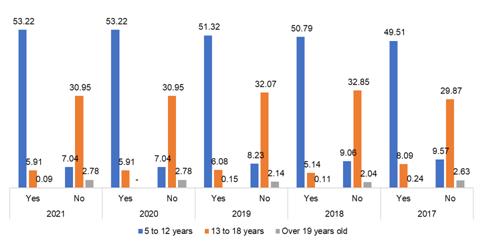
Figure 1: School breakfast or snack coverage rate per year by age of beneficiary population, Paraguay (2017-2021).
Likewise, in all years, it was students in public sector schools who received school breakfast or snacks (Figure 2).
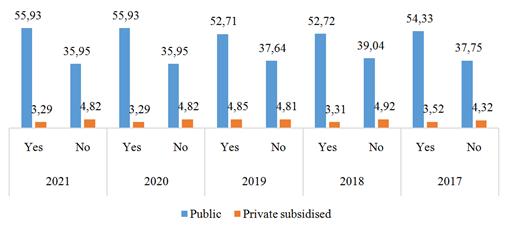
Figure 2: School breakfast or snack coverage rate per year by sector of institution attended by the beneficiary population, Paraguay (2017-2021).
Throughout the five years analyzed, variations were observed in the coverage rate according to the beneficiaries' department of residence, with the Central and Alto Paraná Departments having the highest coverage, and the Caazapá Department having the lowest coverage over the five years (Figure 3).
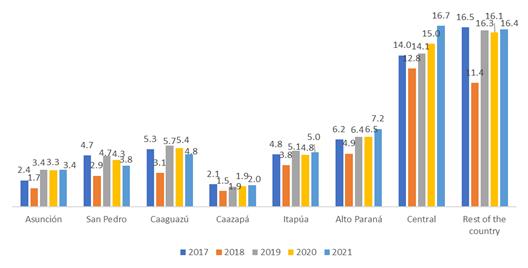
Figure 3: Coverage by year by department of residence of the population that did or did not receive free school breakfast or snack, Paraguay (2017-2021).
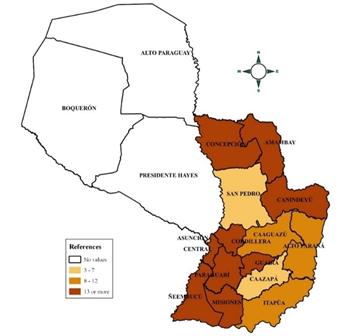
When analyzing the geographical distribution, on average, the departments of Caazapá and San Pedro had the lowest coverage (Figure 4).
DISCUSSION
In the present study, most of the beneficiaries were aged between 5 and 12, followed by the 13 to 18 age group, which is to be expected, since the PME has as its main target students in Basic School Education, thus fulfilling one of the main strategies of the Programme, which is to avoid school dropout. These results are consistent with research conducted in 20 public or subsidized educational institutions where most of the beneficiaries were also under 18 years of age and in grades 4-616. As expected, given their ages, these schoolchildren were unmarried.
The largest proportion of beneficiaries resided in the Central Department, followed by Alto Paraná. This could be because these departments have the highest population density in the country. According to INE data, the population of the department of Alto Paraná for the year 2022 was 853,610 inhabitants, which represents 11.5 % of the country's total population, while the population of the Central department for the same year was 2,286,193 inhabitants, which represents 30.7 % of the country's total population17.
Caazapá is one of the departments with the lowest school lunch coverage, with a 51.49 % incidence of multidimensional poverty17. This is striking, as one would expect an inverse relationship. That is, the higher the proportion of poverty, the higher the coverage of school meals. According to data from the Ministry of Economy, although a higher poverty rate is observed in rural areas compared to urban areas, these differences are not significant18. However, it is important to note that this disparity does not necessarily imply a better quality of life for those living in urban areas of the country. The allocation of resources is not only unequal but also contributes to perpetuating territorial disparity19. It should be remembered that school meals are intended to prevent school dropouts and should therefore be one of the strategic programmes in the departments with the greatest poverty.
Another interesting point is that, during 2020, in all Departments, there was less coverage. It should be remembered that in that year, the COVID 19 pandemic quarantine was implemented, and the beneficiaries withdrew the corresponding supplies20,21.
Regarding the academic characteristics of the population, the data indicates a clear predominance of institutions in the public sector, with private and subsidized private institutions having significantly lower coverage. This is also to be expected since, according to School Snack Law, the school snack is mainly intended for pupils in public schools7.
A significant percentage received breakfast or snacks at their educational institution. According to the research conducted by Mendoza and Sánchez9, it is observed that in none of the departments analyzed does the PAEP reach the desired coverage in terms of the extent of school meals. It is important to consider that there is a small percentage that did not respond, and this may be due to various reasons, such as lack of participation in the survey or lack of knowledge on the subject8.
The level of school lunch coverage is much lower still, with many respondents reporting no school lunch. In the research carried out by Sanabria et al.8, it was found that most schoolchildren alternate the consumption of lunch both at home and at school, depending on the type of food served, either because they dislike the food or because they prefer the food at home, which could be the reason why most of those surveyed said that they did not receive this food aid. A very important point is that in 2023 the ‘Zero Hunger in our Schools and Education System’ Bill was launched with the aim of universalizing the school lunch with equity criteria, and eradicating hunger in the school stage, based on universality in equity as a mechanism to prioritize the most vulnerable sectors, guaranteeing the right to education, reducing food and nutritional insecurity22. The implementation of this Project was not without controversy, due to administrative, technical and political issues23.
Differences by age, type of institution and department of residence in the receipt of food over the five years analyzed are highlighted, providing valuable information to understand the food needs in different segments of the student population according to their geographical regions. In general, the 5- to 12-year-old age group shows a consistent tendency to receive free breakfast or snacks, which can be considered a strength of the Programme. Children are one of the most vulnerable groups, as it is at this stage of growth that the demand for nutrients is highest24.
With regard to the limitations of the present study, we can mention that it might have been interesting to collect more information on this issue, such as, for example, the quality of the menus and/or the satisfaction of the beneficiaries, but as the main objective of the EPHC is not to monitor this issue, few variables were collected in the questionnaire. As a possible bias of the study, we could mention the bias in the information.
As strengths of the present study, we can mention that the methodology used by the INE, through the EPHC, presents a very solid sampling, representative of the whole country, and which is periodically reviewed and adjusted. This census approach provides a solid basis for generalizing findings, thus allowing for a more robust and accurate assessment of the phenomena or variables under study. This sampling strategy strengthens the validity and extrapolability of the results, contributing to the robustness and reliability of the research findings. Finally, it is important to highlight the growing strategic importance of School nutrition programs (PAE) within national social protection policies and systems, which is why they should be monitored periodically to make effective decisions25.
CONCLUSION
The beneficiary population is under eighteen, single, living in urban areas, mainly in the Central Department or Alto Paraná. The majority attend public educational institutions and attend basic education. In terms of geographical coverage, there are variations, with the Central and Alto Paraná Departments having the highest coverage, and Caazapá having the lowest coverage. A challenge at the national level is improving coverage in the distribution of school food programs and to ensure that the departments with the greatest social exclusion are given priority in the allocation of nutritionally complete food assistance.

