




Servicios Personalizados
Revista

Articulo
 texto en
 Inglés (pdf)
 Articulo en XML
 Referencias del artículo

 Traducción automática
 Enviar articulo por email
Indicadores
-
 Citado por SciELO
Links relacionados
-
 Similares en
SciELO
Compartir

 Permalink

Anales de la Facultad de Ciencias Médicas (Asunción)
versión impresa ISSN 1816-8949
An. Fac. Cienc. Méd. (Asunción) vol.59 no.1 Asunción 2026 Epub 30-Mar-2026
https://doi.org/10.18004/anales/2026.e59012651
CASE REPORT
Suprasternal Thyroglossal Cyst, case report

1Universidad Nacional de Asunción, Facultad de Ciencias Médicas, Cátedra y Servicio de Otorrinolaringología y Cirugía de Cabeza y Cuello, San Lorenzo, Paraguay.
The thyroglossal cyst is a congenital anomaly of the thyroid gland and the midline of the neck, affecting 7% of the global population. It presents as a painless mass that moves with swallowing. Diagnosis is made by ultrasound and fine-needle aspiration biopsy to determine the presence of malignancy, which accounts for 1% of cases. The treatment of choice is surgical, using the Sistrunk technique. We report the case of a patient who presented to the otorhinolaryngology service of the hospital: a 7-year-old male with a history of chronic, intermittently growing cervical mass at the level of the suprasternal notch, associated with episodes of upper respiratory tract infections, which resolved with antibiotic and nonsteroidal anti-inflammatory treatment. A soft tissue ultrasound was performed, with a presumptive diagnosis of thyroglossal cyst. A contrast-enhanced computed tomography scan of the neck and thorax was performed three months later, concluding a possible cystic cervical nodule categorized as a dermoid cyst. During follow-up, the patient developed a complication confirmed by cervical ultrasound, which reported a small heterogeneous collection associated with inflammatory changes in the affected region. Surgical intervention was planned and carried out for lesion resection using the Sistrunk technique. The diagnosis was confirmed by anatomopathological study as a thyroglossal duct cyst located in the suprasternal region, accounting for approximately 5% of the global frequency of thyroglossal cysts. Additionally, when comparing Sistrunk surgery versus the modified maneuver, similar effectiveness rates were observed. Given that the thyroglossal cyst is the most common congenital cervical anomaly, it is important to recognize the appropriate management of this pathology, along with this case highlighting its uncommon location.
Keywords: Thyroglossal cyst; congenital anomaly; Sistrunk technique
El quiste tirogloso es una anomalía congénita de la glándula tiroides y de la línea media a nivel del cuello, afecta al 7% de la población mundial. Se presenta como un tumor indoloro, móvil con la deglución. El diagnóstico se realiza con ecografía y biopsia por aspiración con aguja fina, para determinar existencia de malignidad la cual corresponde al 1%. El tratamiento de elección es quirúrgico mediante la técnica de Sistrunk. Se reporta el caso de un paciente que acude al servicio de otorrinolaringología del Hospital, el mismo; masculino, de 7 años de edad, con antecedentes de crónicos de tumoración cervical de crecimiento intermitente a nivel del hueco supraesternal relacionado con la aparición de cuadros infecciosos de las vías aérea superiores, que cede con tratamiento a base de antibióticos y antinflamatorios no esteroideos, se realizó al paciente, una ecografía de partes blandas, con un diagnóstico presuntivo correspondiente a un quiste tirogloso, se realizó una tomografía computarizada con contraste de cuello y tórax tres meses después, concluyendo un posible nódulo quístico cervical categorizado como quiste dermoide. Durante el seguimiento del paciente el mismo presenta una complicación comprobada por ecografía cervical que informó pequeña imagen de colección heterogénea en asociación con cambios inflamatorios en región afectada. Se planificó y llevó a cabo una intervención quirúrgica para la resección de la lesión utilizando la técnica de Sistrunk. El diagnóstico fue confirmado mediante estudio anatomopatológico como quiste del conducto tirogloso de ubicación supraesternal, que resulta ser de alrededor del 5% de la frecuencia global de los quistes tiroglosos. Además, la aplicación de la cirugía Sistrunk vs la maniobra modificada se constató que presentan tasas similares de efectividad. Siendo el quiste tirogloso la anomalía congénita cervical más frecuente, resulta importante reconocer el manejo apropiado de esta patología con la suma a este caso de la ubicación poco frecuente del mismo.
Palabras clave: Quiste tirogloso; anomalía congénita; técnica de Sistrunk
INTRODUCTION
The thyroglossal duct cyst is a common condition in children, although it is not uncommon to find it in adults. According to some literature, it is present in up to 17% of the general population. The embryology of the thyroid explains the location of this and other lesions related to developmental anomalies of the gland.
In general, it can present and develop at any age, with a predominance in the first two decades of life, with 50% of cases occurring before the age of twenty. It shows no gender predilection 1,2. The typical size is approximately 3 cm, although cases up to 10 cm in diameter have been reported. These lesions tend to increase gradually in size and may enlarge rapidly following an upper respiratory tract infection 3,4. The classic clinical presentation is a palpable mass located in the midline, painless, that moves with swallowing and tongue protrusion. Most are benign, but up to 1% may be malignant. The majority are located in the infrahyoid region (80%), 8% in the suprahyoid region, 5% in the suprasternal region of the neck, and only 1-2% at the base of the tongue. Other literature reports that the suprasternal location may reach up to 12.9% of thyroglossal cyst cases 1,5,6,7.
When discussing thyroglossal cysts, it is important to consider thyroglossal fistulas as a differential diagnosis. Due to their shared embryological origin, their tract and opening are located in the midline, above or below the hyoid bone, extending from the skin to the foramen cecum at the base of the tongue, making contact with the hyoid along their course. These fistulous tracts are painless unless infected; their external opening is identified by increased pigmentation or umbilication during swallowing and may sometimes be associated with an eczematous process. Like all congenital fistulas, they may form external or internal tracts, complete or incomplete 8.
Surgical removal of the cyst using the Sistrunk procedure is recommended, which involves excision of the midline portion of the hyoid bone along with a generous portion of tissue along the thyroglossal duct tract. This procedure reduces recurrence to approximately 8%. Malignant transformation is rare; carcinomas are reported in less than 1% of cases.
In the present study, we report the case of a 7-year-old male patient with a history of chronic cervical mass of intermittent growth, associated with episodes of upper respiratory tract infections, which resolved with antibiotic and nonsteroidal anti-inflammatory treatment. The patient was diagnosed with a thyroglossal cyst, and surgical intervention was planned for lesion resection using the Sistrunk technique.
CASE DESCRIPTION
A 7-year-old male patient, from the city of Ypané, Paraguay, a primary school student, presented for consultation with his mother on October 3, 2023.
On history-taking, the mother reported a long-standing history of a cervical mass with intermittent growth, associated with inflammatory signs during episodes of upper respiratory tract infections. The condition resolved on multiple occasions with antibiotic and nonsteroidal anti-inflammatory treatment.
The patient denied a family history of similar conditions, drug allergies, previous surgeries, asthma, or other chronic diseases.
On physical examination, the patient was a lucid, cooperative male, normosomic and eutrophic, with a composed facial appearance, suggestive of a chronic condition. The neck was cylindrical and asymmetrical due to a 3 cm mass located in the suprasternal region, in the midline. The mass was mobile, with a soft-solid consistency and no signs of inflammation. No lymphadenopathy was palpated. Bilateral laryngeal crepitus was present and non-painful. See Figure 1.
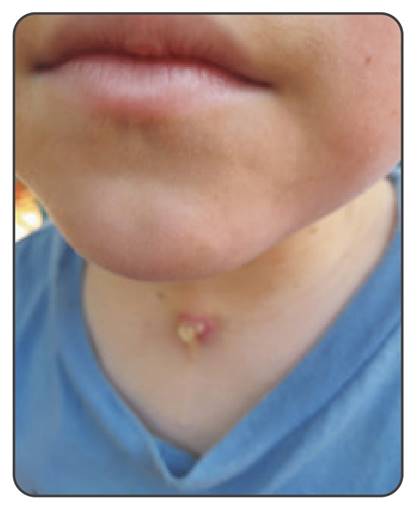
Figure 1 Anterior view of the cervical lesion. Note. The image shows the cystic lesion with visible purulent exudate
He presents with a soft-tissue cervical ultrasound report with a presumptive diagnosis of a thyroglossal cyst; a second ultrasound additionally identified a heterogeneous fluid collection associated with inflammatory changes in the cervical soft tissue planes. A contrast-enhanced CT scan of the neck and chest was performed, revealing a heterogeneous nodular lesion with a non-enhancing center, measuring 25 × 16 mm, centrally located in the midline at the suprasternal region. See Figure 2.
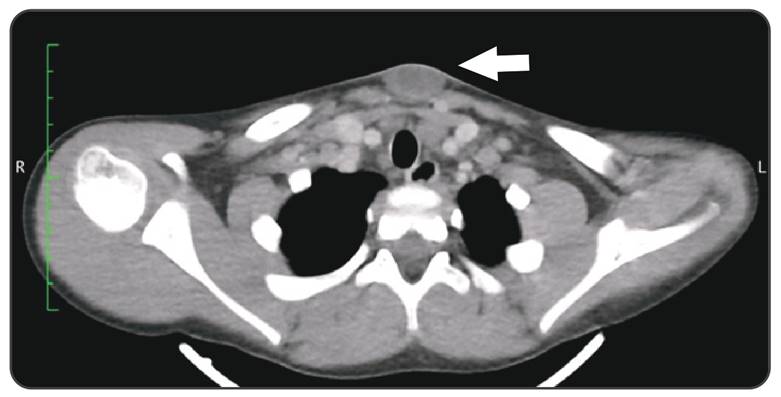
Figure 2 Axial CT scan of the neck and chest at the level of the lesion’s largest diameter, indicated by the arrow. Note. The image shows the CT scan of the lesion
The presumptive diagnosis was a suprasternal thyroglossal cyst; therefore, surgical resection using the Sistrunk technique was indicated. The procedure was performed, and specimens were sent for histopathological analysis. See Figure 3.
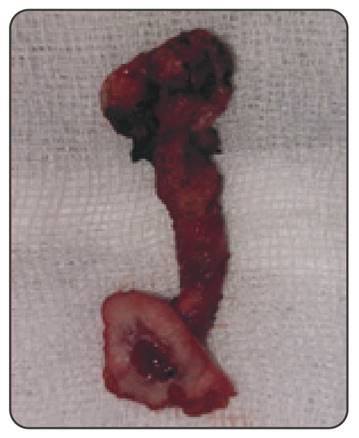
Figure 3 Surgical specimen consisting of the thyroglossal duct and a fistulous tract. Note. The image shows the dissected anatomical specimen.
The specimen consisted of an irregular fragment measuring 2.5 × 0.7 cm, along with a skin fragment measuring 2 × 1.2 × 0.4 cm, with a heterogeneous beige-brown coloration, in addition to a bony tissue fragment measuring 1.6 × 1.2 cm corresponding to the hyoid bone, consistent with a thyroglossal cyst.
DISCUSSION
The thyroglossal cyst is the most common congenital cervical anomaly, with an approximate global prevalence of 7%. It typically presents as a palpable, midline, painless mass that is positive to the Hamilton Bailey maneuver. It may increase in size in association with upper respiratory tract infections and can develop complications. Most cases are benign; however, 1-1.4% may undergo malignant transformation, making it important to assess associated risk factors.
The uncommon suprasternal anatomical location observed in this case was the main reason for reporting it, as only about 5% of thyroglossal cysts present in this region. Additionally, the striking and even rarer differential diagnosis of a dermoid cyst suggested in the contrast-enhanced CT scan of the neck and thorax contributed to the relevance of this case. Dermoid cysts are also described in the literature as a differential diagnosis in suprasternal locations; however, in this patient, their presence was ruled out due to the identification of a cranially directed duct, as confirmed on CT imaging 7,9,10.
The Sistrunk technique, which involves en bloc resection of the cyst, the infrahyoid tract, the central portion of the hyoid bone, and the tract extending to the foramen cecum of the tongue (which is subsequently sutured), is the most commonly used surgical approach and was applied in this case. It is noteworthy that in another reported case of a suprasternal thyroglossal cyst, treatment was limited to cystectomy despite a higher recurrence rate (33%), due to the cystic extension from the thyroid isthmus to the suprasternal region; however, that patient required close follow-up 4,7,11.
It should also be mentioned that both the Sistrunk technique and the modified Sistrunk technique—which involves resection up to the hyoid bone and removal of only the visible suprahyoid fistulous tracts—have shown similar effectiveness rates, reported at 3-4% and 4.5%, respectively 7,11.
Although the thyroglossal cyst is the most common congenital cervical anomaly, its suprasternal presentation remains rare, accounting for approximately 5% of cases, which justifies the importance of this case report. Furthermore, both the Sistrunk and modified Sistrunk techniques demonstrate comparable effectiveness in the management of this condition.
REFERENCES
1. Vintimilla Pogo P, Patiño Patiño M, Inga Lojano M. Caso clínico: quiste tirogloso, cirugía de Sistrunk. Rev Med HJCA. 2019;11(2):149-153. doi: 10.14410/2019.11.2.cc.24. [ Links ]
2. Messias H, Sequeira ML, Vilares M, Bitoque S, Rito M, Gomes P. Ectopic thyroid gland resembling a thyroglossal duct cyst. Clin Case Rep. 2023;11(11):e7951. doi: 10.1002/ccr3.7951. [ Links ]
3. Dedivitis RA, Guimarães AV. Papillary thyroid carcinoma in thyroglossal duct cyst. Int Surg. 2000;85(3):198-201. [ Links ]
4. Oomen KP, Modi VK, Maddalozzo J. Thyroglossal duct cyst and ectopic thyroid: surgical management. Otolaryngol Clin North Am. 2015;48(1):15-27. doi: 10.1016/j.otc.2014.09.003. [ Links ]
5. Saucedo D, Arenas Osuna J. Morbimortalidad y malignidad en pacientes tratados con la técnica procedimiento de Sistrunk para el tratamiento del quiste tirogloso de 2017 a 2022 ;tesis de especialización;. México: Universidad Nacional Autónoma de México, Facultad de Medicina, División de Estudios de Posgrado; 2023. [ Links ]
6. Karmakar S, Saha A, Mukherjee D. Thyroglossal cyst: an unusual presentation. Indian J Otolaryngol Head Neck Surg. 2012;65(1):185 -187. doi: 10.1007/s12070-011-0458-5. [ Links ]
7. Andargie DG, Habtemariam YT, Ayele TY, Agegnehu MA, Biadiglign MG, Endeshaw AS. Thyroglossal duct cyst on the suprasternal region: an extremely unusual location. Int J Surg Case Rep. 2023;110:108752. doi: 10.1016/j.ijscr.2023.108752. [ Links ]
8. Palomo Luna J, de la Fé Soca AM, Bestard Hartman IC, Ramírez Salinas YM, Suárez Lescay C. Fístula tiroglosa con trayecto infrecuente. MEDISAN. 2012;16(9):1451-1456. [ Links ]
9. Sánchez Acuña G, Ramírez Melgoza J, Wilde Jordán I. Quistes del conducto tirogloso: diagnóstico y tratamiento. Rev Mex Cir Bucal Maxilofac. 2009;5(3):111-117. [ Links ]
10. Teixeira RL, Lacerda MB, Paim NP. Quiste dermoide gigante de esternón. Cir Pediatr. 2007;20(4):232-233. [ Links ]
11. de Tristan J, Zenk J, Künzel J, Psychogios G, Iro H. Thyroglossal duct cysts: 20 years’ experience (1992-2011). Eur Arch Otorhinolaryngol. 2015;272(9):2513-2519. doi: 10.1007/s00405-014-3229-6. [ Links ]
Editor responsible: Prof. Dr. Hassel Jimmy Jiménez, https://orcid.org/0000-0003-4078-5853; Dra. Lourdes Talavera, https://orcid.org/0000-0001-9671-3037.
Received: February 03, 2025; Accepted: March 05, 2026
 Este es un artículo publicado en acceso abierto bajo una licencia Creative Commons
