




Servicios Personalizados
Revista

Articulo
 texto en
 Inglés (pdf)
 Articulo en XML
 Referencias del artículo

 Traducción automática
 Enviar articulo por email
Indicadores
-
 Citado por SciELO
Links relacionados
-
 Similares en
SciELO
Compartir

 Permalink

Anales de la Facultad de Ciencias Médicas (Asunción)
versión impresa ISSN 1816-8949
An. Fac. Cienc. Méd. (Asunción) vol.59 no.1 Asunción 2026 Epub 21-Jul-2026
https://doi.org/10.18004/anales/2026.e59012619
ORIGINAL ARTICLE
Perceptions of teachers and students of the Faculty of Medical Sciences-UNA on the negotiation process during the 2015 Student Spring

1Universidad Nacional de Asunción, Facultad de Ciencias Médicas, San Lorenzo, Paraguay.
2Universidad Nacional de Asunción, Facultad de Filosofía, Dirección de Postgrado, Asunción, Paraguay
Introduction:
The Paraguayan Student Spring of 2015, organized around the #UNAnoTeCalles movement, constituted an institutional milestone at the National University of Asunción (UNA) by making visible practices of corruption, clientelism, and inequality in university management. The Faculty of Medical Sciences (FCM-UNA) was one of its main focal points.
Objective:
To reveal the perceptions of teachers and students of the FCM-UNA regarding the negotiation process during the 2015 Student Spring.
Materials and Methods:
Qualitative study with a hermeneutic-phenomenological approach. Twenty participants selected through intentional sampling were included: 5 authorities, 5 ranked teachers, 5 non-ranked teachers, and 5 students. The technique used was the semi-structured interview; the data were analyzed through inductive content analysis with triangulation of informants and sources.
Results:
Four central categories were identified: (1) tension between institutional dialogue and social pressure; (2) facilitating factors: student unity, media visibility, and citizen support; (3) barriers: mistrust, asymmetry of power, and absence of formal negotiation mechanisms; and (4) lessons learned: empathetic dialogue, equitable participation, and a culture of accountability.
Conclusions:
Negotiation in university contexts requires hybrid models that integrate structured dialogue, active participation of all sectors, and institutionalized conflict resolution mechanisms.
Keywords: Perception; negotiation; university conflict; student movement; university governance.
Introducción:
La Primavera Estudiantil paraguaya de 2015, articulada en torno al movimiento #UNAnoTeCalles, constituyó un hito institucional en la Universidad Nacional de Asunción (UNA) al visibilizar prácticas de corrupción, clientelismo y desigualdad en la gestión universitaria. La Facultad de Ciencias Médicas (FCM-UNA) fue uno de sus principales focos.
Objetivo:
Develar las percepciones de docentes y estudiantes de la FCM-UNA sobre el proceso de negociación durante la Primavera Estudiantil de 2015.
Materiales y Métodos:
Estudio cualitativo con enfoque hermenéutico-fenomenológico. Se incluyeron 20 participantes seleccionados mediante muestreo intencional (5 autoridades, 5 docentes escalafonados, 5 docentes no escalafonados y 5 estudiantes). La técnica fue la entrevista semiestructurada; los datos se analizaron mediante análisis de contenido inductivo con triangulación de informantes y fuentes.
Resultados:
Se identificaron cuatro categorías centrales: (1) tensión entre diálogo institucional y presión social; (2) factores facilitadores: unidad estudiantil, visibilidad mediática y apoyo ciudadano; (3) barreras: desconfianza, asimetría de poder y ausencia de mecanismos formales de negociación; y (4) lecciones aprendidas: diálogo empático, participación equitativa y cultura de rendición de cuentas.
Conclusiones:
La negociación en contextos universitarios requiere modelos híbridos que integren diálogo estructurado, participación activa de todos los estamentos y mecanismos institucionalizados de resolución de conflictos.
Palabras clave: Percepción; negociación; conflicto universitario; movimiento estudiantil; gobernanza universitaria.
INTRODUCTION
Higher education in Latin America has undergone profound transformations in recent decades, characterized by the expansion of access, massification, and the growing demand for quality, transparency, and institutional accountability 1-3. In this scenario, student movements have emerged as key actors in processes of university change, particularly in contexts of institutional crisis 4,5.
Organized student participation in Latin American university transformation recognizes a foundational historical precedent in the University Reform of Córdoba of 1918, which established the principles of university autonomy, co-government, and social responsibility as pillars of the regional university model, and instituted student mobilization as a legitimate mechanism for institutional transformation 6. This reformist legacy configured the ideological framework from which subsequent student movements articulate their demands for change in the face of corruption and power inequalities 4,7.
In Paraguay, the so-called Student Spring of 2015 represented a turning point at the National University of Asunción (UNA), by making visible practices of corruption, clientelism, and inequality in university management. This phenomenon, initially driven by the #UNAnoTeCalles movement as of September 21, 2015, generated massive mobilizations that transcended the university sphere, involving civil, media, and political sectors, and leading to an unprecedented institutional crisis 8. The process culminated in the resignation of the rector and the deans of seven faculties, the indictment of 42 officials, and the subsequent statutory reform of UNA.
The Faculty of Medical Sciences (FCM-UNA) constituted one of the main focal points of the conflict, both due to the active participation of its academic community and the relevance of the complaints involving its authorities. This scenario forced the implementation of complex negotiation processes among students, teachers, and authorities, whose characteristics and conditioning factors remain scarcely documented in the scientific literature.
Negotiation has been conceptualized as an interactive process through which two or more parties with divergent interests seek to reach mutually acceptable agreements 9,10. In university contexts, this process acquires particular characteristics associated with the diversity of actors, asymmetries of institutional power, and the legitimacy of the demands 11-13. From a hermeneutic-phenomenological perspective, the analysis of the actors’ perceptions allows for understanding the meanings attributed to the negotiation process, as well as the factors that condition its development and results 14.
Given the scarce scientific production available on negotiation processes in Latin American university conflicts from the direct perspective of their protagonists, the present study aimed to reveal the perceptions of teachers and students of the FCM-UNA regarding the negotiation process during the 2015 Student Spring, identifying the facilitating factors, structural barriers, and lessons learned.
MATERIALS AND METHODS
Design
A qualitative study with a hermeneutic-phenomenological approach was conducted, aimed at understanding the lived experience and the meaning attributed by the actors to the negotiation process. Inductive content analysis was adopted as the main analytical technique. The study report follows the COREQ and SRQR criteria for qualitative research 15,16.
Participants and sampling
The population consisted of members of the academic community of the FCM-UNA who actively participated in the events of 2015. Intentional non-probabilistic sampling was used 14,17, selecting key informants according to criteria of direct participation in the negotiation process and willingness to be interviewed. Teachers and students not belonging to the FCM-UNA and persons with a dependent relationship with the researcher were excluded.
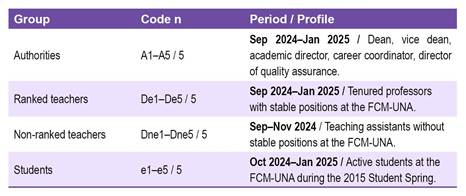
The final sample size was 20 participants, distributed across four groups (Table 1). Theoretical saturation was verified when the discourses no longer contributed new analytical categories 17.
Data collection
The data collection technique was the semi-structured interview, developed with open-ended questions organized into three dimensions: (1) process analysis (purpose, achievements, actors, methods); (2) negotiation dynamics (challenges, strategies, communication, sociopolitical context); and (3) reflection and learning (lessons, evaluation of success, recommendations). The interviews were conducted between September 2024 and January 2025, with an approximate duration of 60 minutes each, after signed informed consent. They were recorded and transcribed verbatim. Participants were coded using the XnEn system (X=group: A, De, Dne, e; n=case number; E=interview; n=transcription line).
Data analysis
The transcripts were analyzed through inductive content analysis 17, following the stages of pre-analysis, exploration of the material, and interpretation. Lincoln and Guba’s criteria of methodological rigor were guaranteed: credibility through triangulation of informants (four groups) and sources (transcripts, field notes, audios); dependability through systematic recording of the analytical process; confirmability through preservation of recordings; and transferability through thick description of the context 18.
Ethical considerations
The study was approved by the Research Ethics Committee of the Faculty of Medical Sciences of the National University of Asunción (CEI Opinion No. 014/2026, dated 03/27/2026; code AT 158/2026). All participants signed an informed consent form prior to the interview, guaranteeing confidentiality, anonymity, and freedom to withdraw at any time. The study was conducted in accordance with the principles of the Declaration of Helsinki.
RESULTS
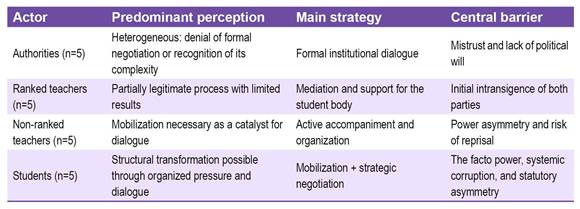
The content analysis of the 20 interviews made it possible to identify four central thematic categories that structure the actors’ perceptions. Table 2 presents a comparative synthesis by group.
Category 1. Tension between institutional dialogue and social pressure
The most widespread perception, transversal to all groups, was the conflicting coexistence between dialogue as a formal negotiation tool and social pressure as a catalyst of the process. This duality constituted the central structural feature of the conflict, consistent with the complexity described in the literature on negotiating behavior 11. The authorities showed heterogeneous positions; some denied the existence of negotiation as such:
"Given that there was no negotiation, the objectives initially proposed could not be discussed. The ideal would have been to reach a consensus." (A1E2-3)
"At that time there was never any negotiation. The students’ only objective was to take over the rectorate and all the faculties." (A2E2)
Other authorities recognized the inevitability of the negotiated process, emphasizing its operational complexity:
"A point came when it seemed that the authorities would not give in to the student demands and a negotiation table had to be established. The table was multidisciplinary and difficult to form. But it was the only way to unlock the conflict." (A4E5)
"Actually, there were no negotiations but rather strong pressure measures. The cause may have been just, but the means harmed the students who had to lose class hours and some even the academic year." (A5E1)
Ranked teachers described the process as harsh but gradually constructive, in line with the dynamic of distributive positions that give way to an integrative logic 9,10:
"The negotiation process was harsh, at times intransigent. There were non-negotiable positions on both sides. It was overcome through dialogue with those people with whom dialogue was possible." (De3E7)
"The approach was initially one of clash; confrontation. Upon realizing that this strategy did not lead anywhere good, the tactics became negotiation in give-and-take: I give in on this and you give in on the other." (De3E8)
From the student group, pressure was conceptualized as a necessary condition to enable dialogue:
"It was definitely pressure; exercising force measures was the only thing that opened the door to sit down and talk. If the students had not been united and the external public opinion had not been involved, the authority group would never ever have sat down to talk with the students and even validate the claims." (e1E13)
"The dialogue table was a good tool so that the entire process of making activities within the faculty transparent could be carried forward." (E4E6)
Category 2. Facilitating factors of the process
Participants consistently identified three determining factors in the progress of the negotiation: the unity of the student movement, media visibility, and the support of external social actors. These elements operated as reducers of statutory power asymmetry, in accordance with the conceptualization of the student movement as a collective political actor 4,7.
"The students were the people who started the struggle, carried it forward, and were later accompanied by professors and by all citizens." (De1E4)
"It is the student body that deserves all the credit, because they united, remained firm and determined, at the cost of reprisals that could have come from the teaching group, which has everything needed to carry the process forward." (Dne1E3)
Media visibility was recognized as a balancing factor of power asymmetry, in line with the literature on networked social movements 5:
"One of the main ingredients was the fear of public exposure. The formal channels were exhausted, and a point came where the authorities were afraid of public opinion, which was on the side of the student struggle." (e1E10)
"The essential resource was the pressure exerted by the students, the suspension of classes, the mutiny at the rectorate and, above all, the support of the press, which with major headlines supported the demonstrators." (A5E12)
The careful selection of representatives at the negotiation tables was highlighted as a differentiating factor in the effectiveness of the process:
"The best strategy: formation of a negotiation table. Secondly: the good judgment in selecting members." (A4E13)
"It was very important that there were leaders capable of filtering the intentions behind it, and that one sector of the faculty knew how to lower itself to humility, to the level of the student and graduates, in order to seek a common solution." (e1E4)
Category 3. Identified barriers
The main barriers recognized were mutual mistrust among actors, structural power asymmetry, the absence of formal institutional negotiation mechanisms, and the political instrumentalization of the conflict. These limitations are consistent with previous findings on university governance in contexts of tension 2.
"At the beginning of the conflict, communication was harsh, intransigent, inquisitive. As the weeks went by, it began to be a little more fluid, less intransigent, but always harsh." (De3E9)
"Communication was very political and inefficient. I do not believe that the negotiation process achieved its objectives since many issues remained pending resolution." (Dne2E9)
"The objectives were half achieved. It was not possible to eradicate pockets of corruption; there was only a rotation of faces. At no point during the negotiation was it possible to get the government to allocate a better percentage of GDP to education." (A5E3)
Non-ranked teachers reported personal consequences derived from their participation, evidencing the power asymmetry within the teaching group:
"It is worth showing one’s face in the face of serious irregularities reported, even if that results in persecution within the institution, as happened to me specifically." (Dne2E15)
From the student group, the deepest barrier was identified as systemic in nature:
"There is a corrupt and economic power that supports the positioning of certain authorities. These barriers are very difficult to break down when a network and a mechanism that allow this to be sustained have already been created." (e1E7)
"It really was not a negotiation process, it was a process of recrimination, because there was no dialogue table, but rather force was used, and force almost never fulfills objectives." (e2E5)
Category 4. Lessons learned and institutional empowerment
All groups agreed in pointing to empathetic dialogue and organized participation as fundamental lessons learned. Negotiation was re-signified as a pedagogical process with lasting institutional impact.
"Always, in any situation, one must dialogue and listen, above all." (De3E15)
"I always emphasize dialogue between two people, even if they think differently. Even if there are differences, everything is possible through dialogue: reaching an agreement, reaching an understanding." (Dne1E15)
"Teamwork, maintaining dialogue: that is the key to the success of negotiations." (De4E16)
Student empowerment was identified as the most lasting achievement of the process, in line with the literature on student movements as agents of university democratic transformation 4,6,7,19:
"The most important thing is that the fear of asking questions was lost: that being able to ask and have access to public information is not only a right but also the obligation to be investigating and asking." (e1E14)
"The University belongs to the student, and the student has not only the right but also the obligation to get involved and occupy decision-making spaces, because it is in those spaces where the skeleton of their own education will be built." (e1E14-15)
Finally, concrete recommendations emerged to strengthen future university negotiation processes:
"Establish mechanisms for fluid communication among the groups in order to detect early if there could be any conflict." (De3E17)
"Create new departments for monitoring teaching and healthcare quality, and create spaces for dialogue. Ideally, problems should be detected in time and solved adequately without the student body having to mobilize." (Dne3E17)
DISCUSSION
The results of the present study show that negotiation in university contexts constitutes a complex phenomenon, influenced by multiple interrelated dimensions including social, political, and institutional factors. This finding is consistent with the conceptualization of negotiation as a process that oscillates between distributive and integrative approaches 9,10, and whose outcome depends both on the individual skills of the negotiators and on the organizational infrastructure that supports it 11,13.
The conflicting coexistence of dialogue and social pressure confirms that university negotiation does not operate under conditions of power symmetry. The pressure of the student movement acted as a catalyst that enabled instances of dialogue. This result connects with the legacy of the Córdoba Reform of 1918, which instituted student mobilization as a legitimate mechanism for university transformation in Latin America 6, and was reactivated in the Paraguayan Student Spring of 2015. Collective action as a lever for institutional change has been documented both in the literature on social movements and in the analysis of the political role of university students 4,7.
The identification of the absence of institutionalized conflict resolution mechanisms as a structural barrier coincides with previous findings on Latin American higher education 3. This situation highlights the need to strengthen university governance through formal dialogue structures that do not depend on crisis to be activated. The strengthening of effective co-government (a foundational principle of the Córdoba Reform 6) remains a pending issue in the universities of the region 2.
Student empowerment as a lasting result of the process represents the finding with the greatest institutional projection of the study. This result is consistent with the literature on student movements as agents of democratic transformation 4,6,7,19, and suggests that the Student Spring of UNA generated a legacy of active participation that transcends the specific conflict.
The present study has limitations inherent to the qualitative design: the retrospective nature of the interviews introduces potential memory biases; intentional sampling limits transferability to other contexts; and the restriction to the FCM-UNA excludes the comparative perspective among faculties. These characteristics are inherent to the adopted approach and do not compromise the internal validity of the study 14,17,18. Future research could incorporate mixed methodologies and comparative perspectives among academic units or Latin American universities with similar experiences.
CONCLUSIONS
The negotiation process during the 2015 Student Spring at the FCM-UNA was determined by the conflicting coexistence between institutional dialogue and social pressure. The legitimacy of the process depended on the participation of multiple actors and the media visibility of the conflict. The main barriers were intergroup mistrust, structural power asymmetry, and the absence of formal institutional negotiation mechanisms.
The most lasting legacy was student empowerment and the establishment of a culture of accountability in the academic community. This result is inscribed in the Latin American reformist tradition that, since Córdoba 1918, recognizes organized student participation as a legitimate driver of university transformation 6,20.
The findings highlight the need to strengthen university governance models that integrate formal negotiation mechanisms and equitable representation of all groups; permanent communication channels and early conflict detection; and an institutional culture based on transparency and shared responsibility.
REFERENCES
1. Altbach, PG. Student politics in America: A historical analysis. London: Routledge; 2018. [ Links ]
2. Brunner JJ. Educación superior en América Latina: cambios y desafíos. Santiago de Chile: Fondo de Cultura Económica; 1990. [ Links ]
3. Gazzola AL, Didriksson A, editores. Tendencias de la educación superior en América Latina y el Caribe. Caracas: IESALC-UNESCO; 2008.. [ Links ]
4. Tarrow S. Power in movement: social movements and contentious politics. 3rd ed. Cambridge: Cambridge University Press; 2011. [ Links ]
5. Castells M. Networks of outrage and hope: social movements in the internet age. Cambridge: Polity Press; 2012. [ Links ]
6. Tünnermann Bernheim C. Noventa años de la Reforma Universitaria de Córdoba: 1918-2008. Buenos Aires: CLACSO; 2008. [ Links ]
7. Ordorika I. Educación superior y globalización: las universidades públicas frente a una nueva hegemonía. Andamios. 2006;3(5):31-47. doi: 10.29092/uacm.v3i5.340 [ Links ]
8. Ferreira Bueno H. Caracterización de los sujetos sociales universitarios movilizados en las luchas de setiembre-octubre de 2015. Estudios Paraguayos. 2015;33(1-2):43-53. [ Links ]
9. Fisher R, Ury WL, Patton B. Getting to yes: negotiating agreement without giving in. 3rd ed. New York: Penguin Books; 2011. [ Links ]
10. Lewicki RJ, Saunders DM, Barry B. Negotiation. 7th ed. New York: McGraw-Hill Education; 2015. [ Links ]
11. Druckman D. Intuition or counterintuition? The science behind the art of negotiation. Negot J. 2009;25(4):431-48. doi: 10.1111/j.1571-9979.2009.00237.x [ Links ]
12. Thompson LL. The mind and heart of the negotiator. 5th ed. Boston: Pearson Education; 2012. [ Links ]
13. Mintzberg H. Patterns in strategy formation. Management Sci. 1978;24(9):934-48. doi: 10.1287/mnsc.24.9.934 [ Links ]
14. Creswell JW, Poth CN. Qualitative inquiry and research design: choosing among five approaches. 4th ed. Thousand Oaks (CA): SAGE Publications; 2018. [ Links ]
15. Tong A, Sainsbury P, Craig J. Consolidated criteria for reporting qualitative research (COREQ): a 32-item checklist for interviews and focus groups. Int J Qual Health Care. 2007;19(6):349-57. doi: 10.1093/intqhc/mzm042 [ Links ]
16. O'Brien BC, Harris IB, Beckman TJ, Reed DA, Cook DA. Standards for reporting qualitative research: a synthesis of recommendations. Acad Med. 2014;89(9):1245-51. doi: 10.1097/ACM.0000000000000388 [ Links ]
17. Patton MQ. Qualitative research & evaluation methods: integrating theory and practice. 4th ed. Thousand Oaks (CA): SAGE Publications; 2015. [ Links ]
18. Lincoln YS, Guba EG. Naturalistic inquiry. Beverly Hills (CA): SAGE Publications; 1985. [ Links ]
19. Aranda Sánchez JM. El movimiento estudiantil y la teoría de los movimientos sociales. Convergencia Rev Cienc Soc. 2000;7(21):225-50. [ Links ]
20. Gentili P, Saforcada F, editores. Ciencias sociales, producción de conocimiento y formación de posgrado: debates y perspectivas críticas. Buenos Aires: CLACSO; 2012. [ Links ]
Editor responsible: Prof. Dr. Hassel Jimmy Jiménez, https://orcid.org/0000-0003-4078-5853; Dra. Lourdes Talavera, https://orcid.org/0000-0001-9671-3037.
Received: June 18, 2026; Accepted: July 04, 2026
 Este es un artículo publicado en acceso abierto bajo una licencia Creative Commons
