




Servicios Personalizados
Revista

Articulo
 texto en
 Inglés (pdf)
 Articulo en XML
 Referencias del artículo

 Traducción automática
 Enviar articulo por email
Indicadores
-
 Citado por SciELO
Links relacionados
-
 Similares en
SciELO
Compartir

 Permalink

Anales de la Facultad de Ciencias Médicas (Asunción)
versión impresa ISSN 1816-8949
An. Fac. Cienc. Méd. (Asunción) vol.59 no.1 Asunción 2026 Epub 30-Mar-2026
https://doi.org/10.18004/anales/2026.e59012618
ORIGINAL ARTICLE
Perception of internal communication and organizational culture among staff of the Faculty of Medical Sciences of the National University of Asunción

1Universidad Nacional de Asunción, Facultad de Ciencias Médicas. Departamento de Comunicación Interna. Asunción, Paraguay.
2Universidad Nacional de Asunción, Facultad de Ciencias Médicas. Dirección Académica, Asunción, Paraguay.
Introduction:
Internal communication is a process that transmits information, ideas, and values among different hierarchical levels and work teams, with a direct impact on the work environment, sense of belonging, and organizational culture of institutions.
Objective:
To describe the perception of FCM-UNA staff regarding internal communication and organizational culture during the year 2024.
Materials and methods:
Observational, descriptive, cross-sectional study with non-probabilistic convenience sampling. The population consisted of teaching, administrative, and healthcare staff of FCM-UNA. Sociodemographic and occupational variables, as well as characteristics of internal communication and organizational culture, were measured using a digital questionnaire created in Google Forms, distributed via WhatsApp® and email. The analysis was performed using descriptive statistics.
Results:
A total of 347 staff members participated; mean age 43 ± 5 years, 68.2% female, mean length of service 15.7 ± 9 years; 51% held administrative positions and 89.6% were permanent staff. More than 80% agreed or strongly agreed with the evaluated internal communication items. Regarding organizational culture, more than 75% recognized that internal communication promotes teamwork, collaboration, a sense of belonging, and alignment with institutional values.
Conclusions:
FCM-UNA staff perceive internal communication as clear, accessible, and useful for the institution’s organizational culture, with recognized effects on cohesion, collaboration, and sense of belonging.
Keywords: organizational communication; organizational culture; teaching staff; administrative staff; healthcare staff.
Introducción:
la comunicación interna es un proceso que transmite información, ideas y valores entre los distintos niveles jerárquicos y equipos de trabajo, con impacto directo en el clima laboral, el sentido de pertenencia y la cultura organizacional de las instituciones.
Objetivo:
describir la percepción de los funcionarios de la FCM.UNA sobre la comunicación interna y la cultura organizacional durante el año 2024.
Material y métodos:
estudio observacional, descriptivo, transversal, con muestreo no probabilístico por conveniencia. La población estuvo constituida por funcionarios docentes, administrativos y asistenciales de la FCM.UNA. Se midieron variables sociodemográficas, laborales, características de la comunicación interna y de la cultura organizacional mediante un cuestionario digital creado en Google Forms, enviado por vía WhatsApp® y correo electrónico. El análisis se realizó con estadística descriptiva.
Resultados:
participaron 347 funcionarios; edad media 43 ± 5 años, 68,2% de sexo femenino, antigüedad media 15,7 ± 9 años; 51% cumple función administrativa y 89,6% son funcionarios permanentes. Más del 80% se mostró de acuerdo o totalmente de acuerdo con los ítems de comunicación interna evaluados. En cuanto a la cultura organizacional, más del 75% reconoció que la comunicación interna promueve el trabajo en equipo, la colaboración, el sentido de pertenencia y la alineación con los valores institucionales.
Conclusiones:
los funcionarios de la FCM.UNA perciben que la comunicación interna es clara, accesible y útil para la cultura organizacional de la institución, con efectos reconocidos sobre la cohesión, la colaboración y el sentido de pertenencia.
Palabras claves: comunicación organizacional; cultura organizacional; personal docente; personal administrativo; personal asistencial.
INTRODUCTION
Adequate internal communication is a process through which information, ideas, and values are transmitted among different hierarchical levels and work teams. When it functions properly, it strengthens the work environment, promotes collaborative work, and contributes to a solid organizational culture. Conversely, poor internal communication can decrease morale, generate conflicts, and affect institutional productivity (1-4.
Internal communication plays a strategic role in improving institutional processes and has a recognized impact on the construction and maintenance of organizational culture, promoting environments of collaboration and commitment among employees 5-8.
In the case of the Faculty of Medical Sciences of the National University of Asunción (FCM-UNA), continuous interaction among teaching staff (tenured and teaching assistants), administrative personnel, and healthcare staff is essential to fulfill institutional purposes, both in academic and healthcare settings. This interaction, aligned with the mission of FCM-UNA to train professionals in Health Sciences, fosters commitment, a sense of belonging, respect among members, and trust and transparency in management—elements that together shape the organizational culture of the institution (9.
Understanding how staff perceive internal communication and its contribution to organizational culture constitutes a valuable tool for identifying strengths and guiding institutional improvements. Within this framework, this study aims to describe the perception of FCM-UNA staff regarding internal communication and organizational culture during the year 2024.
MATERIALS AND METHODS
Observational, descriptive, cross-sectional study with non-probabilistic convenience sampling.
The study population consisted of teaching, administrative, and healthcare staff of FCM-UNA during 2024.
The inclusion criteria comprised: tenured faculty and teaching assistants; healthcare staff (nursing and obstetrics personnel, health technicians, ward assistants, healthcare administrative staff, maintenance and general services personnel); and administrative staff involved in administrative, financial, human resources, and operational and logistical support, with at least one year of affiliation with the institution. Staff who did not wish to participate or did not meet the inclusion criteria were excluded.
The variables measured included: (a) sociodemographic: age, sex, and length of service; (b) occupational: category (teaching, healthcare, or administrative), department, employment status (contracted or permanent), and for teaching staff, level of instruction (undergraduate, postgraduate, or both); (c) internal communication: clarity of information, frequency of communications, effectiveness of the channels used, and overall satisfaction; and (d) organizational culture: cohesion and teamwork, sense of belonging, collaboration, recognition of good performance, and alignment with institutional values.
For data collection, authorization was requested from institutional authorities, and an invitation was extended to all staff across the different categories. Data were collected using a digital questionnaire created in Google Forms, distributed via WhatsApp® and email. The instrument was designed by the researchers and included 8 items on internal communication and 5 items on organizational culture, with responses on a four-point Likert scale (disagree, neither agree nor disagree, agree, and strongly agree).
The collected data were exported to an Excel® spreadsheet. Qualitative variables were expressed as absolute and relative frequencies (percentages), and quantitative variables as means and standard deviation. The statistical program Epi Info version 7.2.6.0 was used. Results were presented in tables.
Ethical considerations
Participation was voluntary and anonymous; completion of the questionnaire constituted implicit consent from the participants. The confidentiality of personal data was guaranteed, and the study did not cause any harm or cost to the participants.
RESULTS
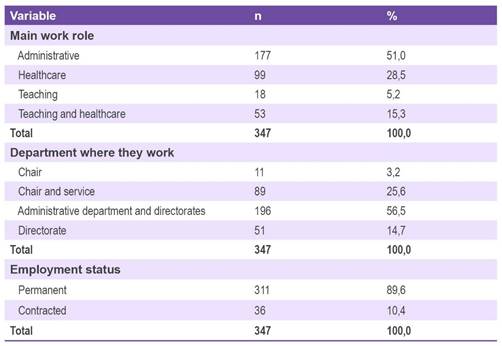
A total of 347 staff members from FCM-UNA participated. The mean age was 43 ± 5 years (range: 20-73 years); 236 (68.2%) were female, and the mean length of service was 15.7 ± 9 years (minimum: 1 year; maximum: 43 years). Table 1 presents the occupational characteristics. The administrative category was the most frequent (177; 51%); by department, most corresponded to administrative departments and directorates (196; 56%); and 311 (89.6%) were permanent staff.
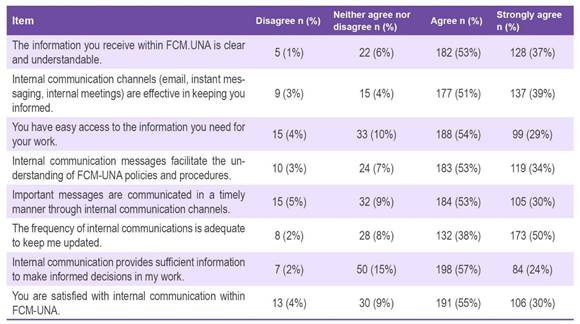
Regarding the perception of internal communication (Table 2), more than 80% of respondents agreed or strongly agreed with all evaluated items: 90% considered that the information received is clear and understandable; the same proportion positively evaluated the effectiveness of the channels used; 83% reported having easy access to the information necessary for their work; 87% indicated that messages facilitate the understanding of institutional policies and procedures; 83% stated that important messages are communicated in a timely manner; 88% considered the frequency of communications to be adequate; 81% recognized that internal communication provides sufficient information for decision-making; and 85% reported being satisfied with internal communication overall.
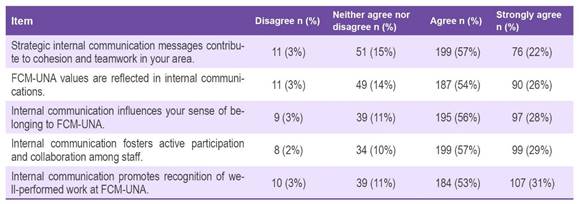
Regarding organizational culture (Table 3), more than 75% of the staff agreed or strongly agreed with all the evaluated items.
Seventy-nine percent acknowledged that strategic internal communication messages contribute to cohesion and teamwork; 80% indicated that FCM-UNA values are reflected in internal communications; 84% reported that internal communication influences their sense of belonging to the institution; 86% considered that it fosters active participation and collaboration among staff; and 84% recognized that it promotes the recognition of well-performed work.
DISCUSSION
This study shows that most staff at FCM-UNA have a positive perception of institutional internal communication and recognize its usefulness for organizational culture. This favorable perception encompasses both operational aspects—such as clarity, timeliness, and accessibility of information—and relational aspects, particularly team cohesion, sense of belonging, and alignment with institutional values.
Regarding sociodemographic characteristics, most participants were female, with a mean age of 43 years and an average tenure of nearly 16 years. These findings are similar to those reported in other academic and healthcare institutions, where female staff predominate in administrative, support, and care roles 10,11. The relatively long tenure suggests a consolidated institution, which favors familiarity with communication processes and a stronger attachment to institutional culture 12.
In terms of occupational characteristics, administrative staff constituted the largest group, followed by healthcare personnel and, to a lesser extent, teaching staff. This distribution is consistent with reports from other higher education institutions with hospital functions 13. Most participants were permanent employees, which contributes to a more stable organizational culture and facilitates the internalization of institutional values 14-16.
The broadly favorable perception of internal communication—across dimensions such as clarity, channel effectiveness, access to information, and overall satisfaction—is consistent with studies indicating that effective institutional communication strengthens the sense of belonging, improves the work environment, and fosters active participation 17-20. The use of digital channels was highly valued, aligning with research highlighting digitalization as a key tool for effective and wide-reaching institutional communication 21.
The findings related to organizational culture are similarly positive: most staff perceived that internal communication contributes to cohesion, recognition of well-performed work, and alignment with institutional values. This is consistent with the literature emphasizing the strategic role of communication in disseminating organizational goals, strengthening collective commitment, and facilitating adaptation to change 22-25. The smaller proportion of staff expressing disagreement or neutrality in some items suggests areas for improvement, possibly related to differences in access to information depending on role or hierarchical level 26.
The limitations of this study include: greater participation from administrative staff compared to healthcare and teaching staff; a cross-sectional design; non-probabilistic convenience sampling, which limits the generalizability of the findings; a questionnaire developed by the researchers without prior psychometric validation; and the potential for social desirability bias in the context of an institutional survey.
Future studies could explore differences in perception across staff groups, levels of seniority, and employment conditions (contracted vs. permanent), as well as evaluate the impact of specific communication improvement initiatives using longitudinal designs.
CONCLUSIONS
Staff at FCM-UNA perceive institutional internal communication as clear, timely, accessible, and useful for strengthening organizational culture. The vast majority recognize its contribution to team cohesion, collaboration among staff, sense of belonging, and alignment with institutional values.
These findings provide a relevant starting point for designing internal communication strategies aimed at the continuous strengthening of FCM-UNA’s organizational culture.
REFERENCES
1. Arévalo Fernández LM, Valdez Sánchez JC. Comunicación interna y productividad laboral en las empresas de Tarapoto. Cientif -K. 2019;7(1):55-60. https://doi.org/10.18050/cientifi-k.v7i1.2126 [ Links ]
2. Cairo-Daza S, Ruiz-Márquez Y, Cahuana-Cairo YP. Cultura organizacional y el desempeño laboral de los docentes en la Escuela de Contabilidad y Finanzas de la Universidad Nacional Amazónica de Madre de Dios. Rev Amaz Cienc Soc. 2022;1(1):e158. https://doi.org/10.55873/racs.v1i1.158 [ Links ]
3. Asencio-Cristóbal L, Fábregas-Rodado C, Carmona-Campo C. Cultura organizacional y el intraemprendimiento académico en la Universidad de Guayaquil-Ecuador. Desarro Gerenc. 2019;11(1):79-103. https://doi.org/10.17081/dege.11.1.3427 [ Links ]
4. Alcocer JAC, Gamboa GEL. La comunicación interna en organizaciones educativas de nivel superior: una revisión sistemática (2012-2022). Rev Panam Pedagog. 2024. 2024;(37):54-71. https://doi.org/10.21555/rpp.vi37.2931 [ Links ]
5. Guerrero Alvarado M, Sotelo González J, Cabezuelo-Lorenzo F. La comunicación interna como herramienta estratégica constructora y transmisora de la cultura organizacional. Adres Rev Int Investig Comun. 2022;(27):54-69. https://doi.org/10.7263/adresic-27-206 [ Links ]
6. Lee Y, Queenie J. The value of internal communication in enhancing employees’ health information disclosure intentions in the workplace. Public Relat Rev. 2020;46(1):101872. https://doi.org/10.1016/j.pubrev.2019.101872 [ Links ]
7. Niño De Guzmán Miranda JC. La cultura organizacional en el contexto de la globalización. Apunt Univ. 2015;5(2):19-40. https://doi.org/10.17162/au.v0i2.239 [ Links ]
8. Yu S, Ko Y. Communication competency as a mediator in the self-leadership to job performance relationship. Collegian. 2017;24(5):421-5. https://doi.org/10.1016/j.colegn.2016.09.002 [ Links ]
9. Facultad de Ciencias Médicas, Universidad Nacional de Asunción. Resolución CD N° 1140/2024: Actualización de Misión y Visión. Asunción: FCM-UNA.2024. https://med.una.py/wp-content/uploads/2025/06/Resol.CD_N_1140_00_2024_Actualizacion_Mision_Vision.pdf [ Links ]
10. Montoya Cáceres P, Beiio-Escamilla N, Bermúdez Jara N, Burgos Ríos F, Fuentealba Sandoval M, Padilla Pérez A, et al. Satisfacción laboral y su relación con el clima organizacional en funcionarios de una universidad estatal chilena. Cienc Trab. 2017;19(58):7-13. [ Links ]
11. Abreu Palermo C, Ochs Olazábal HA, Soler Cornero S, Strauch Mezzera F, Rodríguez Gamarra P, Soto Suárez C, et al. Caracterización de los recursos humanos del Hospital Escuela de la Facultad de Veterinaria UdelaR - 2014. REDVET Rev Electrón Vet. 2015;16(5):1-13. Disponible en: https://www.redalyc.org/articulo.oa?id=63638742002 [ Links ]
12. Schneider B, Ehrhart MG, Macey WH. Organizational climate and culture. Annu Rev Psychol. 2013;64:361-88. https://doi.org/10.1146/annurev-psych-113011-143809 [ Links ]
13. Ángel-Salazar EM del, Fernández-Acosta CA, Santes-Bastián MC, Fernández-Sánchez H, Zepeta-Hernández D. Clima organizacional y satisfacción laboral en trabajadores de la salud. Enferm Univ. 2020;17(3):273-83. https://doi.org/10.22201/eneo.23958421e.2020.3.789 [ Links ]
14. Durán LE, Gualán ÁJ, Moscoso AFO, Pombo MRF. Cultura organizacional actual y deseada de la Universidad de Cuenca (2019-2021): análisis desde el modelo de valores en competencia de Cameron y Quinn. Runae. 2022;(7):99-118. [ Links ]
15. Siqueiros-Quintana MG, Vera-Noriega JÁ. Cultura organizacional en instituciones de educación superior: conceptualización, medidas y variables asociadas. Rev Iberoam Educ Super. 2022;13(36):181-99. https://doi.org/10.22201/iisue.20072872e.2022.36.1190 [ Links ]
16. González Díaz RA, Ochoa Jiménez S, Celaya Figueroa R. Cultura organizacional y desempeño en instituciones de educación superior: implicaciones en las funciones sustantivas de formación, investigación y extensión. Univ Empresa. 2016;18(30):13- 31.http://dx.doi.org/10.12804/rev.univ.empresa.30.2016.01 [ Links ]
17. Cuenca J, Verazzi L. Comunicación interna total: estrategia, prácticas y casos. Austral Comun. 2020;10(1):e4-e6. https://doi.org/10.26422/aucom.2021.1001.lop [ Links ]
18. Nina Apaza SJ. Comunicación interna y compromiso organizacional en docentes de una universidad estatal. Comuni@cción. 2025;16(1):19-31. https://doi.org/10.33595/2226-1478.16.1.1262 [ Links ]
19. Damián-Foronda J, Castillo-Saavedra E, Reyes-Alfaro C, Salas-Sánchez R, Ayala-Jara C. Comunicación interna y desempeño laboral en profesionales sanitarios peruanos durante la pandemia COVID-19. Medisur. 2021;19(4):624-35. http://www.medisur.sld.cu/index.php/medisur/article/view/5033 [ Links ]
20. Pineda-Martínez P, Ruiz-Mora I. Comunicación interna y narrativas transmedia, nuevas estrategias para la empresa responsable: estudio de caso de Telefónica. Prof Inf. 2019;28(5):e280524. https://doi.org/10.3145/epi.2019.sep.24 [ Links ]
21. Tkalac Verčič A, Verčič D, Čož S, Špoljarić A. A systematic review of digital internal communication. Public Relat Rev. 2024;50(1):102400. https://doi.org/10.1016/j.pubrev.2023.102400. [ Links ]
22. Kang M, Sung M. How symmetrical employee communication leads to employee engagement and positive employee communication behaviors: the mediation of employee-organization relationships. J Commun Manag. 2017;21(1):82-102. https://doi.org/10.1108/JCOM-04-2016-0026 [ Links ]
23. Sanabria Estrada FR, Vergara Apolinario M, Santacruz Mora M, Lucin Borbor JM. Influencia de la cultura organizacional en el sistema de gestión de calidad: estado del arte. Cienc Digit. 2019;3(1):205-18. https://doi.org/10.33262/cienciadigital.v3i1.286 [ Links ]
24. Rincón Rodríguez OO, Aldana Bautista L. Cultura organizacional y su relación con los sistemas de gestión: una revisión bibliográfica. Signos Investig Sist Gestión. 2021;13(2). https://doi.org/10.15332/24631140.6675 [ Links ]
25. Rojas Vásquez WJ, Távara Zegarra UY. Cultura organizacional y satisfacción laboral en los trabajadores de la Universidad Marcelino Champagnat. Lima: UMCH. 2017. https://repositorio.umch.edu.pe/handle/20.500.14231/113 [ Links ]
26. Linares Medina I, Ochoa Jiménez S, Ochoa Silva B. Cultura organizacional y evaluación del desempeño del personal académico: estudio de caso en una institución de educación superior pública mexicana. Nova Sci. 2014;6(11):324-45. http://www.scielo.org.mx/scielo.php?script=sci_arttext&pid=S2007-07052014000100018&lng=es [ Links ]
Responsible editor: Prof. Dr. Hassel Jimmy Jiménez, https://orcid.org/0000-0003-4078-5853; Dra. Lourdes Talavera, https://orcid.org/0000-0001-9671-3037.
Author´s Contributions
VMAOB: conception and design of the study, literature review, data collection, manuscript drafting, and approval of the final version.
IOG: study design, literature review, data analysis, manuscript drafting, and approval of the final version.
Received: September 30, 2025; Accepted: March 12, 2026
 Este es un artículo publicado en acceso abierto bajo una licencia Creative Commons
