




Servicios Personalizados
Revista

Articulo
 texto en
 Inglés (pdf)
 Articulo en XML
 Referencias del artículo

 Traducción automática
 Enviar articulo por email
Indicadores
-
 Citado por SciELO
Links relacionados
-
 Similares en
SciELO
Compartir

 Permalink

Anales de la Facultad de Ciencias Médicas (Asunción)
versión impresa ISSN 1816-8949
An. Fac. Cienc. Méd. (Asunción) vol.59 no.1 Asunción 2026 Epub 30-Abr-2026
https://doi.org/10.18004/anales/2026.e59012616
ARTÍCULO ORIGINAL
Frequency of Horizontal Strabismus Cases at a University Hospital
1
 http://orcid.org/0009-0004-8611-3694
1
http://orcid.org/0000-0002-3989-721X
1Universidad Nacional de Asunción, Facultad de Ciencias Médicas, Cátedra y Servicio de Oftalmología, San Lorenzo, Paraguay.
Introduction:
Strabismus is an abnormal alignment of the eyes in which the visual axes are not directed at the same object simultaneously. According to the direction of deviation, it is classified as horizontal, vertical, or torsional. Horizontal strabismus can be further subclassified into esotropia and exotropia.
Objective:
To determine the frequency of the different types of strabismus presenting at a university hospital in Paraguay.
Materials and Methods:
Observational, descriptive, cross-sectional, retrospective design. Non-probabilistic sampling of consecutive cases. Electronic records of patients of all ages with a diagnosis of strabismus who attended the Ophthalmology Service of Hospital de Clínicas in San Lorenzo, Paraguay, from January 2022 to December 2023 were reviewed. The variables analyzed were age, sex, and the different types of esotropia and exotropia.
Results:
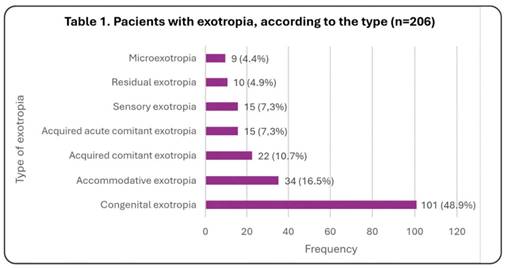
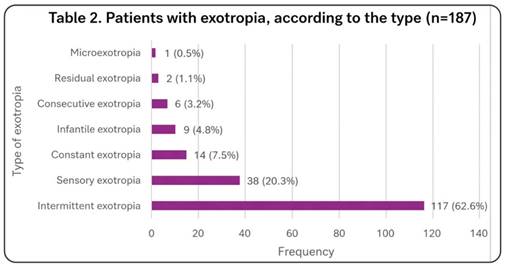
A total of 393 cases of horizontal strabismus were identified. The mean age was 12.13 ± 12.50 years, with a range from 3 months to 83 years. A total of 205 (52.2%) patients were female. There were 206 (52.4%) cases of esotropia, of which 101 (49%) were congenital esotropia. There were 187 cases (47.6%) of exotropia, of which 117 (62.6%) were intermittent exotropia.
Conclusion:
The most frequent horizontal strabismus types were esotropia, among which congenital esotropia was the most common subtype. Intermittent exotropia was the most frequent type of exotropia.
Keywords: strabismus; esotropia; exotropia.
Introducción:
El estrabismo es la disposición anómala de los ojos por la cual los ejes visuales no se dirigen a la vez al mismo objeto. Según la dirección de la desviación, se clasifican en horizontales, verticales y torsionales. Los estrabismos horizontales pueden subclasificarse en esotropias y exotropias.
Objetivo:
Determinar la frecuencia de los diferentes tipos de estrabismos que acuden a un hospital universitario de Paraguay.
Materiales y métodos:
Diseño observacional, descriptivo de corte transversal, retrospectivo. Muestreo no probabilístico de casos consecutivos. Se estudiaron las fichas electrónicas de los pacientes de todas las edades con diagnóstico de estrabismo que acudieron al Servicio de Oftalmología del Hospital de Clínicas en la ciudad de San Lorenzo, Paraguay, de enero de 2022 a diciembre de 2023. Las variables analizadas fueron: edad, sexo y los diferentes tipos de esotropias y exotropias.
Resultados:
Se encontraron 393 estrabismos horizontales. La media de edad fue de 12,13 ± 12,50 años, con un rango de edad de 3 meses a 83 años. Unos 205 (52,2%) pacientes fueron de sexo femenino. Unos 206 (52,4%) casos fueron esotropias, de las cuales 101 (49%) casos fueron esotropias congénitas. Unos 187 casos (47,6%) fueron exotropias, de las cuales 117 (62,6%) casos fueron exotropias intermitentes.
Conclusión:
Los estrabismos horizontales más frecuentes fueron las esotropias, entre las cuales el tipo más frecuente fue la esotropia congénita. La exotropia intermitente fue el tipo de exotropia más frecuente.
Palabras clave: estrabismo; esotropia; exotropia.
INTRODUCTION
Strabismus is an abnormal alignment of the eyes in which the visual axes are not directed at the same object simultaneously 1. Strabismus can produce diplopia in mature individuals, as well as psychosocial and occupational disturbances, while in visually immature individuals, adaptive mechanisms may occur that ultimately lead to irreversible visual impairment, generally unilateral, called amblyopia 2. Amblyopia is the most frequent cause of low vision in children 3 as well as in adults up to middle age 4.
According to the direction of deviation, strabismus can be classified as horizontal, which in turn may be convergent (“esotropia”) or divergent (“exotropia”); vertical, which may be “hypertropia” when the deviated eye is directed upward or “hypotropia” when directed downward; or torsional, which may be “incyclotropia” when the deviated eye intorts or “excyclotropia” when extorts 5.
There are several classifications of horizontal strabismus; in this study, we will use that of Prieto-Díaz and Souza-Días 6.
Among esotropias, several types will be considered. Congenital or infantile esotropia is that which presents before 6 months of age, generally in otherwise healthy children 7. Accommodative esotropias are those that manifest when accommodation is used 5. Acquired comitant or non-accommodative esotropia is a type of esotropia that appears after 6 months of age but before completion of visual maturation 6. Acute acquired comitant esotropia is an acute-onset, comitant, non-accommodative esotropia that appears in adults or visually mature children aged 5 years or older who are presumed to have had previously aligned eyes, and it is a diagnosis of exclusion reached after ruling out neurological pathology 8. Microesotropia is a small-angle esotropia (less than 8 prism diopters), monocular, with a strong tendency to develop mild amblyopia in the deviated eye and usually showing some degree of binocular vision of low functional hierarchy 9. Cyclic esotropia is a rare type of esotropia, with variable age of onset but more frequent in preschool children; it is characterized by periods of deviation with suppression, followed by periods of orthotropia with normal sensory and motor examination, without associated neurological alteration 6. Heavy Eye Syndrome refers to cases in which myopia has a direct pathophysiological role; the most frequent finding is high myopia with increased axial length, with the development of a staphyloma between the superior and lateral rectus muscles, producing esotropia and hypotropia with limitation of abduction and elevation, a condition called heavy eye syndrome6.
On the other hand, several types of exotropias will also be considered. Intermittent exotropia is a type of exotropia in which, at times, the eyes are aligned with normal retinal correspondence and stereopsis and, at other times, in divergence with suppression (6). Infantile exotropia is that which begins before 6 months of age; it is usually associated with neurological pathology and craniofacial disorders, and generally presents with a large angle of deviation, profound binocular dissociation, and high rates of amblyopia (6). Constant exotropia begins after 6 months of age and is common in patients with a long-standing history of intermittent exotropia that has decompensated (5). Microexotropia is a rare entity, characterized by a small-angle exotropia (less than 8 prism diopters), monocular, with binocular cooperation of lower functional hierarchy compared to microesotropia (6).
OBJECTIVE
To determine the frequency of the different types of strabismus presenting at a university hospital in Paraguay.
MATERIALS AND METHODS
The design of this study was observational, descriptive, cross-sectional, and retrospective. Sampling was non-probabilistic with consecutive cases. Electronic records of patients of all ages with a diagnosis of strabismus who attended the Ophthalmology Service of Hospital de Clínicas in the city of San Lorenzo, Paraguay, from January 2022 to December 2023 were reviewed.
The variables considered were: age (continuous quantitative variable), in years; sex (dichotomous variable: male/female); esotropia (nominal qualitative variable: congenital esotropia, accommodative esotropia, acquired comitant esotropia, acute acquired comitant esotropia, sensory esotropia, residual esotropia, microesotropia); exotropia (nominal qualitative variable: intermittent exotropia, sensory exotropia, constant exotropia, infantile exotropia, consecutive exotropia, residual exotropia, microexotropia).
Records with incomplete data and those of patients who discontinued follow-up were excluded. Ethical principles of research were considered, and confidentiality of personal data was maintained.
RESULTS
A total of 393 cases of horizontal strabismus were identified. The mean age was 12.13 ± 12.50 years, with a range from 3 months to 83 years. A total of 205 (52.2%) patients were female; the remainder (103, i.e., 47.8%) were male. The most frequent strabismus types were esotropia, with 206 (52.4%) patients; the remainder (187 patients, i.e., 47.6%) were exotropia.
Among esotropias, the most frequent type was congenital esotropia, with 101 (49%) patients, as detailed in Figure 1.
Among exotropias, the most frequent type was intermittent exotropia, with 117 (62.6%) patients, as detailed in Figure 2.
DISCUSSION
The most frequent horizontal strabismus types in this study were esotropias (52.4%) compared to exotropias (47.6%), reflecting the Western pattern, although without such a large margin of difference compared to other studies in the Western world. Prieto-Díaz and Souza-Días refer to a study conducted in South America by Ciancia and Melek, unpublished, in which esotropias accounted for 90% of horizontal strabismus 6. In a study conducted at Hospital do Servidor Público Estadual de São Paulo, Brazil 10, a predominance of esotropias was also found (44.52%), similar to the percentage observed in our study. In the study by Adán-Hurtado and Arroyo-Yllanes 11, 46.3% esotropias and 27.64% exotropias were reported, while Mohney 12 found 60.1% esotropias and 32% exotropias. In Asian populations, exotropias are more frequent than esotropias, even doubling their frequency 13.
Among esotropias, the most frequent type was congenital esotropia, representing 49% of cases. This is consistent with the study by Adán-Hurtado and Arroyo-Yllanes 11, in which they accounted for 28.46% of esotropias. This contrasts with Mohney’s study on esotropias 14, in which congenital esotropia accounted for only 5.4%, while accommodative esotropias were the most frequent, representing 52% of esotropias. Previous classic studies conducted in the United States reported congenital esotropia in approximately one quarter to one third of esotropias 14,15. This difference may be due, at least in part, to different inclusion and exclusion criteria. Prieto-Díaz and Souza-Días 6 reported that congenital esotropias represented 50% of their strabismus patients; in our study, congenital esotropias represent 18.2% of total strabismus cases and 23.3% of non-paralytic strabismus. Regardless of the percentage considered, these values are far below those reported by them. A study conducted in the United Kingdom reported a 55% decrease in the incidence of congenital esotropia between 1971 and 1991 16. On the other hand, a population-based study in Minnesota, United States, demonstrated a constant incidence of this condition between 1965 and 1994 17. Steven Archer has recently reported observing fewer cases of congenital esotropia in his clinical practice over time 18, which may also partly explain the difference between current and older statistics.
In our study, no cases of cyclic esotropia or heavy eye syndrome were found, which can be explained by the rarity of these conditions. Cyclic esotropia has a frequency of approximately 0.02% of strabismus cases 6, while heavy eye syndrome occurs in approximately 2.65% of patients with myopia greater than -6 diopters 19.
In the group of exotropias in our study, the most frequent type was intermittent exotropia, representing 62.6% of cases. This is consistent with a study conducted in Argentina by Melek 20, in which intermittent exotropias accounted for 85% of exotropias; it also agrees with the study conducted by Souza-Días in Brazil, in which intermittent exotropias accounted for 53%. Likewise, it is consistent with Mohney’s study on exotropias 21, in which they accounted for 47.7%, and with the study by Adán-Hurtado and Arroyo-Yllanes 11, in which they accounted for 35.3%.
This study has limitations due to its observational, descriptive, and retrospective design, and there is also a risk of referral bias, as it is a reference hospital, making it impossible to calculate the exact prevalence of the described conditions. Nevertheless, we believe it is relevant for obtaining an understanding of the epidemiology of strabismus in the Paraguayan population, as there are currently no scientific articles on this topic available in virtual libraries. We suggest conducting further studies, for example with a prospective design, to gather more epidemiological data on this condition.
REFERENCES
1. Real Academia Española. Diccionario de la Lengua Española. 23a. Edic. 2014. https://dle.rae.es [ Links ]
2. Zazo R, Pérez A, Suárez I. El Estrabismo, Problema de Salud en la Infancia. Rev, Cub. de Tecn. en salud. 2021;12(4):88-90. [ Links ]
3. National Eye Institute. Amblyopia (lazy eye). Bethesda (MD): National Institutes of Health. 2024. https://www.nei.nih.gov/learn-about-eye-health/eye-conditions-and-diseases/amblyopia-lazy-eye [ Links ]
4. Centers for Disease Control and Prevention. About common eye disorders and diseases. Atlanta (GA): CDC; 2024. Disponible en: https://www.cdc.gov/vision-health/about-eye-disorders/index.html [ Links ]
5. American Academy of Ophthalmology. Basic and Clinical Science Course. Section 06: Pediatric Ophthalmology and Strabismus. 2019-2020 ed. San Francisco (CA): American Academy of Ophthalmology; 2019. [ Links ]
6. Prieto-Díaz J, Souza-Dias C. Estrabismo. 5a. Edic. Ediciones Científicas Argentina.; 2005:571. [ Links ]
7. Ciancia A. Early Esotropia. Int Ophtalmol Clin. 1971;11(4):81-7. doi: 10.1097/00004397-197101140-00013. [ Links ]
8. Dragomir MS, Merticariu M, Merticariu CI. Management of acute acquired comitant esotropia in children. Romanian J Ophthalmol. 2023;67(1):87-91. doi: 10.22336/rjo.2023.16. [ Links ]
9. Lang J. Microtropia. Int Ophthalmol. 1983;6(1):33-6. [ Links ]
10. Kac MJ, Freitas Júnior MB de, Kac SI, Andrade EP de. Freqüência dos tipos de desvios oculares no ambulatório de motilidade ocular extrínseca do Hospital do Servidor Público Estadual de São Paulo. Arq Bras Oftalmol. 2007;70:939-42. https://doi.org/10.1590/S0004-27492007000600010 [ Links ]
11. Adán-Hurtado EE, Arroyo-Yllanes ME. Frecuencia de los diferentes tipos de estrabismo. Rev Mex Oftalmol. 2009;83(6):340-8. [ Links ]
12. Mohney BG. Common forms of childhood strabismus in an incidence cohort. Am J Ophthalmol. 2007;144(3):465-7. doi: 10.1016/j.ajo.2007.06.011. [ Links ]
13. Lambert SR. Are there more exotropes than esotropes in Hong Kong?. Br J Ophthalmol. 2002;86(8):835-6. doi: 10.1136/bjo.86.8.835. [ Links ]
14. Mohney BG. Common forms of childhood esotropia. Ophthalmology.2001;108(4):805-9. doi: 10.1016/s0161-6420(00)00639-4. [ Links ]
15. Graham PA. Epidemiology of strabismus. Br J Ophthalmol .1974;58(3):224-31. doi: 10.1136/bjo.58.3.224. [ Links ]
16. Carney CV, Lysons DA, Tapley JV. Is the incidence of constant esotropia in childhood reducing? Eye Lond Engl. 1995;9 ( Pt 6 Su):40-1. [ Links ]
17. Louwagie CR, Diehl NN, Greenberg AE, Mohney BG. Is the Incidence of Infantile Esotropia Declining? Arch Ophthalmol. 2009;127(2):200-3. doi: 10.1001/archophthalmol.2008.568. [ Links ]
18. American Association for Pediatric Ophthalmology and Strabismus (AAPOS). Amblyopia (lazy eye). (video en Internet). YouTube; s.f. Disponible en: https://www.youtube.com/watch?v=SWWwySsn4ZA [ Links ]
19. Nakao Y, Kimura T. Prevalence and anatomic mechanism of highly myopic strabismus among Japanese with severe myopia. Jpn J Ophthalmol. 2014;58(2):218-24. doi: 10.1007/s10384-013-0296-y. [ Links ]
20. Melek N. La exotropia intermitente: observaciones clínicas y quirúrgicas. Catálogo de la Biblioteca CAO. 1976:151. https://catalogo.oftalmologos.org.ar/items/show/553. [ Links ]
21. Mohney BG, Huffaker RK. Common forms of childhood exotropia. Ophthalmology. 2003;110(11):2093-6. doi: 10.1016/j.ophtha.2003.04.001. [ Links ]
Responsible editor: Prof. Dr. Hassel Jimmy Jiménez, https://orcid.org/0000-0003-4078-5853; Dra. Lourdes Talavera, https://orcid.org/0000-0001-9671-3037.
Received: March 01, 2025; Accepted: March 31, 2026
 Este es un artículo publicado en acceso abierto bajo una licencia Creative Commons
