




Servicios Personalizados
Revista

Articulo
 texto en
 Inglés (pdf)
 Articulo en XML
 Referencias del artículo

 Traducción automática
 Enviar articulo por email
Indicadores
-
 Citado por SciELO
Links relacionados
-
 Similares en
SciELO
Compartir

 Permalink

Anales de la Facultad de Ciencias Médicas (Asunción)
versión impresa ISSN 1816-8949
An. Fac. Cienc. Méd. (Asunción) vol.59 no.1 Asunción 2026 Epub 30-Mar-2026
https://doi.org/10.18004/anales/2026.e59012614
ORIGINAL ARTICLE
Clinical characterization of recurrent basal cell carcinoma in the dermatology department of the Hospital de Clínicas (2020-2024)

1Universidad Nacional de Asunción, Facultad de Ciencias Médicas, San Lorenzo, Paraguay
Introduction:
Basal cell carcinoma (BCC) is the most common type of non-melanoma skin cancer, primarily associated with chronic exposure to ultraviolet (UV) radiation. Additional factors—such as histopathological subtype and adequacy of initial therapeutic treatment—play a critical role in disease progression and recurrence.
Methodology:
An observational, descriptive, cross-sectional study was conducted in 18 patients with recurrent BCC, selected from a total of 239 medical records of patients who underwent surgery for BCC between 2020 and 2024 at Hospital de Clínicas. Demographic variables (sex, age), tumor characteristics (anatomical location, histological subtype), therapeutic modalities (initial and secondary), and adherence to postoperative follow-up were analyzed. Descriptive statistical analyses were applied.
Results:
The cohort included patients with a mean age of 61.3 years, predominantly male (55.6%) and urban residents (83.3%). The nodular subtype was the most frequent (55.6%), and the nose was the most affected anatomical region (27.8%). The initial treatment of choice was surgical, with simple excision and direct closure being the most commonly used technique (61.1%), with a mean interval of 2.63 years between procedures. Only 27.8% of patients adhered to postoperative follow-up.
Conclusion:
The higher incidence of BCC in urban areas could be attributed to differentiated environmental exposures and greater access to healthcare services. The observed recurrence highlights the need for effective initial interventions—such as Mohs micrographic surgery in high-risk cases—accompanied by structured and long-term follow-up. The anatomical location and histological subtype of BCC require a personalized and multidisciplinary therapeutic strategy, especially in facial tumors due to their functional and aesthetic implications.
Keywords: basal cell carcinoma; recurrence; histopathology; surgical oncology; dermatologic oncology
Introducción:
El carcinoma basocelular (CBC) es el tipo más frecuente de cáncer de piel no melanoma, asociado principalmente a la exposición crónica a la radiación ultravioleta (UV). Factores adicionales-como el subtipo histopatológico y la adecuación del tratamiento terapéutico inicial-desempeñan un papel crítico en la progresión de la enfermedad y su recurrencia.
Metodología:
Se realizó un estudio observacional, descriptivo y de corte transversal en 18 pacientes con CBC recidivante, seleccionados a partir de un total de 239 historias clínicas de pacientes sometidos a cirugía por CBC entre los años 2020 y 2024 en el Hospital de Clínicas. Se analizaron variables demográficas (sexo, edad), características tumorales (localización anatómica, subtipo histológico), modalidades terapéuticas (iniciales y secundarias) y adherencia al seguimiento posoperatorio. Se aplicaron análisis estadísticos descriptivos.
Resultados:
La cohorte incluyó pacientes con una edad media de 61,3 años, predominantemente masculinos (55,6%) y residentes urbanos (83,3%). El subtipo nodular fue el más frecuente (55,6%) y la nariz fue la región anatómica más afectada (27,8%).El tratamiento inicial elegido fue el quirúrgico, siendo la escisión simple con cierre directo, la técnica más frecuentemente utilizada (61,1%), con un intervalo medio de 2,63 años entre procedimientos. Solo el 27,8% de los pacientes cumplió con el seguimiento posquirúrgico.
Conclusión:
La mayor incidencia de CBC en zonas urbanas podría atribuirse a exposiciones ambientales diferenciadas y a un mayor acceso a los servicios de salud. La recurrencia observada subraya la necesidad de intervenciones iniciales eficaces-como la cirugía micrográfica de Mohs en casos de alto riesgo-acompañadas de un seguimiento estructurado y a largo plazo. La localización anatómica y el subtipo histológico del CBC requieren una estrategia terapéutica personalizada y multidisciplinaria, especialmente en tumores faciales debido a sus implicancias funcionales y estéticas.
Palabras clave: carcinoma basocelular; recurrencia; histopatología; oncología quirúrgica; oncología dermatológica.
INTRODUCTION
The clinical characterization of recurrent basal cell carcinoma (BCC) is a critical area of research within dermatology, particularly given the increasing global incidence of this malignant neoplasm. Basal cell carcinoma, as the most prevalent form of skin cancer, represents a significant proportion of non-melanoma skin cancers, accounting for nearly 80% of such cases 1. The pathogenesis of BCC is often related to prolonged exposure to ultraviolet (UV) light, which leads to mutations in the basal cells of the epidermis. These mutations inhibit normal apoptotic processes, resulting in uncontrolled cellular proliferation 2. Clinical manifestations of BCC may vary widely, with different histological subtypes, including nodular, infiltrative, and sclerodermiform forms, each presenting unique challenges in diagnosis and treatment 3,4.
Recurrence of basal cell carcinoma remains a relevant clinical challenge, particularly in patients with a history of multiple lesions. Although various demographic and clinical factors, such as tumor size, histological subtype, and the quality of initial treatment 5, influence the risk of recurrence, current evidence emphasizes that in cases of incomplete excision, especially with involvement of the deep margin, reintervention should be considered the priority therapeutic strategy. This approach is particularly important in high-risk anatomical areas, such as the periorbital, nasal, or labial regions, where recurrence rates and functional implications are significantly higher. Some studies, although proposing close follow-up as an alternative, acknowledge that this strategy may not be adequate in these high-risk contexts 6,7.
Mohs micrographic surgery, for example, has been recognized as a superior treatment option for high-risk basal cell carcinomas due to its ability to ensure complete tumor removal while preserving surrounding healthy tissue 7. In contrast, non-surgical treatments, such as photodynamic therapy and topical chemotherapy, may be more appropriate for superficial basal cell carcinomas or in patients with significant comorbidities 8,9.
The anatomical regions affected by basal cell carcinoma also play a crucial role in determining treatment approaches and outcomes. Lesions located on the face, particularly around the eyes and nose, are often treated more aggressively due to the cosmetic and functional implications of recurrence in these areas 10. This study categorizes lesions according to their anatomical location, which will allow for a nuanced understanding of how location influences recurrence rates and treatment decisions.
METHODOLOGY
An observational, descriptive cross-sectional association study was conducted 11. The population consisted of adult patients with recurrent basal cell carcinoma who were treated at Hospital de Clínicas between 2020 and 2024. The variables included in the study were: sex (male, female); age (years completed); area (urban, rural); histological subtype (nodular, sclerodermiform, nodular infiltrative, infundibulocystic); anatomical region (labial, nasal, right malar, right infraorbital, among others); grouped anatomical region (labial, nose, malar, temple, among others); time (years elapsed between treatments); first treatment (initial procedures such as direct closure, graft, flap, cryotherapy); second treatment (procedures for recurrence such as radiotherapy, direct closure, or no additional treatment); year of first intervention (year of the first surgical intervention); year of second intervention (year of the second surgical intervention); follow-up (yes, no); place of first surgery (type of institution where it was performed: clínicas, other center). For statistical analysis, SPSS version 29 software was used, applying descriptive statistics to all variables.
The study complies with the principles of research ethics and with the principles of the Declaration of Helsinki. The study was approved by the Department and Service of Dermatology of the Faculty of Medical Sciences of the National University of Asunción, in accordance with the current provisions of the Research Directorate.
RESULTS
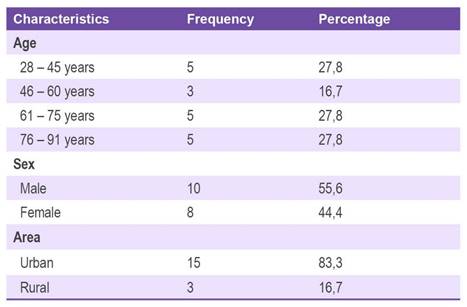
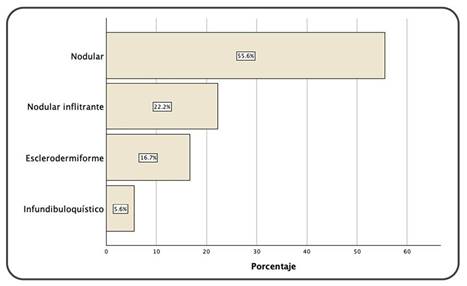
A total of 18 patients were included, with ages ranging from 28 to 91 years, with a mean age of 61.3 ± 17.43 years; 55.6% were male. The 83.3% were from urban areas. Sociodemographic characteristics are detailed in Table 1. Regarding diagnosis, the most frequent subtype was nodular (55.6%), followed by nodular infiltrative (22.2%); the remaining subtypes are specified in Figure 1.
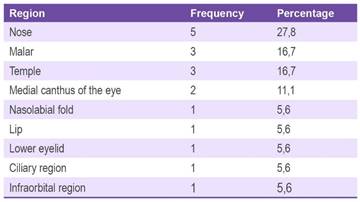
La región anatómica más frecuente fue nariz con 27,8 %, malar con 16,7 % y sien con 16,7 %, las zonas de afectación restantes están detalladas en la Tabla 2.
The time interval between the first and second surgical interventions ranged from 6 months to 5 years, with a mean of 2.63 ± 1.59 years. In previously untreated patients, the most frequent initial approach was surgical excision (61.1%). The most commonly used technique was simple excision with direct closure, followed by flaps (16.7%), grafts (16.7%), and cryotherapy (5.6%).
Regarding the treatment of recurrence, the most commonly used therapeutic option was again surgical excision. The preferred reconstruction technique was direct closure (68.8%), followed by flaps (12.5%). A total of 12.5% of patients were referred to radiotherapy. The remaining 5.6% of cases were referred to the plastic surgery department, as they required extensive reconstruction under general anesthesia. The first surgical intervention was performed at Hospital de Clínicas in 77.8% of cases. Only 27.8% of patients completed postoperative follow-up.
DISCUSSION
The cohort consisted of 18 patients with a mean age of 61.3 years, predominantly male (55.6%) and largely from urban areas (83.3%). This demographic distribution aligns with findings from several studies indicating a higher incidence of certain cancers in urban populations compared to rural ones, often attributed to factors such as greater exposure to carcinogens, lifestyle differences, and better access to healthcare services 12,13.
The predominance of nodular BCC and nodular infiltrative BCC as histological subtypes is consistent with the literature that highlights these types as common forms of skin cancer, particularly in older populations. For example, studies have shown that non-melanoma skin cancers, including basal cell carcinoma and squamous cell carcinoma, are frequent in older adults, and the average age at diagnosis gradually increases over time due to longer life expectancy and greater sun exposure 14-16. Specifically, 55.6% of cases were classified as nodular, while 22.2% were nodular infiltrative. This is consistent with findings from other studies reporting that nodular basal cell carcinoma is the most common subtype across various populations 16,17. This higher frequency may be attributed to its biological behavior and the anatomical locations where it commonly arises, as nodular BCCs are typically found in sun-exposed areas, which correlates with the high incidence of skin cancers in populations with significant sun exposure 18,19.
In terms of anatomical distribution, the regions most frequently affected in this study were the nose (27.8%), the malar area (16.7%), and the temple (16.7%). This distribution is consistent with the literature highlighting the nose as a common site for skin cancers, particularly basal cell carcinoma and squamous cell carcinoma 20,21. The nose as a frequent site of skin malignancies may be attributed to its exposure to ultraviolet (UV) radiation, a major risk factor 22. Additionally, studies have shown that the anatomical characteristics of the nose, including skin thickness and vascularization, may influence the behavior of skin cancers, making it a common site for such lesions 23.
The treatment modalities employed in this cohort also reflect common practices in the management of skin cancer. The initial treatment of choice was surgical, with simple excision and direct closure being the most frequently used technique (61.1%), which aligns with standard surgical approaches for non-melanoma skin cancers 24. The use of flaps and grafts indicates consideration of more complex defects, which is consistent with the literature emphasizing the importance of reconstructive options in facial skin cancer surgery 25,26. Subsequent treatments, including flap and graft procedures, indicate a progression in the complexity of care as the disease may have advanced or recurred, which is consistent with treatment patterns observed in larger studies 27,28,29. The mean interval between the first and second surgical interventions (2.63 years) suggests a significant follow-up period, which is crucial for monitoring recurrence and managing complications, as highlighted in the literature 13,30.
REFERENCES
1. Giorgi VD, Scarfì F, Trane L, Silvestri F, Venturi F, Zuccaro B, et al. Treatment of Advanced Basal Cell Carcinoma with Hedgehog Pathway Inhibitors: A Multidisciplinary Expert Meeting. Cancers. 2021;13(22):5706. doi: 10.3390/cáncer13225706. [ Links ]
2. Chase T, Cham KE, Cham BE. Curaderm, the Long-Awaited Breakthrough for Basal Cell Carcinoma. Int J Clin Med. 2020;11(10):579-604. doi.org/10.23937/2378-3656/1410399 [ Links ]
3. Srđan M, Suzana SR, Milošević N, Dozic B, Dožić M. Locally Advanced Basal Cell Carcinoma of the Auricle and Parotid Region: A Case Report. Stomatol Glas Srb. 2021;68(2):94-8.doi: https://doi.org/10.2298/SGS2102094M [ Links ]
4. Cohen PR, Torres-Quinones M, Uebelhoer NS. Red Dot Basal Cell Carcinoma: Literature Review of a Unique Clinical Subtype of Basal Cell Carcinoma. Dermatol Ther. 2021;11(2):401-13. doi: 10.1007/s13555-021-00496-x. [ Links ]
5. Konstantin Wisdorf, Alexander C. Rokohl, Wanlin Fan, Ludwig M. Heindl. Recurrence Risk of Basal Cell Carcinoma of the eyelid with regard to demographic and clinical patient data. Research Square (Preprint) 2024:1-11. https://doi.org/10.21203/rs.3.rs-4357234/v1 [ Links ]
6. Dika E, Veronesi G, Patrizi A, Salvo S, Misciali C, Baraldi C, et al. It’s Time For Mohs: Micrographic Surgery for the Treatment of High‐risk Basal Cell Carcinomas of the Head and Neck Regions. Dermatol Ther . 2020;33(4):e13535. doi: 10.1111/dth.13474. [ Links ]
7. Duarte B, Vieira L, Ribeiro LM, Costa TP, João A, Varanda A, et al. Five-Year Risk of Basal Cell Carcinoma Recurrence After a Conventional Surgical Excision. J Port Soc Dermatol Venereol. 2020;78(2):115-22. https://doi.org/10.29021/spdv.78.2.1174 [ Links ]
8. Aguiar CS, Pinheiro MMVAM, Melo RHMVAM, Melo VLVAM, Lima LMAC, Caldas Júnior AF, et al. Autograft reconstruction of nasal dorsum in cutaneous neoplasia treatment. Rev Gaúch Odontol. 2022;70:e20200226. doi: 10.1590/1981-86372022002520200226. [ Links ]
9. Hellen R, Dhonncha EN, Havelin A, Kavanagh A, Moriarty B, Collins PM. An Open‐label Prospective Study to Assess Short Incubation Time White LED Light Photodynamic Therapy in the Treatment of Superficial Basal Cell Carcinoma. Photodermatol Photoimmunol Photomed. 2021;38(4): 3227.doi: 10.1111/phpp.12750 [ Links ]
10. Luca E, Tambone S, Catapano S, Fossati B, Peris K. Photodynamic Therapy With 5‐aminolevulinate Patch for the Treatment of Superficial Basal Cell Carcinomas. Dermatol Ther . 2020;33(6). doi: 10.1111/dth.14518. [ Links ]
11. Torales J, Barrios I, Ortiz Galeano I, Estigarribia G. Manual de Metodología de la Investigación: una Introducción a la Investigación Científica en Ciencias de la Salud. 1a ed. Asunción: EFACIM; 2024: 331. [ Links ]
12. Afshar N, English DR, Milne RL. Rural-urban residence and cancer survival in high-income countries: A systematic review. Cancer. 2019;125(13):2172-84. doi: 10.1002/cncr.32073. [ Links ]
13. Zahnd WE, James AS, Jenkins WD, Izadi S, Fogleman A, Steward DE, et al. Rural-Urban Differences in Cancer Incidence and Trends in the United States. Cancer Epidemiol Biomarkers Prev. 2018;27(11):1265-74. doi: 10.1158/1055-9965.EPI-17-0430. [ Links ]
14. Park YJ, Kwon GH, Kim JO, Kim NK, Ryu WS, Lee KS. A Retrospective Study of Changes in Skin Cancer Characteristics Over 11 Years. Arch Craniofacial Surg. 2020;21(2):87-91. doi: 10.7181/acfs.2020.00024. [ Links ]
15. Adhikari RC, Shah M, Jha AK. Histopathological Pattern of Skin Cancer at Tertiary Referral Skin Health Centre. J Pathol Nepal. 2019;9(2):1555-9. https://doi.org/10.3126/jpn.v9i2.25827 [ Links ]
16. Navsaria L, Li Y, Tripathy S, Cox ML, Hinkston CL, Margolis DJ, et al. Anatomic Locations of Procedurally Treated Keratinocyte Carcinomas in the US Medicare Population. Jama Dermatol. 2023;159(6):643. doi: 10.1001/jamadermatol.2023.0611 [ Links ]
17. Subramaniam P, Olsen CM, Thompson BS, Whiteman DC, Neale RE. Anatomical Distributions of Basal Cell Carcinoma and Squamous Cell Carcinoma in a Population-Based Study in Queensland, Australia. Jama Dermatol . 2017;153(2):175. doi: 10.1001/jamadermatol.2016.4070. [ Links ]
18. Gust C, Schuh S, Welzel J, Daxenberger F, Hartmann D, French LE, et al. Line-Field Confocal Optical Coherence Tomography Increases the Diagnostic Accuracy and Confidence for Basal Cell Carcinoma in Equivocal Lesions: A Prospective Study. Cancer s. 2022;14(4):1082. doi: 10.3390/cánceres14041082. [ Links ]
19. Lee KS, Zhao H, Ibrahim SF, Meemon N, Khoudeir L, Rolland JP. Three-Dimensional Imaging of Normal Skin and Nonmelanoma Skin Cancer With Cellular Resolution Using Gabor Domain Optical Coherence Microscopy. J Biomed Opt. 2012;17(12):1. doi: 10.1117/1.JBO.17.12.126006. [ Links ]
20. Derebaşınlıoğlu H, Özkaya NK. Analysis of Basal Cell Carcinoma and Squamous Cell Carcinoma According to Nasal Subunit Location. Facial Plast Surg. 2021;37(03):407-10. doi: 10.1055/s-0041-1726024. [ Links ]
21. Barto V, Kullová M. Body Site Distribution and Relative Tumor Density of Different Human Cutaneous Malignancies with Emphasis on Sunlight Exposure: A Single Institution Experience. J Environ Occup Sci. 2017;6(1):1. [ Links ]
22. Youl P, Janda M, Aitken JF, Mar CD, Whiteman DC, Baade PD. Body-Site Distribution of SkinCancer, Pre-Malignant and Common Benign Pigmented Lesions Excised in General Practice. Br J Dermatol. 2011;165(1):35-43. doi: 10.1111/j.1365-2133.2011.10337.x. [ Links ]
23. Butzelaar L, Niessen FB, Talhout W, Schooneman D, Ulrich MMW, Beelen RH, et al. Different Properties of Skin of Different Body Sites: The Root of Keloid Formation? Wound Repair Regen. 2017;25(5):758-66. doi: 10.1111/wrr.12574. [ Links ]
24. Salgarelli AC, Cangiano A, Sartorelli F, Bellini P, Collini M. The Bilobed Flap in Skin Cancer of the Face: Our Experience on 285 Cases. J Cranio-Maxillofac Surg. 2010;38(6):460-4. doi: 10.1016/j.jcms.2009.10.022. [ Links ]
25. Bouceiro-Mendes R, Mendonça-Sanches M, Alpalhão M, Filipe P, Silva JNM. The Bilobed Flap as an Option for Large Neck. J Port Soc Dermatol Venereol . 2020;78(2):167-9. https://doi.org/10.29021/spdv.78.2.1188 [ Links ]
26. Nguyen Huu Q, Vu Dinh T, Ta Thi Ha P, Nguyen Canh T, Nguyen Huu S, Nguyen Hong S, et al. Nasal reconstruction after Mohs surgery: management of defects according to anatomical units and dimensions. Tap Chi Da Lieu Hoc Viet Nam. 2024;(42). doi: 10.56320/tcdlhvn.42.130. [ Links ]
27. Heitz F, Bender A, Barinoff J, Lorenz-Salehi F, Fisseler-Eckhoff A, Traut A, et al. Outcome of Early Breast Cancer Treated in an Urban and a Rural Breast Cancer Unit in Germany. Oncol Res Treat. 2013;36(9):477-82. doi: 10.1159/000354624. [ Links ]
28. Wierzba W, Śliwczyński A, Karnafel W, Dziemidok P, Pinkas J. Comparison of the Incidence of New Malignancies in Diabetic Patients in Urban and Rural Populations in Poland in the Years 2008-2014 Based on the Database of the National Health Fund. Arch Med Sci. 2019;15(2):330-6.doi: 10.5114/aoms.2017.68409. [ Links ]
29. Jiang C, Guo F, Li N, Liu W, Su T, Chen X, et al. Multipaddled Anterolateral Thigh Chimeric Flap for Reconstruction of Complex Defects in Head and Neck. Plos One. 2014;9(9): e106326.doi: 10.1371/journal.pone.0106326 [ Links ]
30. Baade PD, Turrell G, Aitken JF. Geographic Remoteness, Area-Level Socio-Economic Disadvantage and Advanced BreastCancer : A Cross-Sectional, Multilevel Study. J Epidemiol Community Health. 2011;65(11):1037-43. doi: 10.1136/jech.2010.114777. [ Links ]
Editor responsible: Prof. Dr. Hassel Jimmy Jiménez, https://orcid.org/0000-0003-4078-5853; Dra. Lourdes Talavera, https://orcid.org/0000-0001-9671-3037.
Author’s contributions:
Arnaldo Benjamín Aldama Caballero: supervision, scientific validation, final review of the manuscript.
Received: July 06, 2025; Accepted: March 16, 2026
 Este es un artículo publicado en acceso abierto bajo una licencia Creative Commons
