




Servicios Personalizados
Revista

Articulo
 texto en
 Inglés (pdf)
 Articulo en XML
 Referencias del artículo

 Traducción automática
 Enviar articulo por email
Indicadores
-
 Citado por SciELO
Links relacionados
-
 Similares en
SciELO
Compartir

 Permalink

Anales de la Facultad de Ciencias Médicas (Asunción)
versión impresa ISSN 1816-8949
An. Fac. Cienc. Méd. (Asunción) vol.59 no.1 Asunción 2026 Epub 30-Abr-2026
https://doi.org/10.18004/anales/2026.e59012611
ORIGINAL ARTICLE
Perception of surgeons regarding their training for autonomous practice of the specialty
1
 http://orcid.org/0000-0003-3255-5345
1
http://orcid.org/0000-0001-5306-1286
1Universidad Nacional de Asunción, Facultad de Ciencias Médicas, Hospital de Clínicas. San Lorenzo, Paraguay.
Introduction:
During general surgery residency, the resident physician expands their knowledge, skills, and competencies, progressively acquiring autonomy. In recent decades, changes in teaching-learning models have raised questions regarding the actual preparedness of graduates.
Objective:
To explore the perception of key stakeholders in the educational process regarding the training of general surgery residents at the Hospital de Clínicas, Faculty of Medical Sciences, Universidad Nacional de Asunción, Paraguay, for autonomous professional practice.
Methods:
Qualitative research with an interpretative hermeneutic approach, conducted through 15 semi-structured interviews—five residents, five recently graduated surgeons, and five tutors—between November and December 2020. The analysis was thematic content analysis, organized around two dimensions and nine descriptors.
Results:
General surgery residents graduate without being adequately prepared for autonomous practice, although they are capable of performing low-complexity surgeries. Most participants expressed a desire to pursue subspecialization. Participants reported the need for a higher number of surgical procedures, systematic use of simulators, and structured rotations. The COVID-19 pandemic exacerbated pre-existing deficiencies. Tutors were identified as the main institutional strength.
Conclusions:
Preparation for autonomous practice is incomplete. Extending the duration of residency without addressing infrastructure and administrative management issues will not improve training.
Keywords: medical residency; general surgery; perception; professional autonomy; medical education; qualitative research.
Introducción:
Durante la residencia de cirugía general el médico residente amplía sus conocimientos, habilidades y aptitudes, adquiriendo progresivamente autonomía. En las últimas décadas los cambios en los modelos de enseñanza-aprendizaje han generado interrogantes sobre la preparación real del egresado.
Objetivo:
Explorar la percepción de los actores clave del proceso educativo sobre la formación de los médicos residentes de cirugía general del Hospital de Clínicas, Facultad de Ciencias Médicas, Universidad Nacional de Asunción, Paraguay, para el ejercicio profesional autónomo.
Métodos:
Investigación cualitativa de enfoque hermenéutico interpretativo, realizada mediante 15 entrevistas semiestructuradas -cinco residentes, cinco cirujanos recién egresados y cinco tutores- entre noviembre y diciembre de 2020. El análisis fue de contenido temático, organizado en torno a dos dimensiones y nueve descriptores.
Resultados:
Los residentes de cirugía general egresan sin estar preparados para el ejercicio autónomo, aunque son capaces de realizar cirugías de baja complejidad. La mayoría desea subespecializarse. Los participantes demandan mayor número de cirugías, uso sistemático de simuladores y rotaciones estructuradas. La pandemia COVID-19 agravó deficiencias preexistentes. Los tutores fueron identificados como principal fortaleza institucional.
Conclusiones:
La preparación para el ejercicio autónomo es incompleta. Prolongar la residencia sin resolver los problemas de infraestructura y gestión administrativa no mejorará la formación.
Palabras clave: residencia médica; cirugía general; percepción; autonomía profesional; educación médica; investigación cualitativa.
INTRODUCTION
Medical residency is a teaching-learning period in which the resident physician undertakes a program that allows the expansion of their professional development through knowledge, skills, and competencies within a specialty. Through this process, the trainee deepens their knowledge in a specific area of medicine 1-3.
In Paraguay, the general surgery residency has a duration of three years 1,4, which differs from some international programs that propose longer training periods 2,5.
Various modifications have occurred from the rigid concepts implemented by Dr. William Halsted at the end of the 19th century to the current flexibilization of residency—workload, abolition of the pyramidal system, among others—raising concerns as to whether graduates in general surgery meet the essential requirements for autonomous professional practice, despite having successfully completed the residency6-10.
These considerations, together with the institutional context of the residency at the Hospital de Clínicas, motivated the present study. The research question was: What is the perception of key stakeholders in the educational process regarding the preparation of general surgery residents at the Hospital de Clínicas, FCM-UNA, for autonomous professional practice? The objective was to explore this perception in three groups: residents in training, recently graduated surgeons, and tutors.
MATERIALS AND METHODS
Design and approach
A qualitative study with an interpretative hermeneutic approach 11 was conducted, focused on understanding the meanings and evaluations that the participants themselves assign to their training experiences. This approach was selected because the research question requires understanding perceptions rather than quantifying phenomena.
Context
The study was conducted in the General Surgery Department of the Hospital de Clínicas, affiliated with the Faculty of Medical Sciences of the Universidad Nacional de Asunción, located in the city of San Lorenzo. It is one of the most important referral hospitals in the country. The general surgery residency attached to this institution has a duration of three years. The interviews were conducted between November and December 2020, during the SARS-CoV-2 pandemic.
Researchers’ reflexivity
The researchers are university faculty members actively practicing at FCM-UNA, which facilitated rapport with participants and understanding of institutional terminology, but also entailed a risk of familiarity bias. To mitigate this, a reflexive journal was maintained during the analysis, interpretations were discussed in group sessions among the four researchers, and the member outside the surgical field contributed an external perspective to the training process.
Participants and sampling
The target population consisted of three groups: (a) residents currently enrolled in the program, (b) surgeons who had graduated within the previous two years, and (c) resident tutors—on-call chiefs and ward chiefs. The inclusion criteria were affiliation with the Hospital de Clínicas, FCM-UNA; active practice in the corresponding role; and provision of informed consent. First-year residents with less than three months of training were excluded.
Sampling was purposive, based on criteria and contrasting groups 11,12, with simple random selection within each stratum to minimize convenience bias. The sample size of five participants per group was determined based on adequacy criteria for qualitative research 13. Data saturation was reached by the fourth interview in each group and confirmed with the fifth.
Data collection
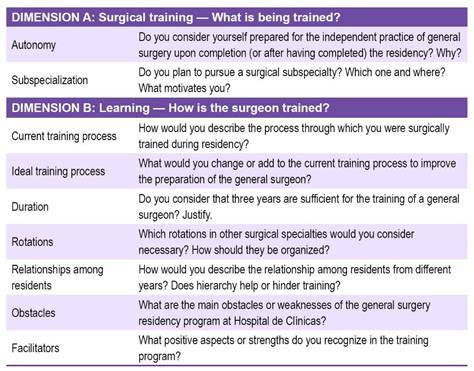
Individual semi-structured interviews were conducted remotely between November and December 2020, with an average duration of 45 minutes (range 30-60 minutes). All interviews were audio-recorded with prior consent. The interview guide (Table 1) was organized into two dimensions with nine descriptors: Dimension A (Surgical training: what is taught?): autonomy and subspecialization; Dimension B (Learning: how is the surgeon trained?): current training process, ideal training process, duration of residency, rotations, relationships among residents, obstacles, and facilitators. The guide was reviewed by consensus among the four researchers and piloted in a preliminary interview prior to fieldwork.
Data processing and analysis
The recordings were transcribed verbatim by the researchers and reviewed by a second member of the team. Each participant received their transcript for validation and potential correction, ensuring the fidelity of the corpus. The analysis followed the phases of thematic content analysis proposed by Bardin 14: (a) pre-analysis and organization of the material, (b) coding of the corpus according to the descriptors of the guide, (c) construction of clusters of meanings in double-entry matrices—actor group × descriptor—and (d) interpretation and triangulation of findings among researchers until consensus was reached.
Methodological rigor
The quality criteria of Yvonna Lincoln and Egon Guba 15 were adopted. Credibility was ensured through triangulation of sources—three groups of actors—and researchers—four coders—as well as the use of a reflexive journal and validation of transcripts by participants. Transferability was facilitated through a thick description of the context. Dependability was ensured by systematic documentation of the analytical process. Confirmability was supported by group discussion of interpretations until consensus was achieved.
Ethical considerations
The study was conducted in accordance with the principles of the Declaration of Helsinki and the current institutional ethical standards of FCM-UNA. All participants signed an informed consent form. Recordings and transcripts were stored in an anonymized manner; participants are identified exclusively by their role and a sequential number (e.g., Resident 1, Tutor 3).
RESULTS
The results are presented organized according to the nine descriptors of the interview guide. Verbatim quotations are identified by group and participant number.
1. Autonomy or independent professional practice
There is a nearly unanimous perception across the three groups: residents are not prepared upon graduation or their preparation is incomplete. Theoretical training is positively valued, but practical surgical skills are considered deficient. Residents consider themselves capable of performing low-complexity surgeries—appendectomies, hernia repairs, laparoscopic cholecystectomies—but not higher-complexity procedures.
“I believe that my learning curve is not yet complete (...) There are many procedures for which I should have surgical skills, having performed them beforehand in order to say that I am ready. (...) So the answer would be no. I still do not consider myself prepared for independent practice.” Resident 2
2. Subspecialization
Virtually all residents and recently graduated surgeons wish to pursue a surgical subspecialty, although many have not yet defined which one. The motivation is centered on acquiring greater technical competence, not on moving away from general surgery. The Hospital de Clínicas is not perceived as an adequate option for subspecialization due to administrative shortcomings and the low number of procedures.
“I would like to pursue a subspecialty. Lately I realize that I am going to fall short; I feel that the training is not really complete. I would like to do it, but I have many doubts about where; I believe Clínicas is not meeting my expectations in that regard.” Resident 4
3. Current training process
All three groups agree on the progression of training: the first year focuses on patient reception and preparation, as well as low-complexity procedures; the second year incorporates medium-complexity surgeries; and the third year includes complex procedures and teaching responsibilities for junior residents.
“The surgeon in charge of the procedure showed me all the steps, placing primary emphasis on preparation before surgery: reading about the technique, understanding the pathology, and managing potential complications. Then, with the support and supervision of a senior surgeon during the procedure, the learning process was completed.” Recently graduated surgeon 2
Tutors prioritize discipline and observation before performing surgery, whereas residents and recently graduated surgeons mainly value the number of procedures performed as the primary operator. The role of a mentor as a personal reference figure is scarcely mentioned.
4. Ideal training process
Participants agree that the current process is a valid foundation but can be improved. The main demand is systematic access to laparoscopic surgery simulators with required hours, supervision, and progressive evaluation. Additionally, there is a need to operate earlier and more frequently, and it is suggested that the current checklist should be transformed into an objective assessment tool.
“A program could be developed in which there are required simulation hours for certain procedures included in the curriculum, with supervision and progressive evaluation.” Resident 1
5. Duration of residency
There is a divergence of opinions regarding whether three years are sufficient. Those who consider it adequate argue that the issue is not the duration but the institutional barriers to performing surgeries. Those who consider it insufficient propose extending it by one or two years. The cross-cutting consensus is that prolonging residency without addressing administrative and infrastructural obstacles would not bring real benefit.
“For a general surgery resident, one of the most important things is being able to operate, operate, and operate. That is where one gains practice and overcomes fear: therefore, it would be necessary to always have operating rooms available so that scheduled surgeries can be performed. Regarding the duration of residency, perhaps one to two more years.” Resident 4
“Regarding the years of residency, if the structure is not changed, it will be of no use. There has to be a structural change.” Tutor 5
6. Rotations
There is consensus that rotations should be systematic, organized into modules with protected time, with an approximate duration of two months per module. The requested specialties include: trauma surgery, vascular, thoracic, colorectal, abdominal wall, hepatobiliopancreatic, upper gastrointestinal, and oncologic surgery. Training in trauma surgery was identified as particularly deficient, as polytrauma patients are not referred to the Hospital de Clínicas.
7. Relationships among residents. Hierarchy
Relationships among residents were generally perceived as good and characterized by camaraderie, although some conflicts and disagreements were reported. All three groups recognize hierarchy as inherent to surgery and necessary for training, although first-year residents often do not understand it as such at the time.
“Hierarchy has its pros and cons. (...) When you are a first-year resident, you at least feel very attacked, you no longer want to be in the place you are, and that makes work more difficult in the long run. Eventually, you understand why there was insistence on certain things.” Resident 1
An antithesis is identified: first-year residents report workload overload, while third-year residents tend to delegate. Episodes of abuse of power among residents were documented, always originating from a senior resident, with a negative impact on the training and well-being of junior residents.
8. Obstacles
The availability of operating rooms and medical supplies was the most pervasive weakness across all narratives, including nursing staff, anesthesiology, and surgical equipment.
“The lack of supplies in the hospital greatly delays work and patient progress; that is very frustrating and exhausting.” Recently graduated surgeon 4
The COVID-19 pandemic, coinciding with the data collection period, was unanimously identified as the most significant obstacle in 2020. Other limitations identified included: low quality of postgraduate classes, scarcity of research projects, and lack of teaching vocation among some tutors.
“If the year had been typical without the pandemic, I definitely would have had much greater surgical skills.” Resident 2
9. Facilitators
As the main strength of the training process, all three groups identified the attitudinal quality and teaching commitment of the tutors—on-call chiefs and ward chiefs.
“The tutors we have are very good; they are always willing to teach and to answer questions; that works well at Clínicas.” Recently graduated surgeon 3
DISCUSSION
This study provides an interpretative understanding of the training of general surgeons for autonomous professional practice at the Hospital de Clínicas, FCM-UNA, Paraguay.
Autonomy at graduation
The lack of preparedness for autonomous practice at the time of graduation has been documented internationally. Mattar et al. found that psychomotor skills at the end of residency are inadequate, although clinical assessment and patient management are satisfactory 7. Bell points out that learning to operate requires, in addition to manual dexterity, visuospatial and tactile skills, as well as the ability to make appropriate clinical judgments, all of which are acquired through the cumulative experience of repeatedly performing surgeries 11. The findings of the present study are consistent with this evidence.
Subspecialization
The trend toward subspecialization and the perception that general surgery is becoming increasingly less attractive have been documented in high-income countries 7,8. Some authors suggest the imminent disappearance of the traditional general surgeon 12. Optimization of resources to increase surgical procedures at the Hospital de Clínicas could improve interest in subspecialization within the institution itself.
Current and ideal training process
The causes of the low level of preparedness are multifactorial: limited exposure to complex procedures, scarcity of mentors, reduction in emergency surgeries, and rigidity of the training paradigm 7. The demand for systematic simulation aligns with the recommendations of the surgical assessment committee of the American Surgical Association, which proposes that residents develop technical competencies in skills laboratories before encountering real patients 13.
Duration of residency
It has been shown that the reduction in working hours affects the quality of training, partly due to the compensatory workload it generates in other residents and the consequent decrease in teaching time 14,15. The findings of the present study suggest that extending the duration without a prior plan for improvements in administrative management would not produce real benefit.
Rotations
The need for systematic rotations and periodic evaluation is consistent with the standards proposed by the ANEAES 16. Debas et al. recommend that the surgical curriculum be organized into competency-based modules 13, which corresponds to the formal program of FCM-UNA 3, although participants report that this is not implemented in practice.
Hierarchy and resident well-being
A recent systematic review documented that general surgery residents may develop abusive behaviors toward their peers and junior trainees 17,18. The present study identified episodes of abuse of power among residents, which calls for a permanent institutional plan to ensure awareness and enforcement of the rights and responsibilities of all members of the service 19,20,21.
Obstacles and strengths
The institutional difficulties described—overload with non-training activities, lack of research, and insufficient supplies—are similar to those reported in high-income countries 13,17,22, although in the local context they are exacerbated by structural factors of Paraguayan public hospitals. The quality and teaching commitment of the tutors constitute valuable institutional human capital upon which to base the necessary improvements.
LIMITATIONS
The study is single-center, and the data collection period coincided with the COVID-19 pandemic, which drastically reduced scheduled surgeries and may have magnified the perception of training deficiencies beyond what is attributable to permanent structural factors. The sample size of five participants per group is modest, although data saturation was achieved. Additional methodological triangulation—such as participant observation or document analysis—was not incorporated. These limitations should be considered when interpreting the transferability of the results.
CONCLUSION
At the completion of general surgery residency at the Hospital de Clínicas, FCM-UNA, graduates are not prepared for autonomous professional practice or report incomplete training: strong in theory but deficient in surgical skills.
Most residents and young surgeons wish to pursue a surgical subspecialty, motivated by the desire for greater technical competence. Systematic rotations and simulation are the most requested training strategies. The availability of operating rooms and supplies, the COVID-19 pandemic, and the scarcity of research constitute the main obstacles identified.
Extending the duration of residency without first addressing structural, administrative, and infrastructural issues will not improve the training of general surgeons. Tutors represent the main strength of the training system.
REFERENCES
1. Facultad de Ciencias Médicas UNA. Acta N. 3085 Resolución N. 0647-00-2018. Por la cual se aprueba la modificación del reglamento y normas de las residencias médicas de la FCM-UNA. San Lorenzo: FCM-UNA; 2018. [ Links ]
2. Miní E, Medina J, Peralta V, Rojas L, Butron J, Gutiérrez EL. Programa de Residentado Médico: Percepciones de los Médicos Residentes en hospitales de Lima y Callao. Rev Perú Med Exp Salud Pública. 2015;32(2):303-310. [ Links ]
3. Facultad de Ciencias Médicas UNA. Curso de Especialización en Cirugía General. Dirección de Postgrado. Asunción: FCM-UNA; 2011. [ Links ]
4. CONAREM. Oferta de plazas de las residencias médicas de especialidades troncales y primarias - 2020. Asunción: Instituto Nacional de Salud; 2019. [ Links ]
5. Napolitano LM, Savarise M, Paramo JC, Soot LC, Todd SR, Gregory J, et al. Are general surgery residents ready to practice? A survey of the American College of Surgeons Board of Governors and Young Fellows Association. J Am Coll Surg. 2014;218(5):1063-1072. doi: 10.1016/j.jamcollsurg.2014.02.001 [ Links ]
6. Vazquez Reta JA, Vazquez Guerrero AL. ¿Cómo educar al residente de cirugía? Cir Gen. 2007;29(2):95-99. [ Links ]
7. Mattar SG, Alseidi AA, Jones DB, Jeyarajah DR, Swanstrom LL, Aye RW, et al. General surgery residency inadequately prepares trainees for fellowship: results of a survey of fellowship program directors. Ann Surg. 2013;258(3):440-449. doi: 10.1097/SLA.0b013e3182a191ca [ Links ]
8. Coleman JJ, Esposito TJ, Rozycki GS, Feliciano DV. Early subspecialization and perceived competence in surgical training: are residents ready? J Am Coll Surg. 2013;216(4):764-771. doi: 10.1016/j.jamcollsurg.2012.12.045 [ Links ]
9. Ortiz D, Ferreira L, Molinas J, Espínola de Canata M. Percepción de Médicos Residentes sobre la Calidad de sus Programas de Formación. Rev Salud Pública Parag. 2014;4(1):16-25. [ Links ]
10. George BC, Bohnen JD, Williams RG, Meyerson SL, Schuller MC, Clark MJ, et al. Readiness of US General Surgery Residents for Independent Practice. Ann Surg. 2017;266(4):582-594. doi: 10.1097/SLA.0000000000002414 [ Links ]
11. Gadamer HG. Verdad y método. 11.ª ed. Salamanca: Sígueme; 2005. [ Links ]
12. Patton MQ. Qualitative research & evaluation methods. 4th ed. Thousand Oaks: Sage; 2015. [ Links ]
13. Creswell JW. Qualitative inquiry and research design: choosing among five traditions. 3rd ed. Thousand Oaks: Sage; 2013. [ Links ]
14. Bardin L. Análisis de contenido. 2.ª ed. Madrid: Akal; 2002. [ Links ]
15. Lincoln, Y.S. and Guba, E.G. Naturalistic inquiry. Newbury Park (CA): Sage Publications; 1985. p. 289-331-. [ Links ]
16. ANEAES. Criterios de Calidad para la evaluación y acreditación de la Especialidad Médica en Cirugía General. Asunción: ANEAES; 2020. [ Links ]
17. Yaow CYL, Mok HT, Ng CH, Devi MK, Iyer S, Chong CS. Difficulties faced by general surgery residents: a qualitative systematic review. J Surg Educ. 2020;77(6):1396-1406. doi: 10.1016/j.jsurg.2020.06.003 [ Links ]
18. Bell RH Jr. Why Johnny cannot operate. Surgery. 2009;146(4):533-542. doi: 10.1016/j.surg.2009.06.044 [ Links ]
19. Fronza JS, Prystowsky JP, DaRosa D, Fryer JP. Surgical residents’ perception of competence and relevance of the clinical curriculum to future practice. J Surg Educ. 2012;69(6):792-797. doi: 10.1016/j.jsurg.2012.05.014 [ Links ]
20. Debas HT, Bass BL, Brennan MF, Flynn TC, Folse JR, Freischlag JA, et al. American Surgical Association Blue Ribbon Committee Report on Surgical Education: 2004. Ann Surg. 2005;241(1):1-8. doi: 10.1097/01.sla.0000150066.83563.52 [ Links ]
21. Dousset B. La formation des chirurgiens digestifs et viscéraux: une évolution nécessaire. Ann Chir. 2004;129(8):395-398. doi: 10.1016/j.anchir.2004.07.004 [ Links ]
22. Whang EE, Mello MM, Ashley SW, Zinner MJ. Implementing resident work hour limitations: lessons from the New York State experience. Ann Surg.2003;237(4):449-455. doi: 10.1097/01.SLA.0000059966.07463.19 [ Links ]
Responsible editor: Prof. Dr. Hassel Jimmy Jiménez, https://orcid.org/0000-0003-4078-5853; Dra. Lourdes Talavera, https://orcid.org/0000-0001-9671-3037.
Authors’ contributions:
Gómez Cantore JA carried out the supervision and critical review at all stages. All authors approved the final version of the manuscript.
Funding: The present study did not receive external funding; it was conducted with the authors’ own resources.
Received: June 24, 2025; Accepted: March 26, 2026
 Este es un artículo publicado en acceso abierto bajo una licencia Creative Commons
