




 English (pdf)
 Article in xml format
 Article references

 Automatic translation
 Send this article by e-mail
 Cited by SciELO
 Similars in
SciELO

 Permalink


INTRODUCTION
The COVID-19 pandemic declared a public health emergency of international concern in January 2020, and has had profound and lasting impacts on multiple aspects of human life1. Among the most affected sectors is the food system, which faced significant disruptions owing to mobility restrictions, border closures, and supply chain limitations2-4.
Globally, the health crisis have triggered drastic changes in dietary behaviors and lifestyles. Increased interest in immunity-boosting alternatives, the adoption of home cooking practices, and growing reliance on indoor activities and digital entertainment have reflected individuals’ efforts to adapt to restrictions and minimize risks. However, the scope and characteristics of these changes varied across social, economic, and cultural contexts, underscoring the need for localized studies5-7.
Dietary changes included the increased consumption of home-cooked meals, fruits, vegetables, legumes, eggs, fish, and yogurt in some populations8,9. While some European countries, especially the Mediterranean ones, showed improved diet quality, countries like Colombia and Saudi Arabia experienced a shift towards poorer nutrient patterns10. In terms of lifestyle changes, most studies reported a decrease in physical activity and increase in sedentary behaviors11,12.
To the best of our knowledge, this study is the first to evaluate how the COVID-19 pandemic has influenced public interest in food-related issues, behaviors, and lifestyles in Paraguay, thereby providing novel findings on these trends. We evaluated the search patterns between December 2019 and December 2020 with Google Trends (GT). This tool enables the temporal analysis of public-interest dynamics by measuring the relative search volume of specific terms on the Internet, offering a unique and complementary perspective to traditional epidemiological analysis13.
Through this research, key topics were explored, including food security, interest in immunity-related nutrients and foods, and changes in leisure and lifestyle activities. The findings will help to identify relevant patterns to inform public health communication strategies and food policies tailored to the local context, strengthen the resilience of the food system, and promote population well-being during crises.
MATERIALS AND METHODS
Data Acquisition
We obtained data on the geographic distribution of the total COVID-19 cases between January 1, 2020, and December 31, 2020, from Our World in Data14. Currently, official websites in Paraguay do not provide access to raw online data.
We initially sought absolute search volume data to analyze trends in COVID-related terms. However, these present significant limitations for the specific time interval from December 2019 to December 2020. The dataset failed to capture the month-by-month fluctuations characteristic of the early stages of the pandemic. For instance, many search terms in the dataset exhibited either missing values or inconsistencies for critical months, particularly in early 2020, when search interest in COVID-related topics surged unpredictably. Although absolute search volume data would ideally provide a direct and quantifiable measure of public interest, the inability to access complete and specific monthly data using these tools renders them unsuitable for this analysis.
To address this limitation, we employed GT (https://trends.google.com/trends/explore?geo=PY) to obtain the relative search volumes (RSVs) for Paraguay, encompassing the early COVID-19 pandemic. We downloaded the data on November 25, 2024, covering the period from December 1, 2019, to December 31, 2020. The aim of GT is to provide data on the frequency of a particular term being searched over the total search volume for a specific period in a given geographical region. Google provides an index instead of an actual search volume. The index awards a score ranging from zero to 100. A value of 0 implies that there was not enough data for this query, whereas a value of 100 indicated the peak popularity of the search term15.
We utilized the Apify platform16 to employ Google Trends Scraper17 to obtain Relative Search Volume (RSV) data. This process involved configuring the scraper to extract data directly from GT by defining the search terms, geographic region, and time intervals. Through this approach, we automated the collection of detailed trend data to capture the temporal variations in the search interest. The scraper provided structured outputs containing RSV values, which represent the proportion of searches for a specified term relative to the total search activity under the defined parameters.
More than 1000 papers utilizing GT across various fields have been documented by the Thompson Reuters Web of Science and PubMed since 2010. In medical sciences, researchers employ GT to monitor epidemics and evaluate public health and well-being. Social science researchers have investigated public sentiments regarding environmental matters and societal views on gender, sexuality, and religiosity. Scholars in finance use GT to explore microeconomic aspects and stock markets. GT data have been used to predict macroeconomic variables, such as trade, unemployment, inflation, and exchange rates. In political science, researchers have used GT for purposes such as polling18.
In developing economies, traditional economic indicators, such as opinion surveys, are occasionally unavailable or disseminated with considerable delays, and are frequently perceived to be of inferior quality compared to those of developed economies. Consequently, given its real-time publication and high data quality, GT can serve as an alternative source of information for predicting consumer behavior15. The main advantage of GT lies in its utilization of revealed rather than stated user preferences19. Consequently, it enables the acquisition of information that would otherwise be challenging or unfeasible to obtain20.
Search Terms
We analyzed the search trends using a previously validated procedure for search terms21. Initially, we searched for user-specified terms related to coronavirus on GT to capture the search activity associated with the COVID-19 pandemic. Prior to finalizing the included search terms for each category, we performed exploratory searches on the GT platform to evaluate search interests concerning dietary behaviors and lifestyle changes during the pandemic.
Based on these exploratory searches, we selected terms demonstrating significant trends, including “coronavirus,” “COVID-19,” “Covid 19,” “Covid,” and “SARS-CoV2.” Our aim was to identify the search patterns most likely related to dietary and lifestyle behaviors during the COVID-19 outbreak. To this end, we analyzed multiple search terms across four predefined categories: food security, dietary behaviors, immune-related nutrients and herbs, and outdoor/indoor lifestyles and behaviors. Google categorizes related queries into two primary categories: top and rising queries. In our analysis, we utilized the top-related terms, thereby ensuring that the search terms predominantly represented relevant searches (content validity) by employing GT to assess the relevance of the most popular occurring related queries22,23.
We acknowledge that the problem of ambiguity in choosing GT keywords could persist owing to inherent challenges. Ambiguity frequently arises when statements are incomplete or missing information, or when words have multiple possible meanings. This directly applies to search terms, where users may have different intentions or interpretations when entering the same term24,25. GT predominantly reflects uncertainty narratives, which may not always align with the specific information that researchers seek to capture26. Furthermore, we recognize that various search strings can be employed for each search term to satisfy our acceptance criterion, and that these different strings may not necessarily provide comparable trends27.
To ensure the reproducibility of the methodology, we provide comprehensive documentation of all GT fields modifiable by the user, specifically, the location of search, time period of search, query category, and terms utilized, as well as the documentation of combinations employed (Supplementary Table 1). In alignment with the methodological recommendations, we followed a checklist for documenting GT searches to ensure rigor, reproducibility, and transparency of our approach28. This procedure enabled a systematic assessment of the search interest dynamics related to the identified categories during the pandemic period.
Statistical analysis
We performed a descriptive analysis of the changes in web search queries related to dietary and lifestyle behaviors, focusing on RSVs for selected search terms within Paraguay. Normality of the data was assessed using the Kolmogorov-Smirnov test. To examine relationships between the selected RSVs and variables related to coronavirus (daily total cases, and “coronavirus-related search terms RSV”), we utilized Spearman’s rank-order correlation coefficient (Table 1)21. Correlation coefficients (r) were interpreted based on the following thresholds: r ≤ 0.2~0.1 very weak; r ≥ 0.3~0.5 fair, r ≥ 0.6~0.7 moderate, r ≥ 0.8~0.9 very strong; and r = 1 perfect (29). A correlation plot was constructed to visualize these relationships (Figure 2) using RStudio version 2024.09.1 Build 39430.
We acknowledge that GT data represent only Internet users, potentially introducing bias, as it does not capture the entire Paraguayan population. We emphasize the relative nature of GT data, noting that they do not reflect absolute search volumes.
RESULTADOS
COVID-19 cases
The temporal relationship between public awareness and disease progression during the COVID-19 pandemic presents a unique opportunity to understand population-level information-seeking behavior during public health crises. Our analysis combines official COVID-19 case data from Paraguay with GT search intensity data, revealing distinct patterns in the public interest that correspond to key pandemic milestones and policy interventions.
Search interest for COVID-related terms exhibited pronounced spikes during critical early-stage events. This initial surge in public interest preceded the implementation of nationwide containment measures, including the suspension of public events (March 10) and the onset of national lockdown (March 16). The search intensity for terms such as "Coronavirus" and "Covid-19" reached its peak during this period, suggesting heightened public awareness and information-seeking behavior during the pandemic's initial phase.
As the pandemic progressed, the relationship between case counts and search behavior evolved. While the total number of COVID-19 cases (Figure 1, represented by the shaded area) showed a gradual but consistent increase throughout the year, search interest demonstrated a more dynamic pattern. The implementation of the "Smart Quarantine" phase in May 2020 coincided with moderate fluctuations in search intensity, indicating sustained public engagement with pandemic-related information, albeit at lower levels than during the initial outbreak.
The transition to the "New Normal" phase in October 2020 occurred against a backdrop of rising case numbers but relatively stabilized search patterns. This observation suggests a potential "pandemic fatigue" in information-seeking behavior despite the ongoing growth in cases. The divergence between case trajectories and search intensity raises important questions regarding the sustainability of public attention and its implications for risk communication strategies.
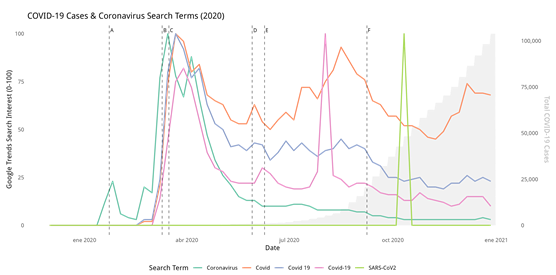
Figure 1. Paraguay trend curves for coronavirus-related search terms and cumulative confirmed coronavirus cases. A: Epidemiological alert No. 1 (Jan-23-2020); B: Suspension of classes and massive events (Mar-10-2020); C: Sanitary Emergency and temporary closure of border crossing points (Mar-16-2020); D: Epidemiological alert No. 2: Identification of localized COVID-19 transmission foci (May-29-2020); E: Epidemiological alert No. 3: Identification of community outbreak of COVID-19 (Jun-09-2020); F: Epidemiological alert No. 4: Increase in COVID-19 cases in healthcare personnel (Sep, 08-2020).
Food security-related
Among the findings is the correlation between "Covid-19" and "Seguridad alimentaria" (food security), which exhibits a coefficient of approximately 0.4649 (Table 1, Figure 2). This value falls within the "fair" category, indicating a moderate positive association. This suggests that as public interest in "Covid-19" increases, there is a corresponding rise in interest in "Seguridad alimentaria." This relationship may reflect heightened public awareness of food safety during the pandemic as concerns about virus transmission through food supply chains became prominent.
Similarly, the correlation between "Covid 19" and "Seguridad alimentaria" was also categorized as "fair," with a coefficient of 0.339. The slightly lower correlation compared to "Covid-19" may be attributed to variations in search behavior or differences in the contextual use of these terms.
Another significant finding is the correlation between "SARS-CoV2" and "Higiene de los alimentos" (food hygiene), which is approximately 0.5135 and falls within the "fair" category. This suggesting that increased interest in "SARS-CoV2" is associated with a rise in interest in "Higiene de los alimentos." This relationship may reflect public efforts to adopt better hygiene practices in response to the pandemic, particularly in of food handling and preparation.
Dietary behavior
The strongest correlation is observed between "Covid 19" and "Restaurante" (restaurant), showing a negative correlation (r = -0.9251). This is followed closely by "Covid-19" and "Restaurante" (r = -0.9062) (Figure 2). Both correlations fall into the "very strong" category (r ≥ 0.8~0.9), indicating a robust inverse relationship between COVID-related searches and restaurant interest. This suggests that, as COVID-19 searches increased, there was a corresponding substantial decrease in restaurant-related searches, likely reflecting the impact of lockdown measures and dining restrictions during the pandemic.
Conversely, there were very strong positive correlations between COVID-related terms and "Pan" (bread), with "Covid-19" showing a correlation of r = 0.8307 and "Covid 19" showing r = 0.8145. These correlations also fell into the "very strong" category, suggesting that as pandemic-related searches increased, there was a corresponding increase in searches related to bread, possibly indicating a surge in home baking and basic food preparation during lockdown periods.
The terms "Covid" and "Coronavirus" also show moderate negative correlations with "Restaurante" (r = -0.7000 and r = -0.6873 respectively), falling into the "moderate" category (r ≥ 0.6~0.7). This further reinforces the pattern of decreased restaurant-related interest during periods of higher COVID-related searches.
These findings provide evidence of significant changes in food-related search behaviors during the pandemic, particularly highlighting a shift away from restaurant-related searches and basic food items, such as bread. This pattern likely reflects broader societal changes in dining and food preparation habits during the COVID-19 pandemic.
Indoor lifestyle
The analysis revealed a moderate positive correlation between "Coronavirus" and "Netflix" (r = 0.7014), suggesting a synchronous increase in searches for both terms. This correlation falls firmly within the moderate category (r ≥ 0.6~0.7) and likely reflects the shift toward home-based entertainment during pandemic-related restrictions (Figure 2).
Similarly, the relationship between "Coronavirus" and "Receta" (recipes) demonstrates a moderate positive correlation (r = 0.6202), indicating an association between pandemic-related searches and interest in home cooking. This finding aligns with global observations of increased home food preparation during lockdown periods, and suggests a shift in culinary behaviors during the pandemic.
Several fair correlations (r ≥ 0.3~0.5) were identified between "Coronavirus" and food-related terms. The correlation with "Comida" (food) (r = 0.4124) shows a fair positive relationship, closely followed by similar correlations with "Pastel" (cake) (r = 0.4105) and "Cocina" (kitchen/cooking) (r = 0.4076). These fair correlations suggest a moderate but consistent relationship between pandemic-related searches and various aspects of food preparation and consumption, possibly reflecting changes in dining habits and food-related behaviors during the pandemic.
Outdoor lifestyle
Among the findings are the very strong negative correlations between "Covid 19" and "Hotel" (r = -0.9127) and "Covid-19" and "Hotel" (r = -0.9082). These correlations indicate an inverse relationship, suggesting that as public interest in COVID-related terms increased, there was a corresponding sharp decline in searches related to hotels. This pattern likely reflects the impact of travel restrictions and reduced tourism during the pandemic period (Figure 2).
Similarly, very strong negative correlations are observed between "Covid 19" and "Parque" (park) (r = -0.9065) and "Covid 19" and "Resort" (r = -0.9023), as well as between "Covid-19" and "Parque" (r = -0.8994) and "Covid-19" and "Resort" (r = -0.892). These findings suggest a decline in outdoor and leisure-related activities during periods of heightened public concern regarding COVID-19. The very strong negative correlations in these cases suggest that the pandemic had a profound impact on public engagement with outdoor spaces and recreational facilities, likely due to lockdown measures and social distancing guidelines.
The results highlight the extent to which the pandemic reshaped public behavior, particularly in relation to outdoor and leisure activities. The very strong negative correlations across multiple terms reflect a consistent and substantial reduction in interest in outdoor lifestyle activities as the pandemic progressed.
Immune-related nutrients-herbs
The analysis revealed particularly strong correlations between COVID-related terms and certain immune-boosting foods. The strongest correlation is observed between "Covid 19" and "Cebolla" (onion) (r = 0.8367), followed closely by "Covid-19" and "Cebolla" (r = 0.8291), both falling into the very strong category (r ≥ 0.8~0.9) (Figure 2). This suggests a substantial synchronous increase in searches for onions during periods of increased COVID-related searches, possibly indicating public interest in natural immune-boosting foods during the pandemic.
"Coronavirus" and "Cebolla" also show a moderate to strong positive correlation (r = 0.7696), falling at the upper end of the moderate category (r ≥ 0.6~0.7). This consistent pattern across different COVID-related terms reinforces the significance of the relationship between pandemic-related searches and interest in onions as potential immune-supporting foods.
Another set of correlations involves "Curcuma" (turmeric), with moderate positive correlations observed with "Covid 19" (r = 0.66), "Covid-19" (r = 0.6379), and "Coronavirus" (r = 0.6199). These correlations, all falling within the moderate category (r ≥ 0.6~0.7), suggest consistent public interest in turmeric, possibly because of its known anti-inflammatory and immune-modulating properties.
While traditional immune-supporting nutrients such as Vitamin C, Vitamin D, and Zinc showed positive correlations with COVID-related terms, these correlations were generally in the fair range (r ≥ 0.3~0.5), suggesting a less pronounced relationship compared to natural food items such as onions and turmeric. This pattern might indicate a stronger public interest in whole food sources of immune support rather than individual nutrients during the pandemic period.
Dietary and Lifestyle Behavior and COVID-19 Cases
The search term "Flor" (flower) exhibited a moderate positive correlation with COVID-19 cases, with a coefficient of r=0.638. This suggests that as the number of COVID-19 cases increased, there was a corresponding rise in search interest for "Flor." Similarly, "Planta" (plant) showed a moderate positive correlation (r=0.620), indicating a similar trend of increased search interest alongside rising cases. These findings may reflect a heightened interest in nature-related activities or items during the pandemic, potentially as a coping mechanism or due to increased time spent at home.
Conversely, "Cine" (cinema) (demonstrated a moderate negative correlation (r=−0.611), suggesting that as COVID-19 cases rose, search interest in "Cine" decreased. This is likely attributable to the closure of cinemas and restrictions on public gatherings during the pandemic. Similarly, "Pizza" showed a moderate negative correlation (r=−0.607), which could reflect changes in consumer behavior or disruptions in food delivery services during the peak pandemic periods.
The search term "Yoga" displayed a fair negative correlation (r=−0.464), indicating a decrease in search interest as the number of COVID-19 cases increased. This might be due to shifts in priorities or reduced engagement in fitness-related activities during periods of heightened pandemic concern. On the other hand, "Hierro" exhibited a fair positive correlation (r=0.441), suggesting an increased interest in iron-related topics, possibly linked to health concerns or dietary adjustments during the pandemic.
Table 1. Spearman’s correlation coefficients of dietary and lifestyle behavior-related search terms and confirmed COVID-19 cases, and coronavirus GT search terms.
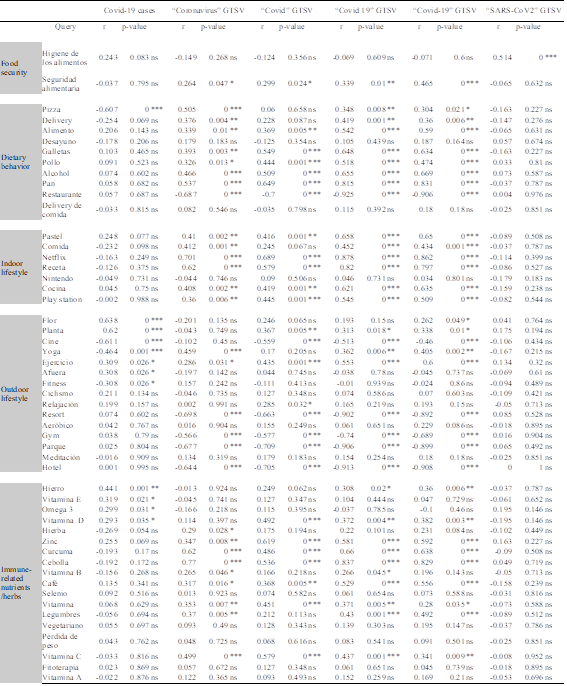
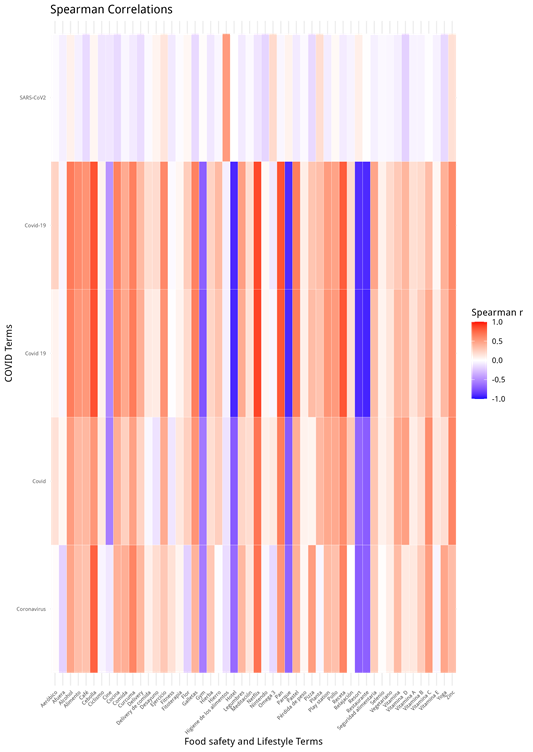
Figure 2. Correlation plot of dietary and lifestyle behavior-related search terms and COVID-19 cases, and coronavirus related GT search terms.
*Supplementary Material available at: (Supplementary Material).
DISCUSSION
The results of our study provide valuable insights into public interest patterns related to the COVID-19 pandemic in Paraguay by analyzing GT searches across various categories linked to food security, dietary behaviors, lifestyle, and immune-boosting nutrients. By correlating search terms with COVID-19 cases, this study revealed how the health crisis influenced the population’s interests and behaviors. We explored the application of GT to gain insights into public perceptions and concerns, specifically within Paraguay, throughout the pandemic. This approach can complement traditional epidemiological data and provide a nuanced understanding of information-seeking behaviors in the population.
A shift toward indoor activities was also evident. The moderate positive correlation between "Netflix" and "Receta" with pandemic-related terms possibly reflects an adaptation to social isolation, characterized by increased consumption of digital entertainment and home cooking. This behavior aligns with global studies reporting a transition toward indoor activities in response to restrictions. In contrast, the very strong negative correlations between "Hotel," "Parque," and "Resort" with COVID-19 terms demonstrate a drastic decline in interest in outdoor recreational activities and travel. This reflects the impact of social distancing measures and mobility restrictions but could also be related to the increased perceived risks associated with these activities. Other studies have indicated that lockdowns and social distancing measures have had a detrimental impact on lifestyles globally. Trends such as increased sedentarism, altered dietary habits, and psychosocial stress have been widely reported31-37.
The significant increase in interest in foods associated with immune system enhancement, such as "Cebolla" and "Curcuma," indicates a pandemic-driven shift in dietary preference. These findings suggest a growing search for natural solutions to improve immune health, particularly in the absence of effective treatments during the early stages of a health crisis. However, the lower correlations with specific nutrients, such as "Vitamin C" and "Zinc", might reflect reduced access or awareness of supplements compared to traditional foods. These results have direct implications for public communication strategies, suggesting the need to tailor messages to current interests and concerns. For example, emphasizing food hygiene and promoting accessible solutions for immune system support could enhance the effectiveness of public health campaigns.
This study demonstrates the utility of GT in analyzing public interest patterns during the COVID-19 pandemic in Paraguay, offering a complementary perspective to traditional epidemiological data. The findings reveal significant behavioral shifts and dietary trends driven by the health crisis but also highlight the digital divide between urban and rural populations as a critical limitation. Addressing this gap in future research could ensure more inclusive analyses that better reflect the needs and concerns of under-served communities.
Moreover, this study shows the importance of tailoring public health strategies to the interests and behaviors of diverse population segments while combating the proliferation of misinformation, particularly on social media platforms. These insights are crucial for strengthening health communication, enhancing food safety practices, and developing more effective public health initiatives, particularly in regions with limited digital access. Future work should build on this foundation, integrating additional data sources and exploring long-term pandemic impacts to inform policies that promote resilience and equity across all sectors of the population.
Several limitations to the current study need to be acknowledged. As GT data only represent people who use Google search engines, this may not be representative of the entire population. This limitation is particularly pronounced in areas with low internet penetration or limited freedom of speech. In addition, the algorithm used by GT, especially regarding how it categorizes terms and languages under "topic" terms, lacks transparency38. This can make it difficult for researchers to fully understand and interpret the data in certain contexts. Consequently, a potential limitation that could arise in searches conducted in Paraguay is Internet access, which is predominantly concentrated in urban areas within the metropolitan region, thereby excluding rural zones. Consequently, the search terms used were primarily associated with urban lifestyles rather than rural life, which could introduce a bias or limitation to this study.
To overcome these limitations, the scope of the analysis can be expanded by integrating GT data with other social Big Data sources. This approach addresses the limitations of using only search information and provides a more comprehensive perspective on the subject matter. By combining GT data with additional data sources, researchers can obtain more insight and validate their findings across multiple platforms. Furthermore, shifting the focus from describing and diagnosing trends to forecasting changes enables researchers to leverage GT data for predictive analysis, thereby enhancing the value of the tool for future-oriented studies39.
Potential challenges related to keyword contamination, dilution, and translation can be addressed by examining the search volume for search topics instead of individual search terms. Search topics enable us to gauge the search volume for specific themes regardless of the exact words or language used in the search query. This approach allows for the creation of a language-independent measurement that is not affected by keyword contamination or dilution. It is worth noting that Google's algorithms may be more effective than others in categorizing topics for certain languages18,40.

